+1 470-260-7028
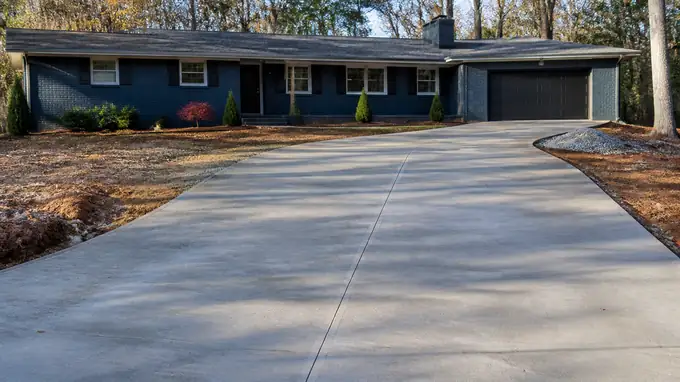
A finished concrete driveway sweeping from the street to the garage, clean-edged and evenly toned in the sun. at a grey split-level home in Alpharetta, GA.

Alpharetta Craftsman Concrete: Residential & Commercial concrete slab installations, concrete driveway installations, concrete flooring installations & concrete slab repairs

We pour and repair concrete for homes and businesses in Alpharetta: residential driveways, garage and addition slabs, interior floors, and commercial slabs built to carry real weight. The median house here was built in 1996, so a lot of the driveways and patios around town have been carrying cars and weather for a long time. Some of that concrete needs a repair. Some of it needs to come out. We tell you which, and why.

Every installation starts with the ground, not the pour. Fulton County is hilly, and the grade can change from one lot to the next, so we set the slope and test the soil on each site before any forms go down. Rion soil drains well across much of the county, but not everywhere, and we would rather find the soft spot with a probe than with a crack. Reinforcement goes in where the load calls for it.

Most failed surfaces we see come down to water. The area gets about 50 inches of rain a year, and a slab that sheds it the wrong way ends up washing out its own base, settling, and cracking along the low side. Getting the pitch, the joints and the base right is part of the job from the start, and it is what keeps a new slab flat. Call for a free estimate on your driveway, patio or floor.

Call +1 470-260-7028

Get a FREE Quote

Why Alpharetta Chooses Alpharetta Craftsman Concrete

Most of the concrete we pour in Alpharetta goes next to a house that already has a history. Much of what we see is an original driveway, patio or garage slab that has settled, cracked, or simply worn past the point of patching. We treat that as residential structural work, not cosmetic work. A new slab has to meet the old grade, drain away from the foundation, and carry whatever the owner actually parks on it. Getting those right is most of the job, and it is where we spend our attention.

Every site gets its own look before anything is formed. The ground here has 241 feet of local relief within a few miles, and it changes from one block to the next, so we grade and test each lot on its own terms. We also check what is under your yard instead of assuming. From there the installation follows the ground: base compacted, reinforcement set for the load, forms checked for fall. We handle the permit when the project needs one.

Water causes most of the failures we get asked to fix. A slab pitched the wrong way sends rainwater toward the garage, the foundation, or the neighbor's lawn. The other common problem is a thin, unreinforced pour laid over a base nobody compacted properly. It looks fine for a season. Then a corner drops, a crack runs across the middle, and the only honest repair is to cut it out and start again. Stamped and decorative surfaces fail the same way, only the damage is harder to hide.

Doing it properly costs time more than anything else. Checking the grade, compacting the base, placing reinforcement where the slab will be loaded, and letting the concrete cure before anyone drives on it all add days that a rushed crew skips. We would rather explain that before the pour than stand over a failed slab later. Our solutions are plain ones: the right thickness, the right base, the right slope. On homes with a median value of $605,700, the driveway and patio are part of what the property is worth, and they should be built with that in mind.

From First Visit to Final Pour

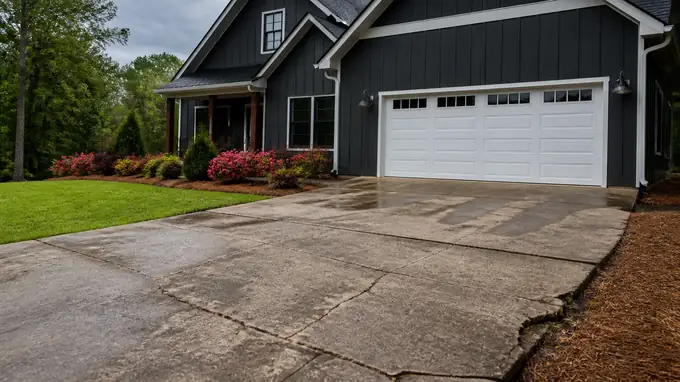
A worker examines an old driveway before replacement. at a charcoal farmhouse-modern home in Alpharetta, GA, after a rain shower.

Step 1: Site Assessment

We walk the property with you and look at what the slab has to carry: a truck, patio furniture, or foot traffic to the back door. We check the fall of the lot and where water will go, and every site's soil is tested on its own before we recommend concrete solutions.

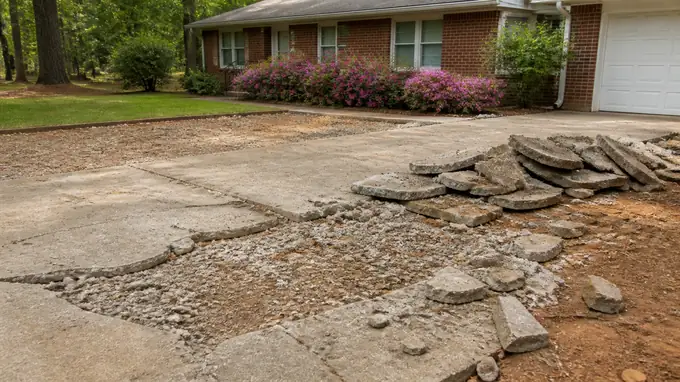
An old patio slab is broken up and hauled away. at a red-brick ranch home in Alpharetta, GA, under bright midday cloud.

Step 2: Site Preparation

Most slab failures start underneath, so this is where we spend the time. We strip topsoil and roots, cut to grade, and compact the subgrade with a plate compactor or roller, then add a compacted gravel base so the slab bears evenly. On a sloped lot we pitch the grade away from the house. That fall matters as much as the concrete. We handle the permit when the project needs one.

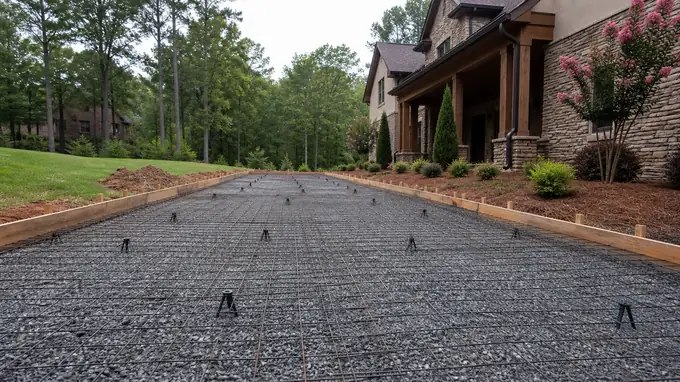
Wire mesh is unrolled across a driveway base before pouring. at a stacked-stone and stucco home in Alpharetta, GA, under an overcast sky.

Step 3: Forming & Reinforcement

Forms set the shape, height and slope of the finished surface, so we string them, stake them and check them again before the truck arrives. Rebar tied in a grid goes into driveways and anything carrying a vehicle. Welded wire mesh suits lighter residential slabs and walks. Both sit on chairs so the steel ends up mid-slab, not lying in the dirt doing nothing. Thickened edges go where a driveway meets the street or garage.

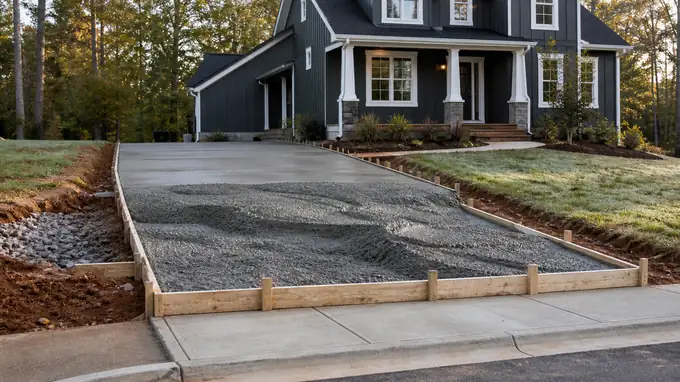
A ready-mix truck discharges concrete into a driveway form. at a charcoal farmhouse-modern home in Alpharetta, GA, in early morning light.

Step 4: Pouring

Concrete arrives mixed to the job: a higher-strength mix for driveways, air-entrained where the surface sits outdoors. We check it at the truck. Nobody adds water on site to make it spread easier, because extra water is the fastest route to a weak, dusty surface. The crew places it, screeds it flat to the forms, and bull-floats it while it is still workable. If rain is moving in, we reschedule the pour rather than race it.

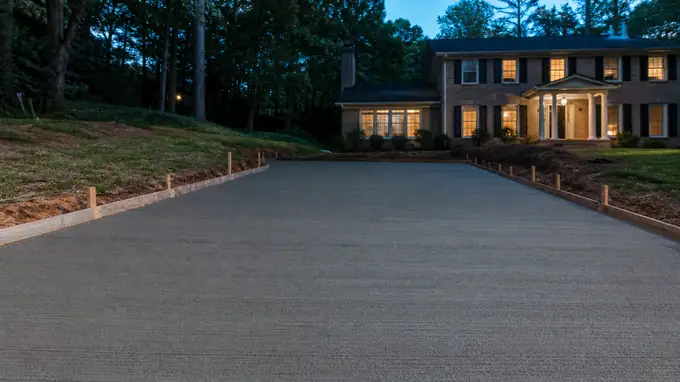
A broom drags across a driveway creating a slip-resistant texture. at a tan-brick colonial in Alpharetta, GA, at blue hour.

Step 5: Finishing

Timing decides this step. Finish too early and bleed water gets trapped under the surface, which flakes off later. Wait too long and the concrete won't take a texture. Driveways and walks get a broom finish for grip. Patios can be stamped with a pattern and color, or hand-troweled smooth. Control joints are tooled or saw-cut at planned spacing, so when the slab cracks (all concrete does) it cracks along a line we chose.

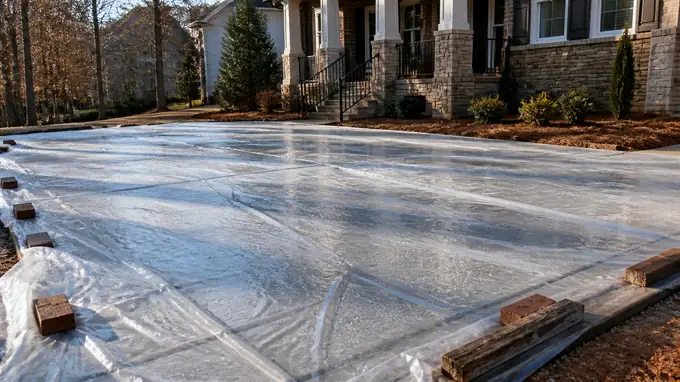
Plastic sheeting covers a curing driveway slab. at a brick-and-siding two-story home in Alpharetta, GA, under low winter sun.

Step 6: Curing

Strength comes from the concrete holding onto its water, not from drying out. Right after finishing, we apply a curing compound or keep the slab wet and covered, so the surface doesn't dry faster than the core. Skipping this causes most of the surface cracking and dusting people blame on bad concrete. Foot traffic comes first, cars later, and we tell you when your slab is ready for each instead of leaving you to guess.

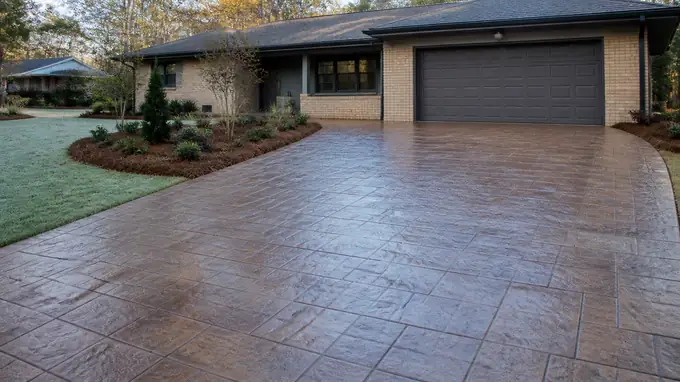
A finished stamped surface shows a glossy sealed sheen. at a buff-brick ranch home in Alpharetta, GA, in early morning light.

Step 7: Sealing

Once the slab has cured, sealer goes on. Penetrating sealers soak in and keep a natural, matte look. Acrylic sealers add a slight sheen and bring out the color on stamped and decorative surfaces. Either one slows water, oil and stains from working into the concrete. Sealer wears down with sun and traffic, so plan on resealing when water stops beading on the surface. It is the simplest upkeep a driveway or patio gets.

What Concrete Costs in Alpharetta

The price of a concrete job comes down to what sits under it, what goes into it, and how much of it there is. Size matters most, but it is rarely the whole story. A driveway on a slope needs more grading and forming than one on flat ground. Soil varies across the county too, so we test every site before we price it. Tearing out an old slab, hauling it off, and pulling the permit all add to the total.

Finish is the other big lever. A broom-finished slab is the plainest option. Stamped and decorative surfaces take more labor, more materials, and more time on site. When you set competing bids side by side, check that they describe the same job:

  • Slab thickness, stated in writing
  • Type of reinforcement (rebar, wire mesh, or fiber) and how it is placed
  • Base preparation: how much gravel goes down and how it is compacted
  • Demolition and haul-off of the existing surface
  • Control joints, sealing, and who handles the permit

A low number usually leaves one of those lines out. Thin base, no reinforcement, joints cut too far apart: the savings show up later as cracks and settling, and tearing out a failed driveway costs more than building it right the first time. Our estimates break out each piece of the work, so you can see what your property is getting and why each line is there. That is how we price concrete solutions: plainly, and before anything is poured. Call for a free estimate.

What We Do for Alpharetta

concrete slab installation completed by a local contractor at a stacked-stone and stucco home in Alpharetta, GA, in clear late-morning sun.

Concrete Slab Installation Cost

What a slab costs depends mostly on what sits under it and what will sit on it. A shed pad on level, well drained ground is simple work. A garage slab on a sloped lot needs more excavation, a compacted stone base, thickened edges and steel reinforcement, and each of those adds labor and material. Tearing out an old slab, pump access and the finish you pick all move the figure too. We price every slab after walking the site, not before.

concrete driveway installation completed by a local contractor at a charcoal farmhouse-modern home in Alpharetta, GA, in late afternoon light.

Concrete Driveway Installation

Driveways here carry cars, delivery trucks and the occasional moving van, often up a grade. We set forms to shed water away from the garage and the house, and we pour over a compacted base instead of loose fill. Reinforcement sits on chairs at the right depth rather than lying in the dirt. Control joints get cut early, so the driveway cracks where we choose instead of where it wants.

concrete flooring installation completed by a local contractor at a painted-white-brick two-story home in Alpharetta, GA, in early morning light.

Concrete Flooring Installation

Basements, garages, workshops and commercial floors all start as a slab, and the finish decides how they live. We pour over a vapor barrier where ground moisture matters, then finish to suit the room: a hard steel trowel for a shop, a light broom where grip counts, or a polished or stained surface for living space. Floors that will take tile or other flooring get checked for flatness before the finish goes on.

concrete slab repair completed by a local contractor at a red-brick ranch home in Alpharetta, GA, at blue hour.

Concrete Slab Repair

Most slab failures start in the base, not the concrete. Water carries fill out from under an edge, the slab loses support, and it cracks or drops. Drainage is usually part of the fix. Depending on the damage, we fill voids and seal joints, cut out and replace the failed section with doweled edges, or tell you plainly that the slab needs to come out.

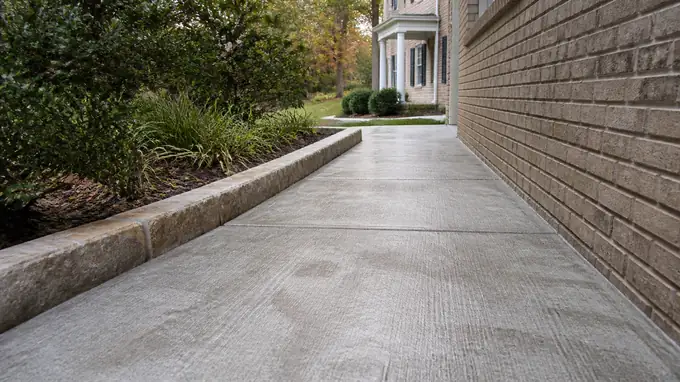
concrete sidewalk installation completed by a local contractor at a tan-brick colonial in Alpharetta, GA, under bright midday cloud.

Concrete Sidewalk Installation

A sidewalk should drain, meet the surfaces around it flush, and never catch a toe. We grade the path so water runs off to the side and tie it into the driveway or steps with an isolation joint, so each piece can move on its own. Finishes run from a plain broom texture for grip to stamped or colored decorative work that matches a patio. Tree roots close to the path get dealt with before we pour.

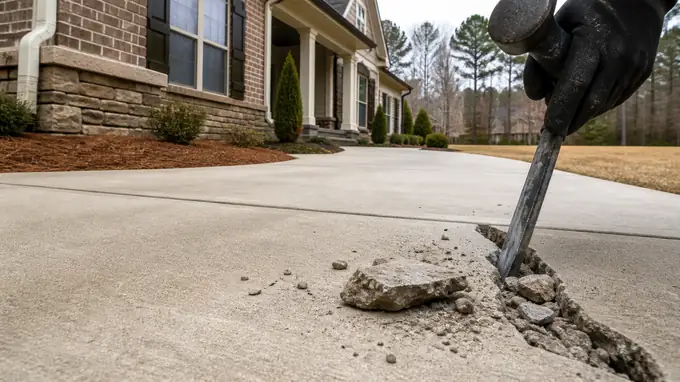
concrete driveway crack repair completed by a local contractor at a brick-and-siding two-story home in Alpharetta, GA, under an overcast sky.

Concrete Driveway Crack Repair

Not every crack needs fixing. Hairline shrinkage cracks show up in almost any slab and are mostly cosmetic. Cracks that widen, shift in height, or let water through are different, because they point to movement underneath. We rout and seal cracks that have stopped moving, lift sunken panels where the base allows, and replace sections that have broken apart. First, though, we find out why it cracked. Otherwise the repair just cracks again.

concrete installation completed by a local contractor at a buff-brick ranch home in Alpharetta, GA, under low winter sun.

Concrete Installation

Steps, equipment pads, footings, curbs, retaining wall bases: plenty of work is smaller than a driveway and still has to be right. The process stays the same at any size. We test the soil, compact the base, set forms and reinforcement, and pour a mix suited to the job. Then we cure it properly, which is where small pours usually go wrong.

concrete patio repair completed by a local contractor at a brick-and-siding two-story home in Alpharetta, GA, under low winter sun.

Concrete Patio Repair

Patios settle, flake at the surface, and pull away from the house. A lot of original patios around town are showing their age. Scaling and worn finishes can often be resurfaced. A patio that has sunk toward the foundation is a drainage problem first, and we fix the slope before anything cosmetic. Stamped and decorative patios can usually be cleaned, patched and resealed rather than torn out.

concrete construction services completed by a local contractor at a tan-brick colonial in Alpharetta, GA, at blue hour.

Concrete Construction Services

For builders, property managers and commercial owners, we take on the concrete scope of a larger job: footings, foundation slabs, walks, dumpster pads and parking areas. We work from your drawings, schedule pours around the other trades, and handle the permit. Structural work gets the reinforcement the plans call for, placed and tied before inspection. Call for a free estimate, and we will walk the site with your plans in hand.

Our Service Area

  • Alpharetta
  • Milton
  • Roswell
  • Johns Creek
  • Chamblee
  • Woodstock
  • Canton
  • Ball Ground
  • North Decatur
  • Acworth

Common Questions About Concrete

What are the warranty or guarantee terms for services provided by Alpharetta Craftsman Concrete?

That is a conversation for your own job, with the scope in front of us, not a line on a web page. What we can describe here is what makes concrete last: a compacted base, the right reinforcement, control joints cut where cracks want to form, and a proper cure before anyone drives on it. Those steps decide how a surface holds up over the years. Ask us about the rest directly.

What areas beyond Alpharetta do you serve?

The full list sits in the service area section of this page. Short version: we work the towns around Alpharetta the same way we work in Alpharetta itself, with the same materials and the same standards on every pour. If your property sits near the edge of that map, call and ask. A driveway doesn't care which side of a city line it lands on.

Can you provide custom wire mesh sizes for specific projects?

Yes. Reinforcement gets chosen for the slab in front of us, not pulled from a default. A patio that only sees foot traffic, a driveway carrying a loaded truck, and a commercial floor under racking all need different mesh or rebar, spaced and lapped differently. We cut sheets to fit the shape of the pour and set them on chairs, so the steel sits inside the concrete instead of on the ground. Tell us what it will carry.

Are you fully licensed, insured, and bonded for commercial work in Southern Alpharetta?

Ask any contractor for current documents before commercial work starts, and read them yourself rather than trusting a line on a website. That goes for us too. A commercial installation on an occupied site also brings its own checklist: who pulls the permit, how the work area is fenced off, where the trucks stage, and how tenants and customers get in and out while fresh concrete cures. Those details get settled before the first form goes up.

How does Alpharetta Craftsman Concrete protect our property and keep the job site clean?

Plywood goes down over any lawn the wheelbarrows and buggies cross. Plastic goes over brick, siding and doors near the pour, so splatter never has a chance to set on them. Washout stays contained in a lined pit or bin, never rinsed into the grass or a storm drain. When the forms come off, the lumber, stakes and spoil leave with us. The only thing we mean to leave behind is the new slab.

How do you minimize dust, noise, and disruption on occupied Alpharetta properties during demolition ?

Cutting is done wet, with water at the blade, which keeps most of the dust out of the air and off your cars. We saw the old slab into sections before breaking it, so there is less hammering and the pieces lift out cleanly. Debris goes straight into a truck or bin rather than sitting in a pile by the garage. Working hours, where equipment parks, and which door stays usable all get agreed before demolition starts.

What permits are required for retaining walls in Alpharetta?

It depends on the wall: how tall it is, what it holds back, and whether a driveway, a structure or a property line sits close above it. Every site is graded and tested on its own, and drainage behind a wall matters as much as the wall. We handle the permit.

Do I need permits for foundation work in Alpharetta?

Yes, in most cases. Footings and structural slabs carry a building, so they usually need a permit, and an inspection of the forms and reinforcement before the pour is common. We handle the permit. Every site is tested individually before construction starts. Pouring on untested ground is how good foundations end up needing repair.

Tap to call +1 470-260-7028