
+1 470-260-7028
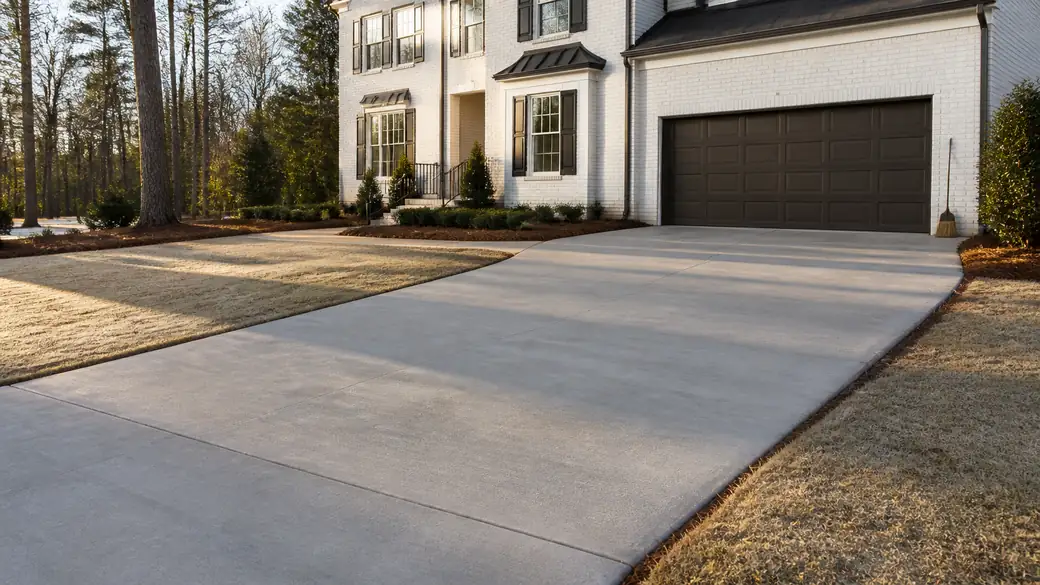
A finished concrete driveway sweeping from the street to the garage, clean-edged and evenly toned in the sun. at a grey split-level home in Alpharetta, GA.

Polished Concrete Floors in Milton, Georgia

A polished concrete floor is the slab itself, ground down with diamond tooling until the surface is flat, dense and bright enough to throw back the light in the room. There is no coating sitting on top to peel, lift or scuff through. We polish floors in Milton homes and commercial spaces alike: basements, kitchens, garages turned into workshops, showrooms and offices. The finish runs from a soft satin to a high gloss, and the aggregate can stay hidden or be exposed as a decorative feature.

Every project starts with the slab as we find it. We check it for cracks, old adhesive, patched areas and how hard the concrete actually is, because that decides which diamonds we start with. Then comes a series of grinding passes, each one finer than the last, with a densifier worked in partway through to harden the surface. Joints and cracks get filled before the final cuts. The last step is a guard that helps the floor stand up to spills and daily traffic.

Most polished floors that disappoint were rushed. Skip a grit and the scratches from the coarse pass show up the first time low sun crosses the room. Polish a soft slab without hardening it first and the shine fades early. Moisture matters too: a slab that is still wet underneath can haze and blotch. That is why we look at each slab and site on its own before work starts, and why we would rather tell you a floor is a poor candidate than polish it anyway.

Call +1 470-260-7028

Get a FREE Quote

Our Concrete Work Around Milton

concrete slab installation completed by a local contractor at a stacked-stone and stucco home in Alpharetta, GA, in clear late-morning sun.

Concrete Slab Installation Cost

What moves the number on a slab is mostly what sits under it and inside it. A site that needs grading, hauled-in gravel or a thicker section for vehicle loads costs more than a flat pad for a shed. Rebar on chairs costs more than wire mesh, and mesh more than fiber alone. Finish matters too: a broom finish is the plainest, while stamped or colored surfaces add labor. We price each slab after walking the property.


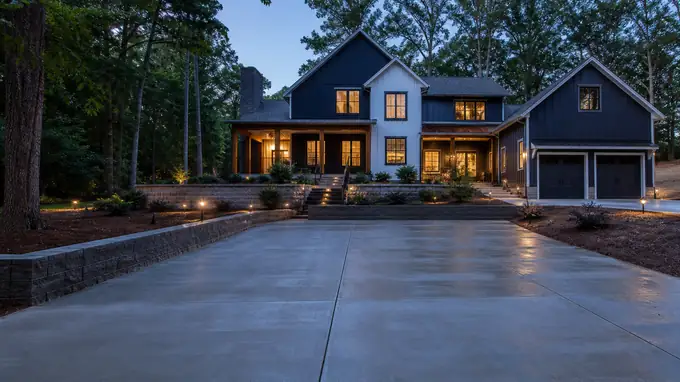
concrete driveway installation completed by a local contractor at a charcoal farmhouse-modern home in Alpharetta, GA, in late afternoon light.

Concrete Driveway Installation

Driveways fail from the bottom up, so most of our time goes into the base. We cut out topsoil and roots, lay compacted gravel, and set rebar on chairs so the steel ends up in the middle of the slab instead of lying in the dirt. The apron at the street gets extra thickness because that is where trucks turn. Control joints are sawn early, before the concrete picks its own crack lines. Finish is broom, exposed aggregate or stamped.

concrete flooring installation completed by a local contractor at a painted-white-brick two-story home in Alpharetta, GA, in early morning light.

Concrete Flooring Installation

Inside a house or shop, a concrete floor has to be flat before it can look good. New floors go down over a vapor barrier so ground moisture stays out of whatever sits on top, and we power trowel them tight. For a polished finish we grind with diamond tooling, coarse to fine, harden the surface with a lithium silicate densifier, then polish and seal. Existing slabs can often be ground the same way once old coatings and adhesive come off.

concrete slab repair completed by a local contractor at a red-brick ranch home in Alpharetta, GA, at blue hour.

Concrete Slab Repair

A cracked slab is telling you something, and we want to know what before we patch it. Hairline shrinkage cracks are usually cosmetic. We rout and seal those. A crack with one side higher than the other usually means the base washed out or settled, and filling it only hides the problem. Depending on what we find, we inject, lift, or cut out a section and pour it back with dowels tying new concrete to old.

concrete sidewalk installation completed by a local contractor at a tan-brick colonial in Alpharetta, GA, under bright midday cloud.

Concrete Sidewalk Installation

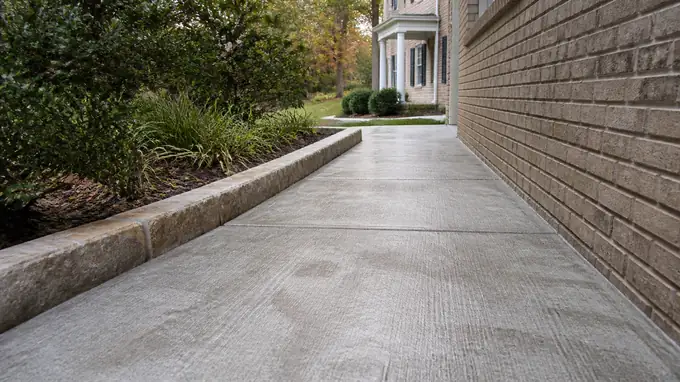
Walks look simple, but they take foot traffic every day, so small choices show. We form them with a slight cross slope so rain runs off the side instead of pooling, and this area gets about 50 inches of it a year. Rion soil, the dominant type in Fulton County, drains well, but it varies, so every site is tested before work starts. Joints go in at even spacing, edges get tooled, and the surface gets a broom finish for grip.

Our Warranty and Guarantee in Milton

We do not hand out a printed warranty with our name at the bottom, and we would rather you judge the work than a sheet of paper. What we offer instead is a plain account of how your slab, driveway or patio is built, what it is built to handle, and where concrete has limits that no contractor can write away. Polished floors, stamped surfaces and ordinary residential pours all get that same explanation before a project starts.

Durability starts under the surface. Rion soil, which is well drained, is the dominant type in Fulton County, but it varies from one property to the next, so every site is tested individually before work starts. That result shapes the base, the reinforcement and the thickness of the pour. With about 50 inches of rain a year here, we also plan where water goes once the forms come off, because water that sits against a slab works on it for years.

Concrete cracks. Control joints are cut so it cracks where we choose, in straight lines, instead of wandering across a polished floor or a decorative driveway. Hairline shrinkage cracks are normal; a slab that settles or heaves is not, and we explain the difference up front so you know what to expect from the materials over time. If you want to talk that through for your own property, call for a free estimate.

How a Concrete Job Runs in Milton

A contractor checks slope and drainage before work begins. at a tan-brick colonial in Alpharetta, GA, after a rain shower.

Step 1: Site Assessment

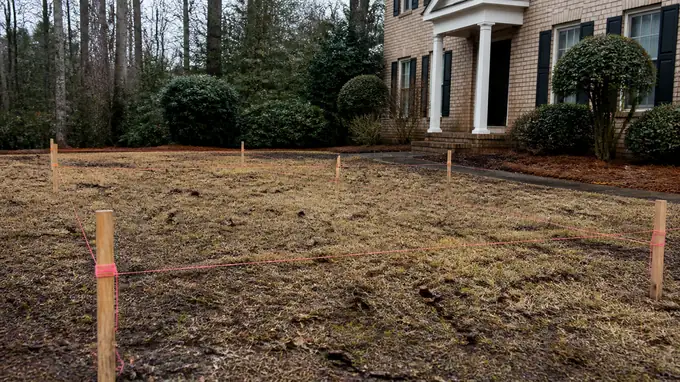
We start by walking the property and looking at where water goes now, what the slab has to carry, and what sits under the surface. Rion soil, which drains well, is Fulton County's dominant type, but it varies across the county, so every site is tested individually before work starts. Tree roots, old fill, buried downspout lines and the existing grade all get noted here, because each one shapes the rest of the project.

A plate compactor tamps down soil in a small excavated area. at a tan-brick colonial in Alpharetta, GA, at blue hour.

Step 2: Site Preparation

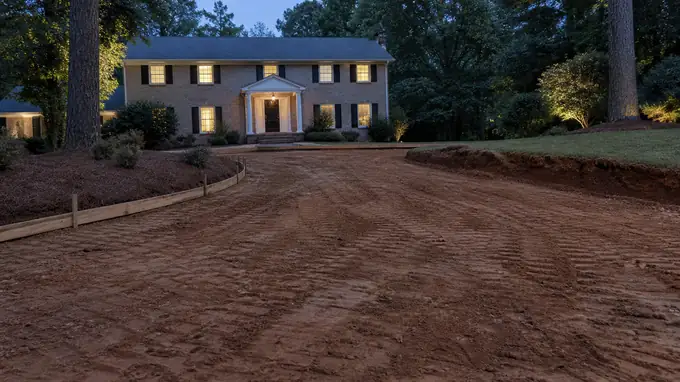
Most failures we get called to fix began in the ground, not the concrete. We strip topsoil and organic material down to firm subgrade, cut out soft spots, and compact in lifts rather than all at once. A compacted gravel base goes on top. Then comes grading. The finished slab needs a steady fall away from the house, and with about 60" of rain a year, a flat or back-pitched driveway turns into a problem fast.

Wooden forms outline a patio slab before the pour. at a painted-white-brick two-story home in Alpharetta, GA, under an overcast sky.

Step 3: Forming & Reinforcement

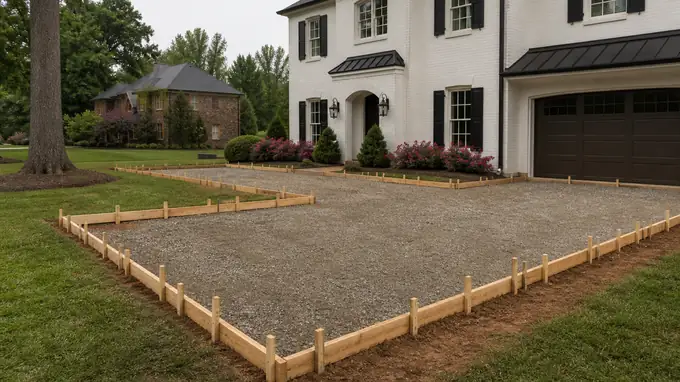
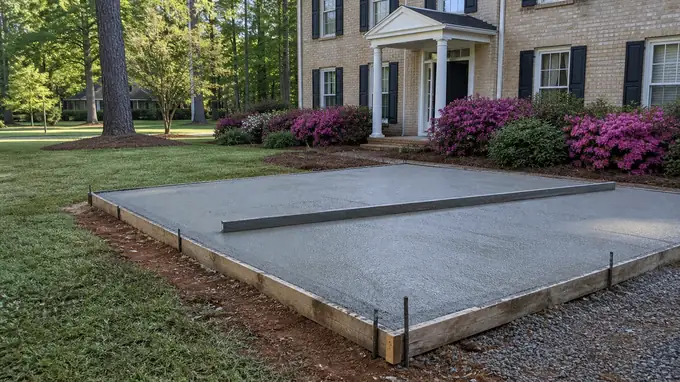
Forms are set to string lines and checked for pitch before any steel goes in. Driveways and structural slabs get rebar tied on a grid; lighter patios and walks often take welded wire mesh. Either way, the reinforcement sits on chairs or dobies so it ends up in the middle of the slab. Steel lying on the gravel does nothing. Isolation joints go wherever the new concrete meets the house, a garage slab or a step.

A screed board levels fresh concrete on a small patio. at a tan-brick colonial in Alpharetta, GA, in early morning light.

Step 4: Pouring

Concrete gets ordered for the job it has to do. A driveway mix is not a basement floor mix, and we specify strength and slump to suit the slab. We place it in one continuous pour where the site allows, moving it with shovels and come-alongs instead of adding water to make it flow. Extra water makes placement easier and leaves a weaker, dustier surface that cracks sooner. It is the most common shortcut in residential construction.

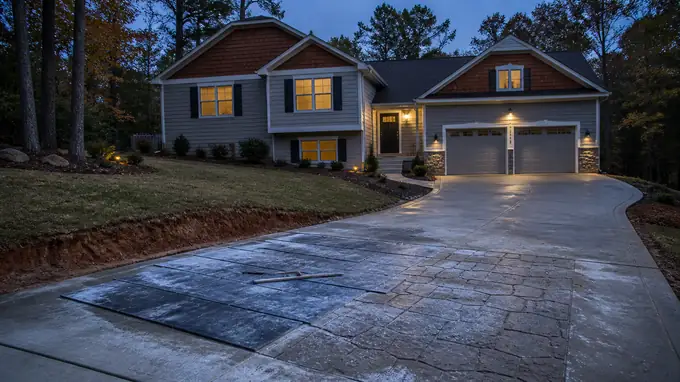
Stamping mats are pressed into a patio surface to imprint a pattern. at a grey split-level home in Alpharetta, GA, at blue hour.

Step 5: Finishing

Timing matters more than technique here. We screed the surface flat, float it, then wait for the bleed water to leave before closing it up. Troweling over bleed water is what makes a surface flake and scale later. Control joints get tooled or saw-cut deep enough to decide where the slab cracks. Driveways get a broom finish for grip. Stamped and decorative work happens in this window, and slabs meant for polishing are finished hard and flat so they grind evenly.

A hand sprayer applies curing compound to a finished patio. at a charcoal farmhouse-modern home in Alpharetta, GA, at blue hour.

Step 6: Curing

Concrete keeps gaining strength for weeks after it looks done, and it only does that while it holds its moisture. We apply a curing compound or keep the slab covered and damp, depending on the finish. A slab that dries out too fast ends up with a weak top layer that dusts and wears early. Foot traffic comes back well before car traffic, so stay off a new driveway with vehicles until we say it is ready.

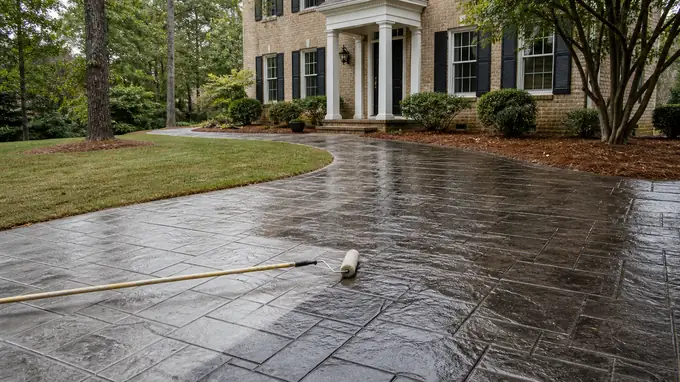
A roller applies sealer to a stamped patio surface. at a tan-brick colonial in Alpharetta, GA, after a rain shower.

Step 7: Sealing

Sealing waits until the slab has cured enough to let its moisture out; seal too early and the coating can cloud or peel. Exterior driveways and patios usually get a penetrating sealer that keeps water, oil and stains out without making the surface slick. Stamped and decorative surfaces often take an acrylic that brings the color back up. Polished floors are densified and guarded rather than coated. We tell you what went on and when it should be redone.

How Much Does Concrete Cost in Milton?

We price every job after walking the property, because two slabs of the same size can land far apart once we see what sits under them and around them. The factors below move a quote the most, and nearly all of them are things you can check on your own lot before anyone measures a thing.

What changes the priceWhich wayWhy
Old concrete, asphalt or pavers in the waycosts moreEverything has to be broken up, loaded and hauled off before we can grade and set forms.
A clear path for the mixer truckcosts lessA truck that backs right up to the forms pours straight from the chute. Without that, we pump or wheel the concrete in, which adds equipment and labor.
Low spots or a slope toward the housecosts moreThis area sees about 50 inches of rain a year, so we grade for runoff and sometimes add a drain before the pour.
Thicker slab or heavier reinforcementcosts moreA driveway carrying vehicles needs more depth and more steel than a patio does.
Soft fill or disturbed groundcosts moreRion soil drains well across much of Fulton County, but it varies, so we test every site. Soft spots get dug out and rebuilt with compacted stone.
Tree roots near the workcosts moreRoots are cut back and the base rebuilt, or the slab lifts later.
Stamped or decorative finishcosts moreColor, stamping and sealing add materials and hours on pour day.
A sound existing slab to polishcosts lessGrinding a slab that is already there skips excavation and the pour. Cracks and old coatings add passes.

Compare competing bids line by line on the same points: slab thickness, what reinforcement goes in, how deep the stone base is, who hauls away the old material and how the water gets handled. A lower number that leaves one of those out is a different job, not a cheaper one.

Frequently Asked Questions About Concrete in Milton

What type of foundation is best for Milton homes?

It depends on the lot, and we don't guess at it. Rion soil is Fulton County's dominant type and it drains well, but it varies across the county, so every site gets tested before we recommend anything. A flat lot with firm ground often suits a slab on grade. A sloped lot, or a plan with a lower level, usually calls for a basement or crawlspace foundation with stepped footings.

Will Alpharetta Craftsman Concrete take care of our city permits and inspections?

Yes. When a project needs a permit, we pull it, and we build the schedule around the inspections so any required check of forms and reinforcement happens before concrete goes in. You don't have to chase paperwork or learn the permit office's process. If a job turns out not to need a permit at all, we say so plainly rather than add a step that does nothing for your property.

What areas beyond Milton do you serve?

We work across metro Atlanta, on the same terms in every town we cover. A driveway in Roswell gets the same crew, the same materials and the same attention to the base as one poured here. The full list of towns sits elsewhere on this page. If yours isn't on it, call and ask anyway. A straight answer beats guessing.

How deep do commercial foundations need to be in Milton?

As deep as the engineer's drawings say, and no shallower. Commercial footings in Milton are sized by a structural engineer from the building's loads, the soil report and the code the city enforces, so no single number fits every job. Our part is building to that design exactly: excavate to the specified depth, confirm we've reached bearing soil, place the reinforcement as drawn, then pour.

Should a damaged Milton patio be repaired or replaced?

That comes down to what's underneath. Hairline cracks and a worn or stained surface can usually be repaired, sealed or resurfaced with far less work than a new slab. Sunken, heaved or separated sections are different. They mean the base has failed, and patching the top only hides it for a while. About 50 inches of rain a year gives water plenty of chances to work into those gaps. We look at the slab and the base before recommending either.

What types of commercial projects does Alpharetta Craftsman Concrete handle?

Mostly the flatwork and structural concrete that keeps a business open. That covers slabs and foundations for new construction, parking areas, sidewalks, curbs, loading pads and dumpster pads, plus polished and sealed interior floors. Professional and management services are the area's largest employers by share, with health care and education second. So offices, clinics and school properties are the commercial work we build for most often around here.

Get a Free Estimate

Get a FREE Quote

Tap to call +1 470-260-7028