
+1 470-260-7028
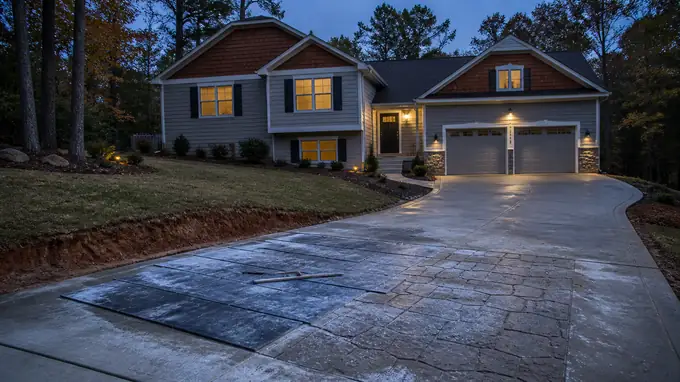
concrete driveway crack repair completed by a local contractor at a brick-and-siding two-story home in Alpharetta, GA, under an overcast sky.

Concrete Driveway Crack Repair in Alpharetta, GA

A cracked driveway is rarely just a surface problem. The crack is where the slab shows what is happening underneath it, and we read it before we fill it. In Alpharetta the median home was built in 1996, so many of the driveways we see have been carrying cars and trucks for decades. Hairline shrinkage cracks, a control joint that has opened up, a corner that has dropped: each one points to a different cause, and each one gets its own repair. Treating all three the same way is how a crack comes back.

Water is usually what turns a small crack into a large one. The area gets about 50 inches of rain a year, and every bit of it that finds an opening works its way under the slab. Fulton County is hilly, too, so a driveway that falls toward the garage or the street can have runoff chewing at its edges for years before anyone notices. Rion soil, the county's dominant type, drains well, but it changes from lot to lot. We check the conditions under your driveway before choosing materials. If a crack has started to widen, or one side now sits higher than the other, call for a free estimate.

Call +1 470-260-7028

Get a FREE Quote

Our Concrete Driveway Crack Repair Work in Alpharetta

concrete slab installation completed by a local contractor at a stacked-stone and stucco home in Alpharetta, GA, in clear late-morning sun.

Concrete Slab Installation Cost

What drives a slab's cost is mostly what happens below it. Grade, base depth, thickness and reinforcement set the number, and on a sloped lot (local relief here runs 241 feet within a few miles) the excavation and forming can outweigh the concrete itself. We test and grade every site before quoting, then price a 4-inch slab on compacted gravel with rebar or wire mesh as its own line. Call for a free estimate.


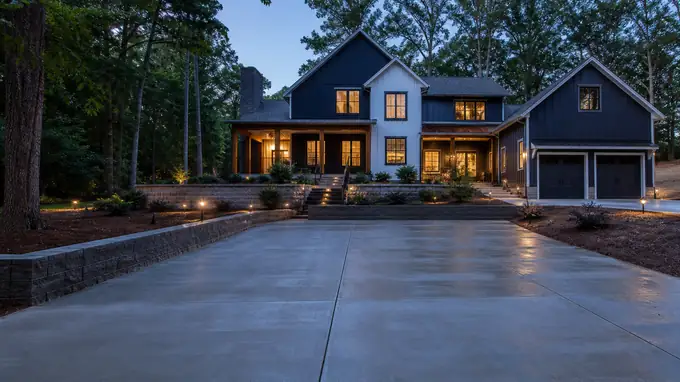
concrete driveway installation completed by a local contractor at a charcoal farmhouse-modern home in Alpharetta, GA, in late afternoon light.

Concrete Driveway Installation

A driveway fails from the base up, so that is where our time goes. We remove the old surface, compact a gravel base, and pour at least 4 inches (5 where heavy vehicles park) with rebar set on chairs so the steel sits mid-slab. With about 50 inches of rain a year, we pitch the surface away from the garage. Control joints cut to a quarter of the slab's depth decide where it cracks. Finishes run from broom to stamped.

concrete flooring installation completed by a local contractor at a painted-white-brick two-story home in Alpharetta, GA, in early morning light.

Concrete Flooring Installation

Garage, basement and shop floors are where we see most interior work. On new pours we lay a 10-mil vapor barrier over compacted stone before the slab goes down, because moisture coming up through bare concrete lifts coatings and flooring later. On existing floors we grind the surface, fill cracks and spalls, then seal, polish or apply an epoxy coating. Grinding matters: a slick trowelled finish will not hold a coating.

concrete slab repair completed by a local contractor at a red-brick ranch home in Alpharetta, GA, at blue hour.

Concrete Slab Repair

Not every cracked slab needs replacing. Hairline shrinkage cracks get routed out and sealed with flexible polyurethane so water stays out of the base. A crack with one side higher than the other usually means the base has settled or washed out, and sealing it alone will not last. Sunken sections can be lifted with injected foam. Broken or root-heaved panels get cut out at the joints and repoured, with dowels drilled into the concrete that stays.

What Makes Alpharetta Craftsman Concrete's Concrete Work Different

We start with why a driveway cracked, not the crack itself. The median home here was built in 1996, so many of the driveways we see were poured alongside the house and have carried cars ever since. Fulton County is hilly, and about 50 inches of rain a year finds the low side of each slab. Cracks show us where that water goes, where joints were missing, and where the ground underneath has moved.

A crack sealed over a problem it did not address tends to open again, usually a little wider. Rion soil drains well and is the county's dominant type, but it changes from one property to the next, so we test each site on its own. Getting it right sometimes means correcting drainage or cutting a proper control joint along with the repair, and we tell you when that is the case. Sometimes the honest answer is that a crack is cosmetic and can be left alone.

How a Concrete Driveway Crack Repair Job Runs in Alpharetta

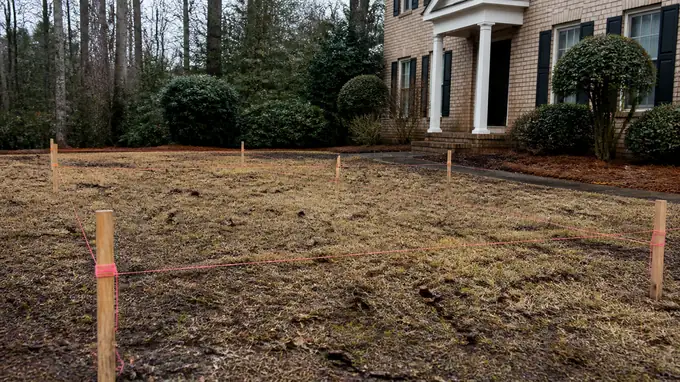
A contractor checks slope and drainage before work begins. at a tan-brick colonial in Alpharetta, GA, after a rain shower.

Step 1: Site Assessment

The first question is whether a crack is cosmetic or structural. A hairline shrinkage crack that has stopped moving is a sealing job. A crack with one side higher than the other, or a panel that rocks underfoot, means the base underneath has shifted, and filling it only hides the problem for a season. We measure the offset, trace where water runs off the slab, and check the grade, because lots around Alpharetta rarely sit flat.

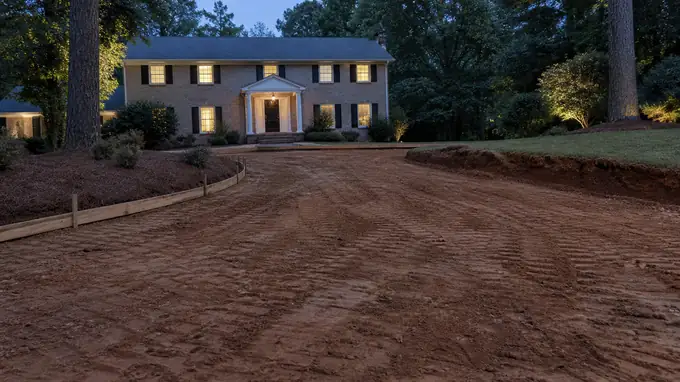
A plate compactor tamps down soil in a small excavated area. at a tan-brick colonial in Alpharetta, GA, at blue hour.

Step 2: Site Preparation

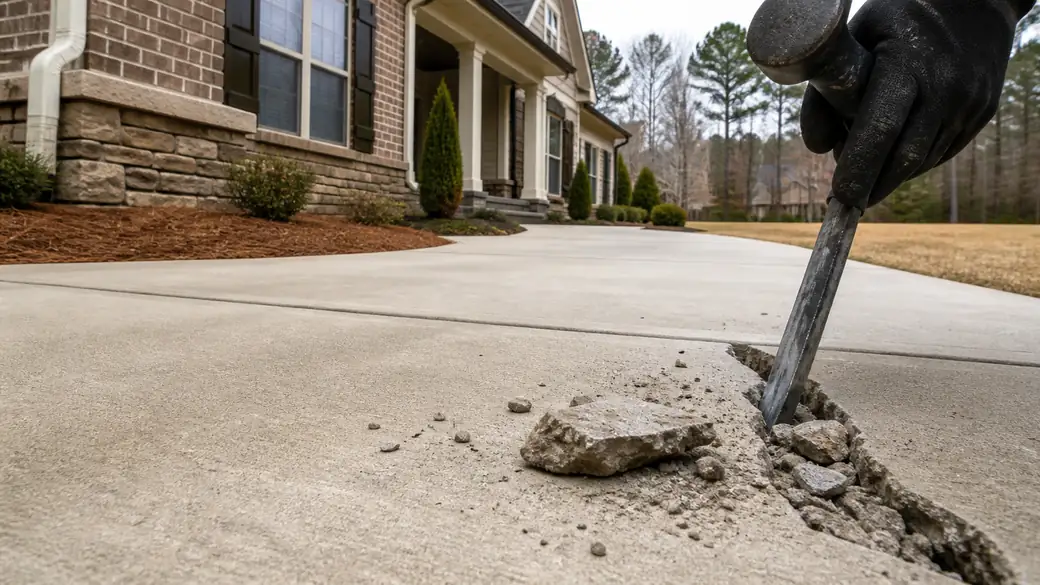
For cracks we can save, preparation means cutting the crack open with a diamond blade into a clean, square channel, then vacuuming out dust and old filler. Sealant will not bond to crumbled edges. When a panel has to go, we saw-cut it at the nearest control joint, break it out, and dig to the base. Soil changes from lot to lot, so we test the subgrade, replace washed-out gravel, and compact it in lifts.

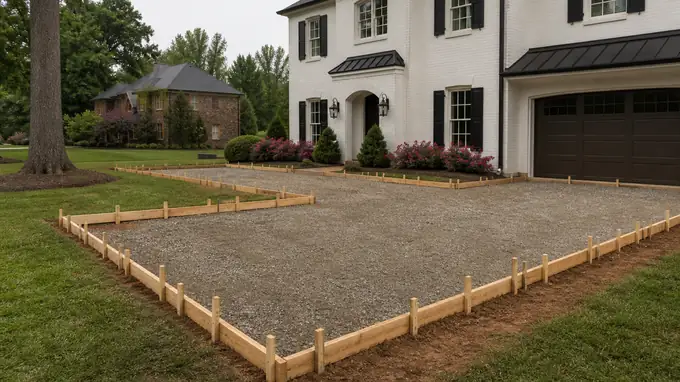
Wooden forms outline a patio slab before the pour. at a painted-white-brick two-story home in Alpharetta, GA, under an overcast sky.

Step 3: Forming & Reinforcement

Replacement panels get forms set to the existing grade, so the new surface meets the old one flush and keeps its pitch away from the garage. Smooth steel dowels are drilled and epoxied into the edges of the neighboring panels, which stops the new section from settling out of line. Inside the form, rebar sits on chairs at mid-depth. Mesh left lying on the gravel does nothing, and it is one of the most common shortcuts we tear out.

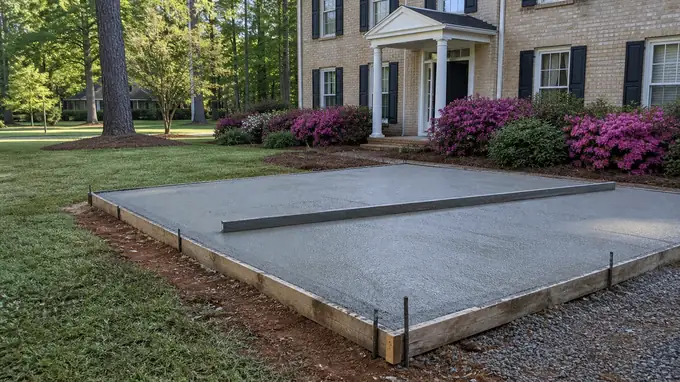
A screed board levels fresh concrete on a small patio. at a tan-brick colonial in Alpharetta, GA, in early morning light.

Step 4: Pouring

Pour day depends on the forecast. With about 50 inches of rain a year here, we wait for a dry window, because a downpour on fresh concrete washes out the cement paste and leaves a weak, sandy surface. The mix arrives with its water content held low. Adding water at the truck makes the concrete easier to place and the slab weaker. We place it, consolidate it around the dowels and rebar, and screed it off the forms.

Stamping mats are pressed into a patio surface to imprint a pattern. at a grey split-level home in Alpharetta, GA, at blue hour.

Step 5: Finishing

Matching the old driveway matters more on a repair than on new work. Most driveways carry a light broom finish, so we pull the broom in the same direction as the existing panels and tool the edges to the same radius. Control joints go back exactly where the originals were. On stamped or decorative surfaces, we match pattern and color as closely as the materials allow. New concrete still reads a shade brighter at first, and it mellows with weather.

A hand sprayer applies curing compound to a finished patio. at a charcoal farmhouse-modern home in Alpharetta, GA, at blue hour.

Step 6: Curing

Concrete gains strength slowly, and the first days decide how strong the patch ends up. A slab that dries from the top down develops surface crazing and a dusty, weak finish. We apply a curing compound or keep the surface covered and damp so moisture stays in the concrete while it hardens. Foot traffic comes first, cars later. Before the cones come down, we tell you when the new section is ready for each.

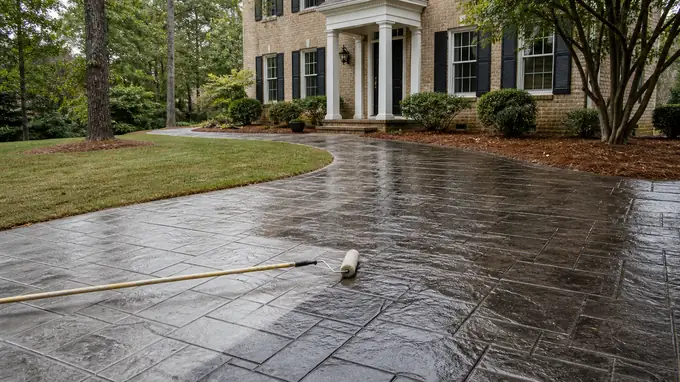
A roller applies sealer to a stamped patio surface. at a tan-brick colonial in Alpharetta, GA, after a rain shower.

Step 7: Sealing

Once the concrete has cured, we seal. Routed cracks on the rest of the driveway get backer rod pressed in and a flexible polyurethane sealant tooled over it, so the joint can move without tearing loose. Then a penetrating silane or siloxane sealer goes across the whole surface, old panels and new. It keeps rainwater and oil from soaking in, and it helps the patch and the original slab weather at the same pace from here on.

Choosing the Right Concrete System

The right fix depends on what the crack is doing, not how wide it looks. A hairline crack that has stopped moving gets routed out and filled with a flexible sealant that keeps water away from the base. A crack that opens and closes through the year needs backer rod and a sealant rated for that movement, set to the right depth. Where one side of the slab has dropped, filling the gap only hides the problem, so we lift or replace that section instead. Stamped and decorative surfaces get a color-matched repair.

Before we choose a system, we measure the crack, check whether both edges sit level, and watch where water runs off the driveway. Drainage matters here. Fulton County sees about 50 inches of rain a year, and the ground is hilly, so water on a sloped lot will find any open joint and work under the slab. The median home in Alpharetta was built in 1996, which means plenty of driveways have been through a lot of weather. If sealing will not hold, we tell you, and we price resurfacing or a new slab instead.

Concrete Driveway Crack Repair Pricing in Alpharetta, GA

A crack repair can be a morning of routing and sealing, or it can be the first sign that a section of slab has to come out. The price follows which one your driveway needs. Most of what moves it is something you can check yourself before we ever look at the job.

What changes the priceWhich wayWhy
A hairline crack with both edges levelcosts lessWe rout and seal it. No concrete comes out.
One side of the crack sitting lower than the othercosts moreThe slab has moved, so a section usually needs lifting or replacing, not just filling.
Gaps or washed-out base under the slab edgecosts moreThe void gets filled and compacted first, or the new sealant has nothing solid to sit on.
Downspouts or runoff aimed across the drivewaycosts moreWith about 50 inches of rain a year, water pointed at the slab keeps working the crack open, so we may need to redirect it.
A steep drivewaycosts moreFulton County is hilly, and a steep grade puts more strain on joints and makes patch material harder to place and cure.
Rebar or wire mesh in the existing slabcosts more if a section comes outReinforcement has to be cut, cleaned and tied into the new concrete.
A saw or truck can't reach the damaged areacosts moreMaterial and equipment get moved by hand.
A stamped or decorative surfacecosts moreMatching color and pattern takes far longer than a broom finish.

When you line up bids, check whether each one says what caused the crack and what it does about that cause. See whether base repair, drainage and any section removal are written in or left out. A bid that only fills the surface can mean paying for the same crack twice.

Get a Free Estimate

Get a FREE Quote

Tap to call +1 470-260-7028