
+1 470-260-7028
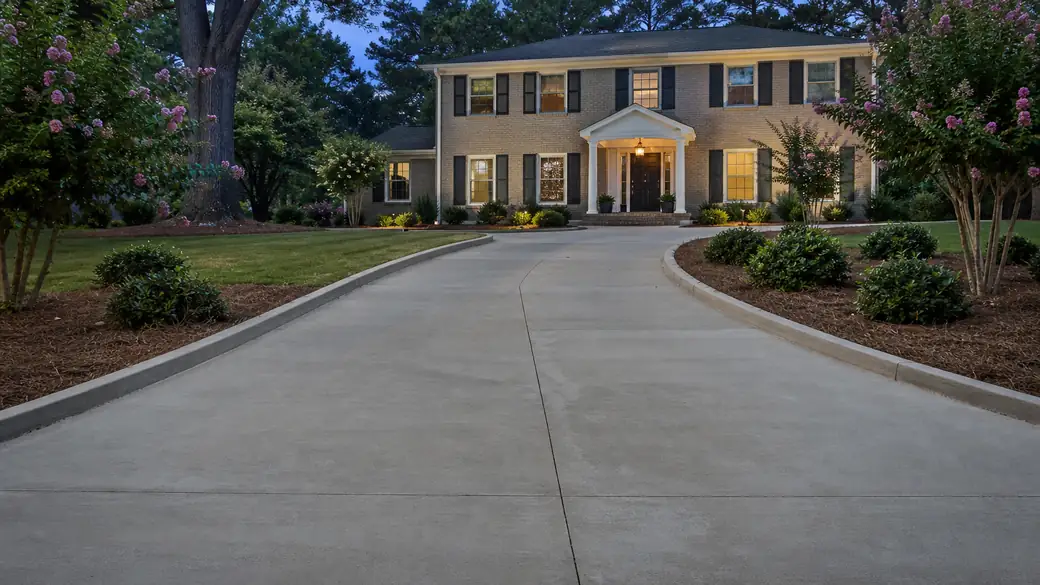
concrete construction services completed by a local contractor at a tan-brick colonial in Alpharetta, GA, at blue hour.

Concrete Construction Services in Alpharetta, GA

Alpharetta Craftsman Concrete builds driveways, patios, walkways and slabs for residential and commercial property across Alpharetta. The median home here was built in 1996, so a good share of the concrete poured with those houses has been through decades of weather and traffic. You can see it from the street: cracks that keep widening, sections that have dropped, a surface worn thin where the cars sit. We tear out what has failed and pour new work meant to outlast the first round. Some owners want a plain broom finish. Others want stamped or decorative concrete. The preparation underneath is the same either way.

The ground is where most concrete trouble starts, so that is where we start. Fulton County is hilly, with 241 feet of local relief within a few miles, and the area takes about 50 inches of rain a year. On a sloped lot, that much water will find any gap under a slab. Rion soil, the county's dominant type, drains well, but it changes from one block to the next. That is why we grade and test every site on its own before a single form goes in. Then come the base, the reinforcement and the pitch that carries water away from the house. Call for a free estimate.

Call +1 470-260-7028

Get a FREE Quote

Our Concrete Construction Services Work in Alpharetta

concrete slab installation completed by a local contractor at a stacked-stone and stucco home in Alpharetta, GA, in clear late-morning sun.

Concrete Slab Installation Cost

What a slab costs depends on what sits under it and what goes into it. Thickness, reinforcement (welded wire mesh, rebar on chairs, or fiber in the mix), the amount of grading, and whether a pump truck has to reach the back of the property all move the number. Fulton County is hilly, so many lots need cut and fill before any forms go up. We price each slab after walking the site.


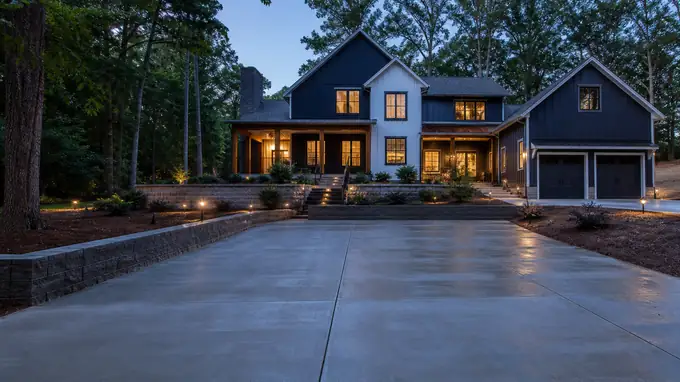
concrete driveway installation completed by a local contractor at a charcoal farmhouse-modern home in Alpharetta, GA, in late afternoon light.

Concrete Driveway Installation

A driveway fails from the bottom up. We strip out organic soil, compact a crushed stone base, and set rebar on chairs so the steel sits in the middle of the slab instead of on the dirt. Much of the county sits on well-drained Rion soil, but with about 60" of rain a year we still pitch every surface away from the garage. Control joints go in early. Finishes run from broom to exposed aggregate to stamped.

concrete flooring installation completed by a local contractor at a painted-white-brick two-story home in Alpharetta, GA, in early morning light.

Concrete Flooring Installation

Garage floors, basements, workshops and small commercial spaces all start the same way: a compacted base, a heavy vapor barrier, and reinforcement sized to the load the floor will carry. We power trowel the surface flat so it takes a sealer, a polish or a coating cleanly. Most floor problems trace back to curing. A slab that dries too fast on top curls at the edges and cracks, so we keep it wet or covered.

concrete slab repair completed by a local contractor at a red-brick ranch home in Alpharetta, GA, at blue hour.

Concrete Slab Repair

The median home here was built in 1996, so many patios, walks and garage floors have had decades to settle. Before we fix anything, we find out why it moved: a washed-out base, a downspout dumping water at the edge, a tree root. Hairline shrinkage cracks get routed and sealed. Sunken sections can often be lifted. When the base has failed, we saw out the bad panel, dowel into the sound concrete and pour new.

How a Concrete Construction Services Job Runs in Alpharetta

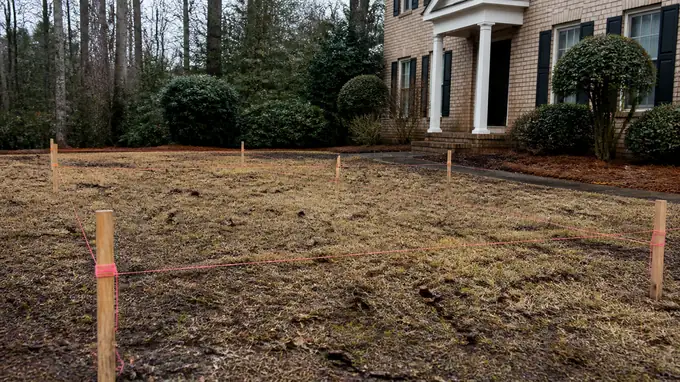
A contractor checks slope and drainage before work begins. at a tan-brick colonial in Alpharetta, GA, after a rain shower.

Step 1: Site Assessment

We start by walking the property and watching where the water goes. Fulton County has about 241 feet of local relief within a few miles, so plenty of lots slope one way at the street and another at the garage. We shoot grades, probe the soil, and look for roots, old fill and buried lines. Rion soil drains well across much of the county, but we test every site ourselves before planning anything.

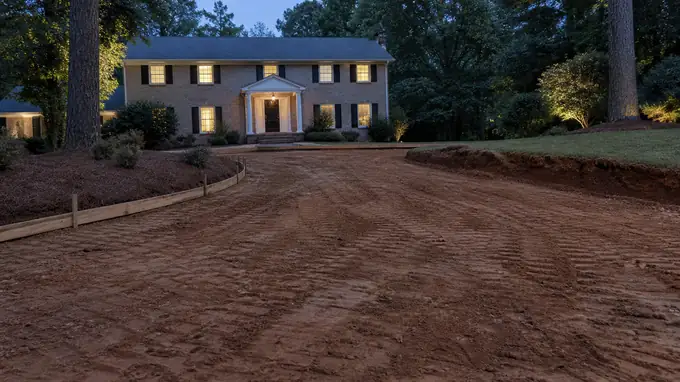
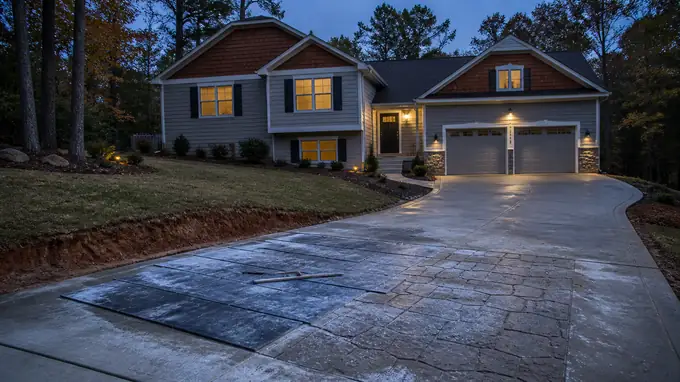
A plate compactor tamps down soil in a small excavated area. at a tan-brick colonial in Alpharetta, GA, at blue hour.

Step 2: Site Preparation

Digging out comes next, down past the topsoil and anything soft or organic. We build a gravel base in lifts and run a plate compactor over each one, rather than dumping it all at once and hoping. With around 50 inches of rain a year, the grade matters as much as the base: the finished surface has to shed water away from the house, never toward it. We handle the permit when the project needs one.

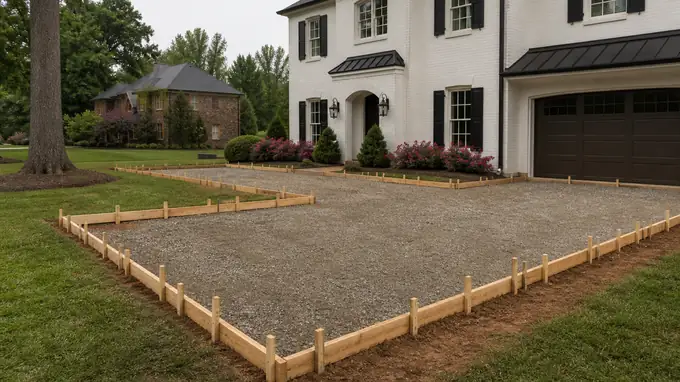
Wooden forms outline a patio slab before the pour. at a painted-white-brick two-story home in Alpharetta, GA, under an overcast sky.

Step 3: Forming & Reinforcement

Forms go in on stakes, set to string lines so the pitch holds from one end to the other. Driveways get rebar tied in a grid; lighter patios may take welded wire mesh or fiber reinforcement. Either way, the steel sits on chairs so it ends up in the middle of the slab. Mesh left lying on the gravel does nothing at all, and it is behind a lot of cracked residential slabs.

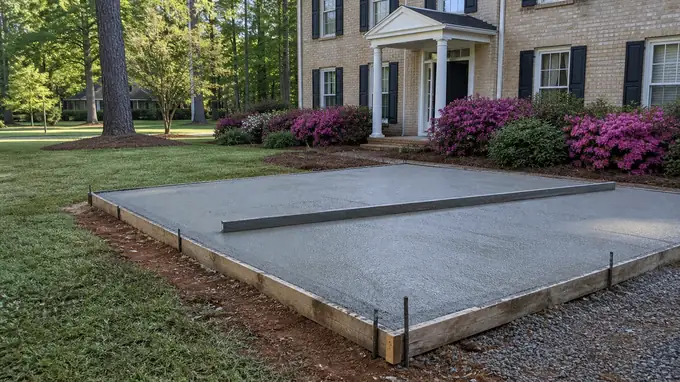
A screed board levels fresh concrete on a small patio. at a tan-brick colonial in Alpharetta, GA, in early morning light.

Step 4: Pouring

The truck backs in and we place concrete quickly, working from the far corner toward the exit. A pour can't stop halfway, so the crew, the tools and the pump (if the site needs one) are ready before the first chute swings over. We screed the surface flat, then bull float it. Adding water at the truck makes a mix easier to spread and weaker once it sets. We don't do it.

Stamping mats are pressed into a patio surface to imprint a pattern. at a grey split-level home in Alpharetta, GA, at blue hour.

Step 5: Finishing

Timing is the whole job here. We wait for bleed water to leave the surface before touching it, because troweling that water back in leaves a weak top layer that flakes later. Then come the edges, control joints cut deep enough to decide where the slab cracks, and the finish itself: broom texture for traction on a sloped driveway, or stamped and colored patterns for decorative patios and walkways.

A hand sprayer applies curing compound to a finished patio. at a charcoal farmhouse-modern home in Alpharetta, GA, at blue hour.

Step 6: Curing

Concrete gains strength slowly, and it needs moisture to do it. Average daily highs here run around 71°F, and on a warm, breezy afternoon the surface can dry out well ahead of the slab beneath it. That leads to crazing and a dusty top. We keep it damp or apply a curing compound, and we tell you when it can take foot traffic and when it can take a car.

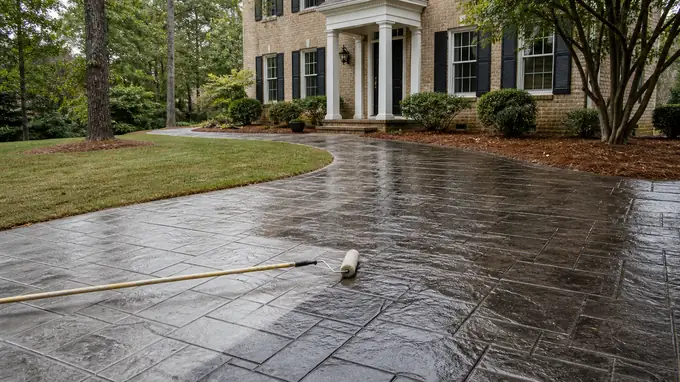
A roller applies sealer to a stamped patio surface. at a tan-brick colonial in Alpharetta, GA, after a rain shower.

Step 7: Sealing

Sealer goes on only after the slab has cured and dried enough to take it. A penetrating sealer suits broom-finished driveways. Stamped and colored surfaces usually get a film-forming sealer that deepens the color and keeps oil and leaf stains from soaking in. Laid on too thick, it turns cloudy or slick when wet. We apply thin, even coats and show you what resealing involves down the road.

Choosing the Right Concrete System

The right system starts with what the slab has to carry. A patio that holds chairs and a grill can run thinner than a driveway that takes a loaded truck every evening, and a structural slab under an addition is a different job again. Reinforcement follows the load: rebar where the surface will work hard, wire mesh or fiber where it won't. Then comes the finish. A broom finish gives tires and shoes grip on a slope. Stamped and decorative surfaces suit patios and walkways well, but we'll tell you plainly where they turn slick in the wet.

Site conditions decide the rest. Fulton County is hilly, with 241 feet of relief within a few miles, and it changes from one block to the next, so we grade and test every site before settling on a thickness or a base. About 50 inches of rain falls here in a typical year. That water has to go somewhere, and a driveway that sheds it toward the garage will give you trouble no matter how clean the pour was. Rion soil drains well across much of the county, but not everywhere. We check yours instead of assuming.

Concrete Construction Services Pricing in Alpharetta, GA

No two slabs cost the same, because no two properties are set up the same way. We price a job after walking the site, and the number comes down to a handful of things you can mostly check yourself before anyone arrives.

What changes the priceWhich wayWhy
An old slab, pavers or asphalt that has to come out firstcosts moreBreaking it up, loading it and hauling it away is labor and disposal before any new concrete goes down.
A mixer truck that can't back up to the pourcosts moreConcrete then has to be pumped or wheeled in, which adds equipment and crew time.
A steep grade across the work areacosts moreFulton County is hilly, and a sloped site needs cut and fill, taller forms, and sometimes steps or a retaining edge.
A slab that has to carry trucks or heavy loadscosts moreIt calls for more thickness and heavier reinforcement than a patio that only sees foot traffic.
Water that pools or runs toward the house nowcosts moreWith about 50 inches of rain a year, we regrade or add a drain before pouring rather than seal a problem under the slab.
Roots, soft spots or buried lines found when the site is testedcosts moreSoil varies across the county, and bad ground gets dug out and replaced with compacted base.
A plain broom finish instead of stamped or decorativecosts lessStamping and color take extra materials, more hands during the pour, and sealing afterward.

When you compare bids, put them side by side on the same terms. Look at the slab thickness each contractor wrote down, the reinforcement they plan (rebar, wire mesh or fiber), and how deep the gravel base goes. Check whether tear-out and haul-off are included. Ask where the control joints go and who handles the permit. A lower number that leaves any of these out is usually a different job, not a better price.

Frequently Asked Questions About Concrete Construction Services in Alpharetta

How long does concrete patio construction take?

Most of the time goes into the ground, not the pour. We grade the site, test the soil, build forms and set reinforcement, and that prep usually runs longer than the day the truck arrives. Once the concrete is placed and finished, the slab needs several days before you walk on it, and longer before furniture or a grill goes on top. Rain can move a pour date, and Alpharetta gets about 50 inches of it a year.

What is the typical timeline for permitting, scheduling, and completing a commercial concrete construction job in Alpharetta?

It depends on the permit more than the concrete. We handle the permit, but the review period is set by the office that issues it, so we plan around it rather than guess. Scheduling follows approval and has to fit with the other trades on site. The work itself moves in stages: excavation, subgrade, forms and reinforcement, inspection, then the pour. How long each stage runs comes down to the size of the slab and what the site asks for.

What factors influence the cost of a commercial concrete construction project in Alpharetta, and how are estimates put together?

Square footage is only the start. Slab thickness, the reinforcement the structural drawings call for, the concrete mix, access for trucks and pumps, and how much grading the lot needs all move the number. The ground around here is hilly, with 241 feet of local relief within a few miles, so site work can be a real share of a commercial project. We build every estimate from a site visit and the drawings, line by line, so you can see where the cost sits.

How much does concrete step and staircase construction cost in Alpharetta, GA?

That comes down to the steps themselves. The number of risers, the width, whether they climb a slope or sit against a foundation wall, the footings underneath, and the finish (plain, stamped or decorative) all change the figure. Handrails and tie-ins to an existing walk or porch matter too. We price steps only after measuring the rise and seeing where they land, because two sets that look alike on paper rarely build the same. Call for a free estimate on your property.

What factors affect the price of residential concrete construction in Alpharetta?

Size and thickness come first, then what is already there. The median Alpharetta home was built in 1996, so replacing a driveway or patio can mean breaking out and hauling away an old slab before new work begins. Slope, drainage, truck access, reinforcement and finish all add or remove labor and materials. Rion soil, which drains well, is the dominant type in this area. It still varies from lot to lot, so we test every site before we pour.

Do I need permits for concrete patio construction in Alpharetta?

Yes, in some cases. Whether a patio needs one depends on its size, where it sits on the lot, and whether it ties into the house, a retaining wall or a drainage path. We check the requirements for your address before the work goes on the schedule. When a permit is needed, we handle the permit, including the paperwork and any inspection it calls for. You do not have to sort that part out on your own.

Get a Free Estimate

Get a FREE Quote

Tap to call +1 470-260-7028