
+1 470-260-7028
stamped concrete installation completed by a local contractor at a grey split-level home in Alpharetta, GA, under low winter sun.

Stamped Concrete Installation in Alpharetta, GA

We pour and stamp concrete for patios, driveways, walkways and pool decks across Alpharetta. Stamped concrete is an ordinary structural slab with a pattern pressed into the surface while it is still soft, so it can read as slate, flagstone, brick or weathered wood and still carry weight like any other concrete. The median home here was built in 1996, and a lot of the original flatwork has been down a long time. That is the work: replacing a cracked, faded patio or driveway with something that suits the house.

Most stamped concrete that fails does so from underneath. A slab poured on a poorly prepared base, without enough reinforcement, or pitched the wrong way will crack and settle no matter how good the pattern looks on the first day. Alpharetta gets about 50 inches of rain a year, and water that sheets toward a foundation or sits on a patio finds every weak spot. Stamping has its own narrow window, too. Press too early and the pattern slumps. Press too late and the surface tears.

Getting it right starts before the truck arrives. Fulton County is hilly, and the ground changes from one block to the next, so we grade and test every site on its own. Rion soil, which drains well, is the most common type here, but we check rather than assume. From there it comes down to a proper base, the right reinforcement, a pitch that sends water away from the house, and a crew ready to stamp the moment the concrete is. If you have a patio, driveway or walkway in mind, call us for a free estimate.

Call +1 470-260-7028

Get a FREE Quote

Our Stamped Concrete Installation Work in Alpharetta

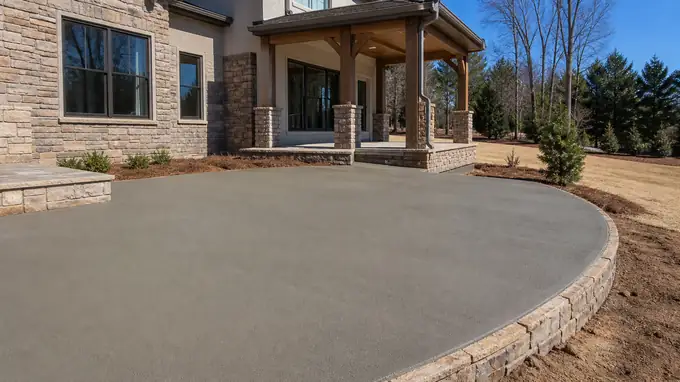
concrete slab installation completed by a local contractor at a stacked-stone and stucco home in Alpharetta, GA, in clear late-morning sun.

Concrete Slab Installation Cost

What sets the cost of a slab is mostly what sits under it. A flat yard with firm ground goes quickly. A sloped lot means cutting, filling and compacting before a form goes down, and Fulton County carries 241 feet of local relief within a few miles. Thickness, reinforcement, stamp pattern, color and sealer add to it too. We walk the property, test the ground, and price the job from what we find there.


concrete driveway installation completed by a local contractor at a charcoal farmhouse-modern home in Alpharetta, GA, in late afternoon light.

Concrete Driveway Installation

A driveway carries more weight than anything else we pour. We build it thicker than a patio and set rebar on chairs so the steel sits mid-slab instead of lying in the dirt. Driveways usually fail at a thin apron or over a base nobody compacted. With about 50 inches of rain a year, we pitch the surface to shed water and cut control joints early, before cracks choose their own lines.

concrete flooring installation completed by a local contractor at a painted-white-brick two-story home in Alpharetta, GA, in early morning light.

Concrete Flooring Installation

Inside a garage, basement or workshop, a concrete floor has different jobs than a patio. We lay a vapor barrier over compacted stone so ground moisture stays out of the slab. Then we power trowel it smooth, or stamp and stain it for a finished room. The common mistake is rolling a coating onto a floor that is still damp underneath. We let the slab cure fully and test for moisture before any sealer or epoxy goes down.

concrete slab repair completed by a local contractor at a red-brick ranch home in Alpharetta, GA, at blue hour.

Concrete Slab Repair

Cracks, sunken sections and flaking stamped surfaces all have a cause, and the cause decides the fix. The median home here was built in 1996, so plenty of original patios and walks have settled over fill that was never compacted, or beside a downspout emptying at the edge. A hairline shrinkage crack can be routed and sealed. A slab that has dropped or heaved needs the section cut out, the base rebuilt, and new concrete doweled in.

How a Stamped Concrete Installation Job Runs in Alpharetta

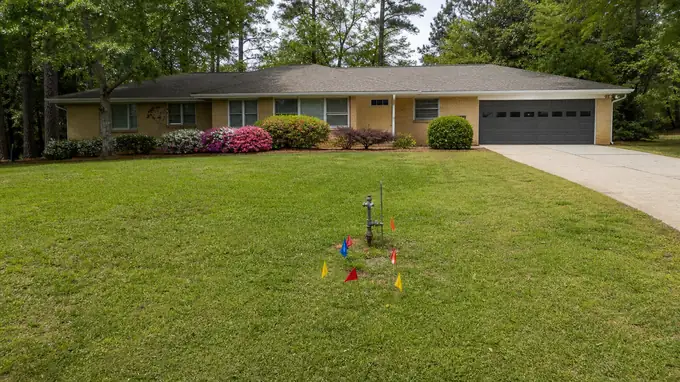
Utility flags mark buried lines before digging starts. at a buff-brick ranch home in Alpharetta, GA, under bright midday cloud.

Step 1: Site Assessment

We start by walking the property with a level and a probe. Fulton County is hilly, with 241 ft of local relief within a few miles, so we check how water leaves the spot you want stamped and where it goes next. Rion soil drains well across much of the county, but it changes block to block, so we test yours. The median home here was built in 1996, which means we also look for settled walks, buried downspouts and old tree roots.

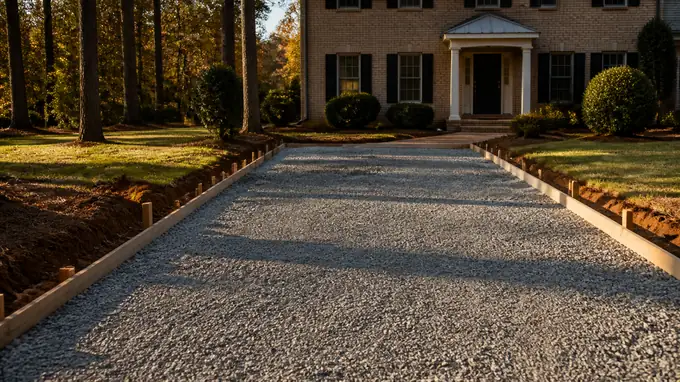
Crushed stone base is raked level inside driveway forms. at a tan-brick colonial in Alpharetta, GA, in late afternoon light.

Step 2: Site Preparation

Excavation comes next. Sod, topsoil and anything organic come out until we reach firm subgrade, which we compact before placing a crushed stone base in lifts rather than all at once. With about 60" of rain a year, slope matters more than most people expect, so we set a fall away from the house before any form goes in. Soft spots get dug out and replaced. Covering them over is how slabs sink.

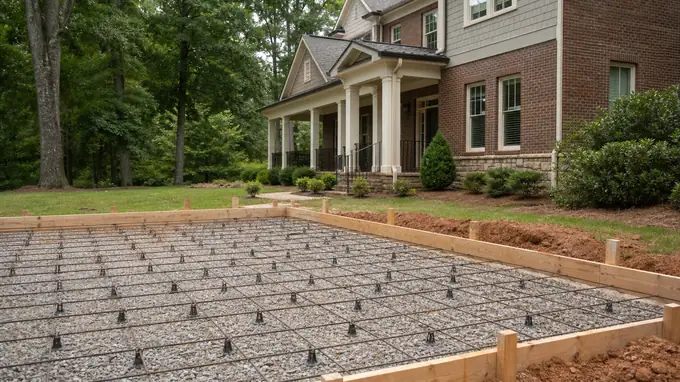
A worker ties rebar into a grid before a residential pour. at a brick-and-siding two-story home in Alpharetta, GA, under bright midday cloud.

Step 3: Forming & Reinforcement

Forms go in from straight lumber or steel, staked tight and checked with a string line, since a stamped surface shows every wobble along its edge. Curves get bender board. Reinforcement is rebar tied in a grid and held up on chairs so it sits in the middle of the slab, not on the dirt where it does nothing. Driveways get thickened edges. We also mark where every control joint will fall.

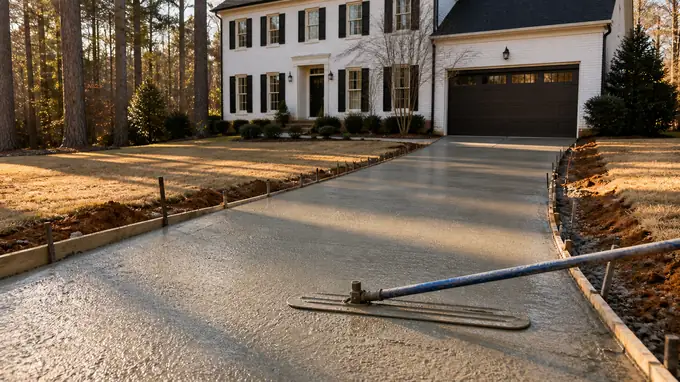
A bull float smooths a residential walkway surface after screeding. at a painted-white-brick two-story home in Alpharetta, GA, in late afternoon light.

Step 4: Pouring

Once the forms pass a final check, the truck backs in. A good pour depends on the right mix, so we order strength, slump and air content for the job and turn away a load that shows up wrong. Integral color goes in at the plant for an even tone all the way through. We place, screed and bull float quickly, because stamped concrete gives a narrow window before the surface gets too stiff to print.

A hand trowel smooths a small patio surface to a hard finish. at a stacked-stone and stucco home in Alpharetta, GA, in clear late-morning sun.

Step 5: Finishing

Timing is the whole trade here. We broadcast color hardener, trowel it in, then apply release agent so the mats lift clean and leave antiqued highlights. Mats go down in sequence (ashlar slate, cobblestone, wood plank or whatever pattern you picked) and each one gets tamped. Stamp too early and the pattern slumps. Too late and it tears. Edges and corners are detailed by hand with texture skins, and control joints get cut before the slab can crack on its own.

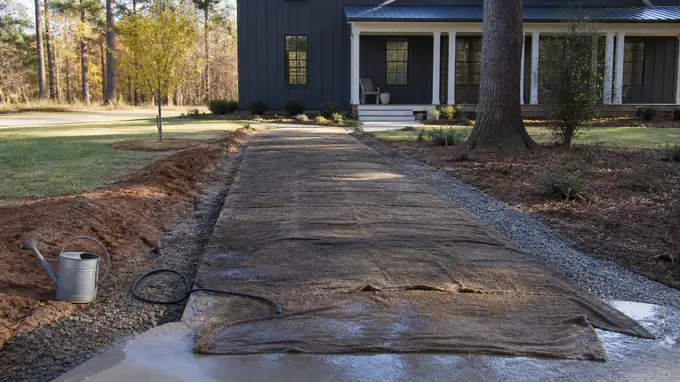
Damp burlap covers a small slab section during curing. at a charcoal farmhouse-modern home in Alpharetta, GA, under low winter sun.

Step 6: Curing

Concrete gains strength slowly, and most of what goes wrong with stamped work starts here. We keep the surface from drying too fast, using a curing method that suits the release agent and the weather. Hot afternoons, wind and a sudden shower all change the plan. Foot traffic comes first, then light use, then vehicles. We tell you when your driveway can take a car, and waiting a few extra days beats a cracked slab.

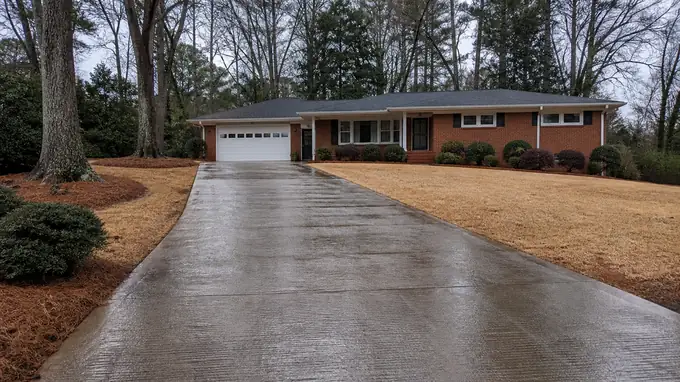
A sprayer applies sealer across a driveway. at a red-brick ranch home in Alpharetta, GA, after a rain shower.

Step 7: Sealing

After curing, we pressure-wash off the leftover release agent and let the surface dry out fully. Sealing over trapped moisture turns a clear coat cloudy white, which is the most common way stamped work goes wrong. We roll on an acrylic sealer in thin coats, adding a slip-resistant grit where people walk barefoot or near a pool. The sealer deepens the color and brings out the pattern, and it needs a fresh coat over time.

Choosing the Right Concrete System

A stamped surface is only as good as the slab under it, so we choose the system from the ground up. That means the base, the thickness, the reinforcement, the color method and the sealer, picked together for how the slab will be used. A patio that sees chairs and foot traffic needs a different build than a driveway carrying two cars every day. We walk you through each layer before anything is poured, and we write down what goes in so you know exactly what you are getting.

Site conditions decide most of it. Fulton County is hilly, with about 241 feet of relief within a few miles, and the grade can change from one block to the next. Rion soil is the most common type here and it drains well, but it is not the only one, so we test every site before we settle on a base. Around 50 inches of rain a year means a sloped yard needs a slab that sheds water where you want it, not toward the house. Steeper lots may call for a stepped slab.

Early failures usually trace back to a slab built for looks alone. Skip the reinforcement and a crack can open wide across the pattern, where no color hides it. Put a dark color down without a good sealer and it fades unevenly. We place control joints inside the grout lines so any crack follows the design instead of crossing a stone. The median home here was built in 1996, so many properties already have older flatwork beside the new pour, and we match the grade so the two meet cleanly.

Stamped Concrete Installation Pricing in Alpharetta, GA

Two stamped patios of the same size on the same street can price very differently, and the reasons are mostly things you can walk outside and check yourself. We look at all of them before we write a number down, so here is what moves it.

What changes the priceWhich wayWhy
An old slab, pavers or gravel already in placecosts moreIt has to be broken out and hauled off, and the base under it checked, before new work starts.
How a truck reaches the pourcosts more when blockedIf the mixer cannot back up to the forms, the concrete gets pumped or wheeled in, which adds equipment and labor.
Slope across the areacosts more on a pitchFulton County is hilly and it varies block to block, so a sloped yard may need cutting, fill or a formed step before the slab goes in.
Where water sits after a stormcosts more if it poolsWith about 50 inches of rain a year, the surface has to fall away from the house, and sometimes that means adding a drain.
Thickness and reinforcementcosts more for vehicle loadsA driveway that carries cars needs more depth and steel than a patio or walkway.
Number of colors and borderscosts moreEach release color, accent band or hand-tooled edge is another pass while the concrete is still workable.
Tree roots and buried linescosts moreRoots get cut back and irrigation or lighting lines moved before we dig.

When you compare bids, put them side by side on the details. Each one should state slab thickness, the type of reinforcement, how deep the base is, how many colors, which sealer, and whether demolition and haul-off are included. A low number that leaves out the base is not the same job.

Get a Free Estimate

Get a FREE Quote

Tap to call +1 470-260-7028