
+1 470-260-7028
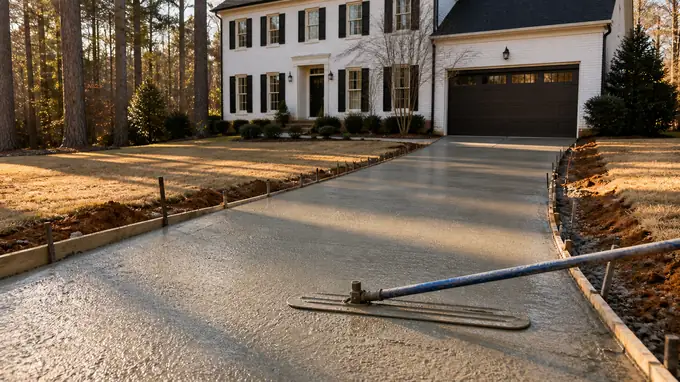
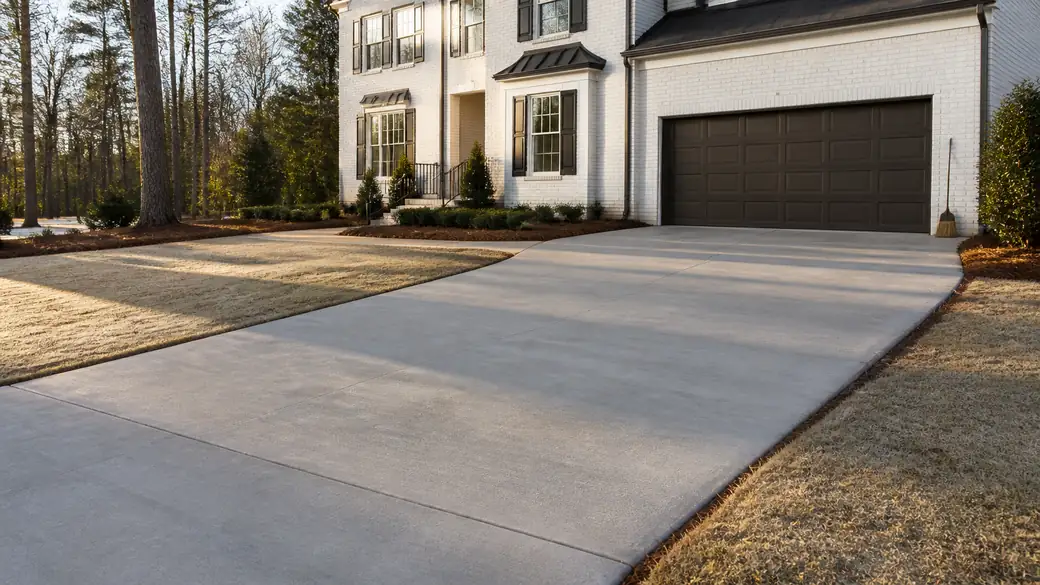
A finished concrete driveway sweeping from the street to the garage, clean-edged and evenly toned in the sun. at a grey split-level home in Alpharetta, GA.

Polished Concrete Floors in Johns Creek, Georgia

A polished concrete floor is usually the slab you already have, ground flat and honed until the surface holds a clean, even sheen. We cut through the top layer with diamond tooling, harden the concrete with a densifier, then work up through finer grits until the floor reads the way you want it: a soft satin in a residential basement, a brighter gloss in a showroom or office. Nothing is laid on top, so there is no coating to peel. The finish is the concrete itself. That is why it suits Johns Creek homes and commercial property alike, in garages, living spaces and busy entryways.

Most problems with polished floors start before the first pass. A slab with cracks, patchy repairs or an old glue line will show every one of them once it is polished, because grinding exposes the concrete rather than hiding it. So we look hard at the slab first: how flat it is, how sound, what has been spilled or stuck to it over the years. Some floors need crack repair or a heavier first grind to take down high spots. A few are better served by a different surface, and we say so. If you have a slab you are wondering about, call for a free estimate.

Call +1 470-260-7028

Get a FREE Quote

Our Concrete Work Around Johns Creek

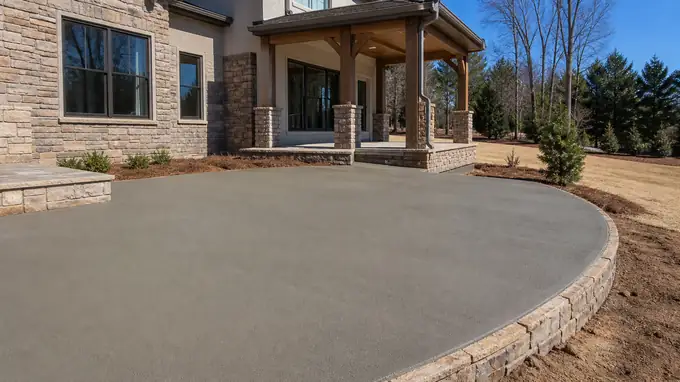
concrete slab installation completed by a local contractor at a stacked-stone and stucco home in Alpharetta, GA, in clear late-morning sun.

Concrete Slab Installation Cost

What moves the number on a slab is mostly underneath it. Thickness, how much base stone the ground needs, whether the slab gets wire mesh or rebar, and how far the truck has to pump all show up in the estimate. The dominant soil here is Rion, which drains well, but it varies from lot to lot. So we test every site before we price the work. A shed pad and a garage floor are not the same job, and the estimate says why.


concrete driveway installation completed by a local contractor at a charcoal farmhouse-modern home in Alpharetta, GA, in late afternoon light.

Concrete Driveway Installation

Most driveway failures start at the edges and the apron, where tires load concrete that was poured too thin or over soft fill. We compact the base, thicken the edges, and set rebar on chairs so it sits in the middle of the slab instead of the bottom. Control joints are cut so cracks follow our lines. With about 60" of rain a year, we pitch every driveway to shed water away from the garage.

concrete flooring installation completed by a local contractor at a painted-white-brick two-story home in Alpharetta, GA, in early morning light.

Concrete Flooring Installation

Inside a house or a shop, the slab is the finished floor, so the pour has to be flatter and denser than anything outdoors. We lay a vapor barrier under it, place the concrete, and trowel it hard. Polished floors are ground in stages with progressively finer diamonds, then densified and sealed. Stained floors skip the heavy grinding. What goes wrong is usually moisture coming up through a slab that never had a barrier.

concrete slab repair completed by a local contractor at a red-brick ranch home in Alpharetta, GA, at blue hour.

Concrete Slab Repair

Not every cracked slab needs to come out. Hairline shrinkage cracks can be routed and sealed. A settled section can sometimes be lifted, and a broken panel between joints can be cut out and repoured with dowels tying it to the concrete around it. We look at why it failed first: a washed-out base, a downspout emptying against the edge, roots, or no reinforcement at all. Patching over the cause just means repairing it again.

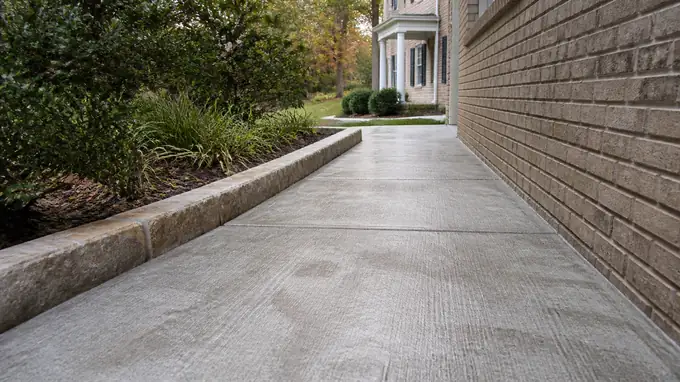
concrete sidewalk installation completed by a local contractor at a tan-brick colonial in Alpharetta, GA, under bright midday cloud.

Concrete Sidewalk Installation

Walks look simple, which is why the details get skipped. We form them straight, compact the base, and cross-slope the surface slightly so water runs off instead of sitting. Joints go in at regular spacing, and we isolate the walk where it meets the driveway or steps so each can move on its own. A broom finish gives footing in the wet; stamped or exposed aggregate can match a nearby patio.

Our Warranty and Guarantee in Johns Creek

Anything we pour or polish in Johns Creek has to hold up long after the crew leaves, so we put our effort into the part you never see. Fulton County's dominant soil is Rion, which is well drained, but it varies across the county. That is why every site is tested individually before work starts. A polished floor is only as good as the slab under it, and a slab is only as good as the ground and reinforcement under that. We would rather spend an extra morning on preparation than hand over a surface that looks right on day one and tells a different story later.

Water is the other thing we plan around. The area sees about 50 inches of rain a year, and a slab that sheds it badly shows it at the edges and joints first. We set drainage, joint placement and reinforcement for the property in front of us, not from a template. Ask us anything about how your floor, driveway or patio is built: the materials, the mix, why a joint sits where it does. We think a homeowner who understands the construction is the best judge of it, and we would rather be measured by the work than by paperwork. Call for a free estimate and see for yourself.

How a Concrete Job Runs in Johns Creek

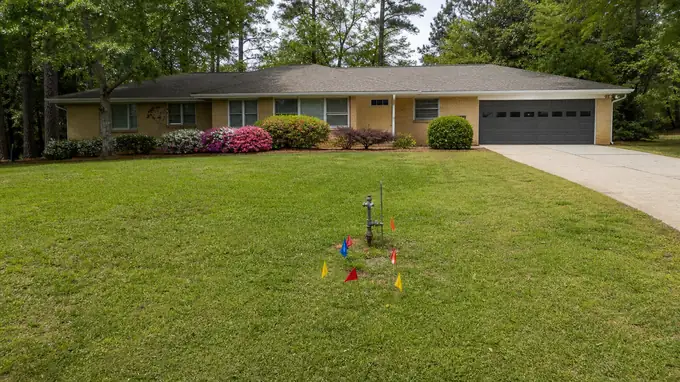
Utility flags mark buried lines before digging starts. at a buff-brick ranch home in Alpharetta, GA, under bright midday cloud.

Step 1: Site Assessment

We start on the ground, not on paper. Rion soil, which drains well, is Fulton County's dominant type, but it varies across the county, so every site gets tested before work starts. We probe the subgrade, watch where water runs off the roof and across the yard, and look for old fill, stumps and buried lines. For an interior polished floor, we check the existing slab for cracks, moisture and leftover adhesive.

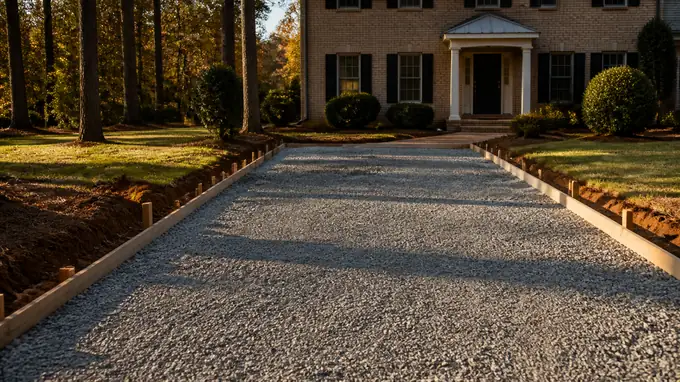
Crushed stone base is raked level inside driveway forms. at a tan-brick colonial in Alpharetta, GA, in late afternoon light.

Step 2: Site Preparation

Digging out comes next. We strip topsoil and organic material down to firm subgrade, then bring in crushed stone for the base and compact it in lifts with a plate compactor. Soft spots get dug out and replaced, not covered over. With about 50 inches of rain a year, grade matters: we set a gentle fall away from the house so water leaves the surface instead of pooling against the foundation.

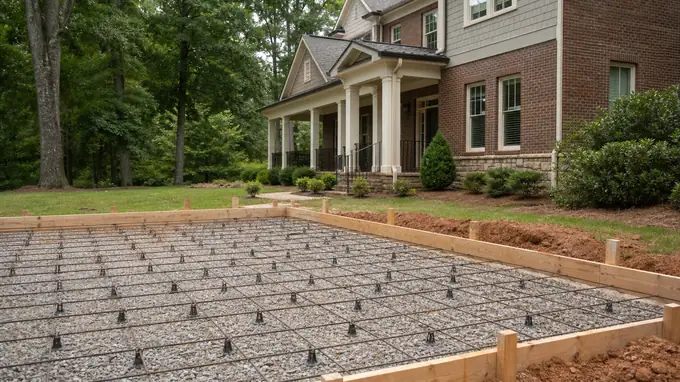
A worker ties rebar into a grid before a residential pour. at a brick-and-siding two-story home in Alpharetta, GA, under bright midday cloud.

Step 3: Forming & Reinforcement

Forms are straight lumber or steel, staked and checked against a string line so the edges come out true. Inside them, reinforcement depends on the job. Driveways that carry vehicles get rebar tied on a grid and set on chairs, so it sits in the middle of the slab rather than on the dirt, where it does nothing. Patios and walks may use welded wire mesh or fiber. Control joint locations are marked before any concrete arrives.

A bull float smooths a residential walkway surface after screeding. at a painted-white-brick two-story home in Alpharetta, GA, in late afternoon light.

Step 4: Pouring

Ready-mix comes from the plant batched to the strength the project needs, and we check the slump at the truck. Adding water on site makes concrete easier to place and weaker at the surface, so we don't do it. The crew places the mix, works it tight against the forms, and screeds it flat. Pouring runs without long breaks, because a slab left half-placed forms a cold joint that tends to crack later.

A hand trowel smooths a small patio surface to a hard finish. at a stacked-stone and stucco home in Alpharetta, GA, in clear late-morning sun.

Step 5: Finishing

Timing is most of finishing. After screeding, we bull float the surface and wait for the bleed water to leave before touching it again. Working it too early traps water near the top, and that shows up later as flaking. Outdoors we cut control joints, give driveways a broom finish for grip, or press stamped patterns into decorative patios. On a polished floor, the work continues later with diamond grinding through progressively finer grits.

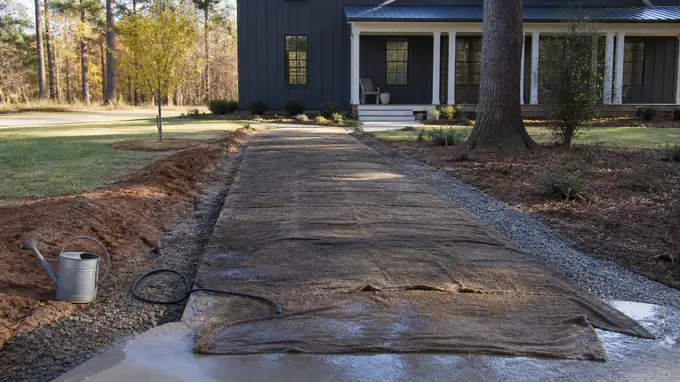
Damp burlap covers a small slab section during curing. at a charcoal farmhouse-modern home in Alpharetta, GA, under low winter sun.

Step 6: Curing

Concrete keeps gaining strength for weeks after the pour, and it needs moisture to do it. A slab that dries out too fast loses surface strength and develops fine shrinkage cracks. We apply a curing compound or cover the surface to hold water in through the early days. Foot traffic can usually come onto a slab well before vehicles can. Driveways wait the longest, since they carry the heaviest loads they will ever see.

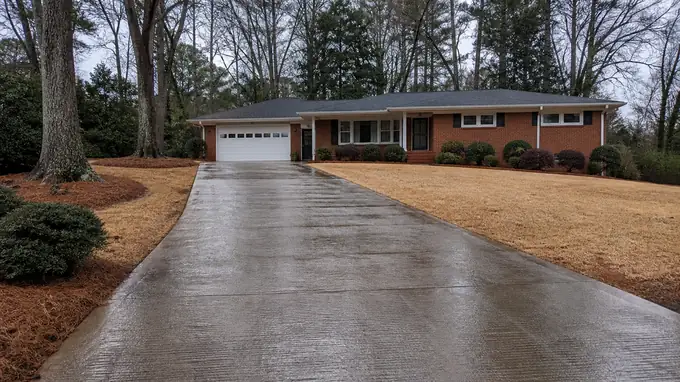
A sprayer applies sealer across a driveway. at a red-brick ranch home in Alpharetta, GA, after a rain shower.

Step 7: Sealing

Sealing is the last coat and the one people notice. Once the slab has cured, we clean it and apply a sealer matched to the surface. Stamped and decorative concrete usually gets a film-forming sealer that deepens the color. Broom-finished driveways often get a penetrating sealer that resists stains without making the surface slick. Polished floors get a densifier during grinding and a guard coat afterward. Resealing every few years keeps the protection working.

The Concrete Options Available in Johns Creek

Polished floors are the heart of what we do, but they sit alongside the other surfaces a Johns Creek property tends to need. Inside, that means ground and polished slabs for basements, garages and commercial spaces, finished to a matte, satin or high gloss. Outside, it means driveways, patios and walkways, poured plain, broom finished, stamped or colored. Decorative work covers the rest: exposed aggregate, scored patterns and stained surfaces that pick up the lines of the house. Most jobs mix two or three.

Choosing between them starts with how the space gets used. A garage floor takes hot tires, dropped tools and oil, so we lean toward a dense polish with a sealer that shrugs off stains. A patio sees bare feet and wet leaves, so texture matters more than shine. Driveways carry weight, and we set the reinforcement and slab thickness to the load rather than to habit. Seeing a sample in your own light settles most of these decisions faster than any brochure.

What goes wrong usually goes wrong underneath. A polished finish shows every flaw in the slab it sits on, so cracks, patches and uneven curing all come through the gloss. Water is the other thing to plan for. This area sees about 50 inches of rain a year, and a surface laid without proper slope and joints will hold it. Rion soil drains well across much of Fulton County, but it varies, so we test every site before any materials arrive.

How Much Does Concrete Cost in Johns Creek?

Price depends on what we find on your property. Most of what moves the number is visible if you walk your own slab or yard with a flashlight and a tape measure, and knowing it ahead of time makes any estimate easier to read.

What changes the priceWhich wayWhy
Carpet glue, tile mastic or paint on the existing floorcosts moreEvery layer has to be ground off before polishing starts, and old adhesive wears through diamonds quickly.
Cracks, spalls and low spots in the slabcosts moreEach one gets filled or patched first. Polishing shows every flaw it passes over.
An existing slab that is sound and flatcosts lessNo pour, no forms, and fewer grinding passes to reach a clean surface.
Old concrete, footings or roots where a new slab goescosts moreBreakout and haul-off come before any new construction can begin.
Distance from the street to the pourcosts more the farther it isA truck that backs up to the forms saves a pump or a crew moving concrete by wheelbarrow.
Thickness and reinforcement the floor needscosts more for heavier useA shop floor carrying vehicles needs more depth and more steel than a sunroom.
Water that pools after raincosts moreWith about 50 inches of rain a year, a low site needs grading or a drainage base under the slab. Soil varies across Fulton County, so we test every site before work starts.
How much stone you want showing, and how high the shinecosts more as both go upDeeper exposure means deeper grinding, and every added grit step is another pass over the whole floor.

When you compare bids, check that each one names the slab thickness, the reinforcement, the number of grinding steps and the final grit, and whether removal, haul-off, densifier and sealer are included. A lower number that leaves those out is not a lower price.

Get a Free Estimate

Get a FREE Quote

Tap to call +1 470-260-7028