+1 470-260-7028
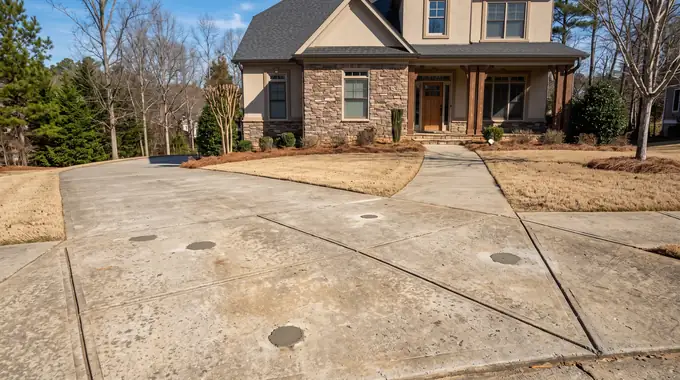
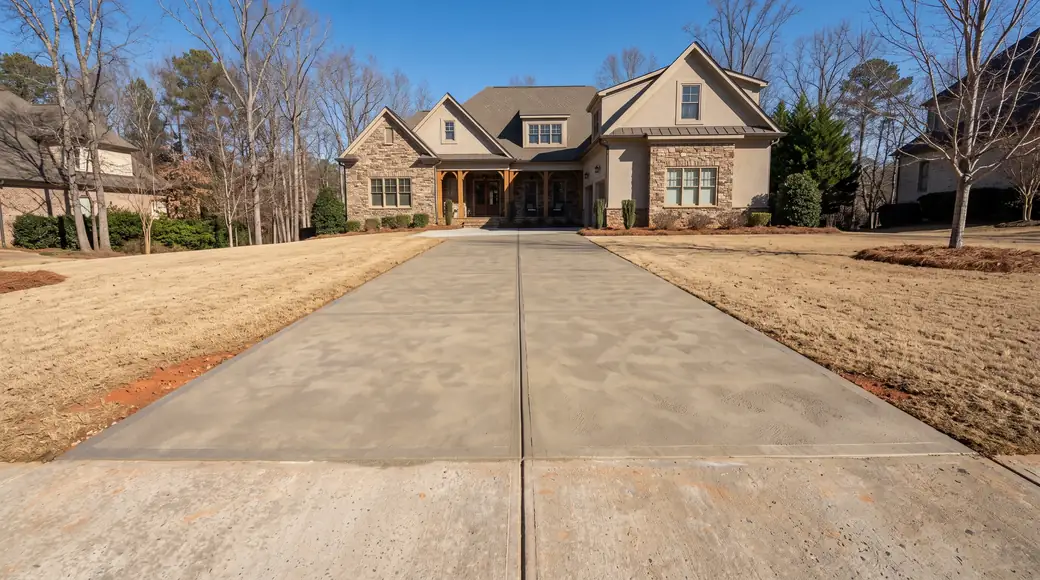
Replaced concrete driveway panel with clean saw-cut edges at a stacked-stone and stucco home in Alpharetta, GA, in clear late-morning sun.

Repair, Leveling & Resurfacing in Alpharetta, GA

Concrete that has sunk, cracked or worn down does not always need to come out. A sidewalk that catches a toe can often be ground or lifted flat again. We repair, level and resurface driveways, sidewalks and patios across Alpharetta, and the first thing we work out is whether the base under the slab is still doing its job. If it is, a lift or a new surface will hold. A tired patio can take stamped concrete over the top instead of a full tear out.

Most of what we see here is age. The median Alpharetta home was built in 1996, so a lot of original flatwork is now thirty years old, and that is about when a sidewalk panel starts to lift at the joint, a driveway cracks along the wire mesh, and a patio surface goes chalky underfoot. Some of it moved. Some of it simply wore. Neither one means the concrete is past saving.

Pick a concrete contractor who will tell you honestly when repair is the wrong call, because sometimes it is, and a patched slab over a failed base fails again. The answer is not always the one that sells more concrete. We walk the pour with you, mark what we would fix and what we would replace, and explain the difference. Call for a free estimate on anything from a single sidewalk panel to a full driveway resurface.

Call +1 470-260-7028

Get a FREE Quote

Repair, Leveling & Resurfacing: What the Work Covers

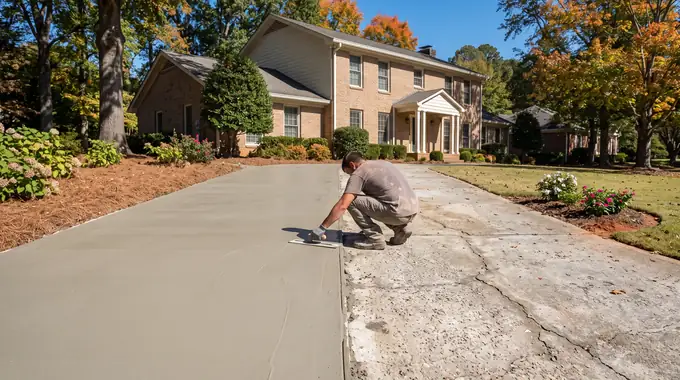
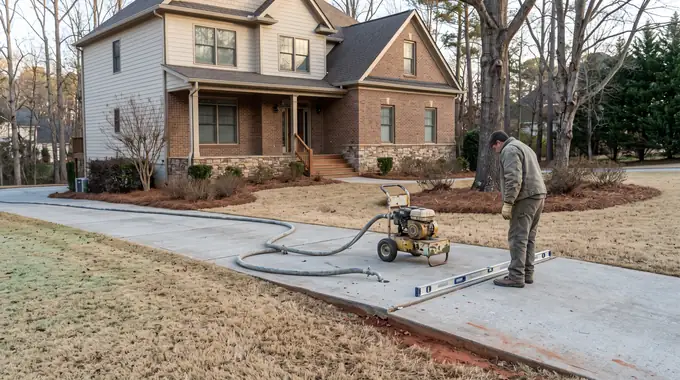
Thin concrete overlay being troweled onto an old worn slab at a tan-brick colonial in Alpharetta, GA, in clear late-morning sun.

Concrete resurfacing

Resurfacing puts a new wear layer over concrete that is sound underneath but ugly on top. We grind or shot blast the surface, patch spalls, then bond an overlay a quarter inch or so thick. Broom finish, stamped concrete, or color, depending on what the slab is doing. If the base is cracked through or rocking, an overlay just cracks again in the same line.
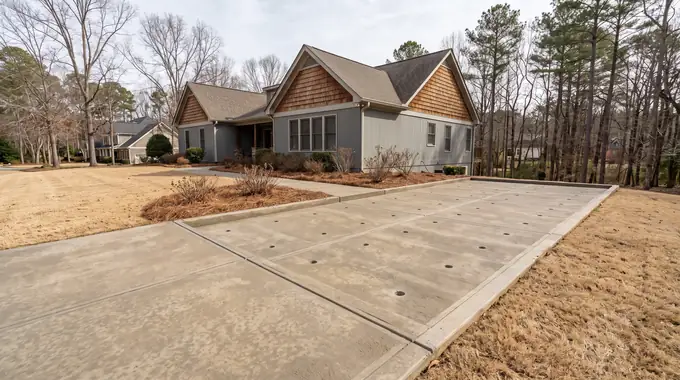
Sunken concrete slab with small drill holes for leveling at a grey split-level home in Alpharetta, GA, under bright midday cloud.

Concrete leveling

Leveling brings a settled slab back to grade instead of tearing it out. We drill small ports through the concrete, pump material underneath until the slab rises, then patch the holes. It works on a driveway panel that has dropped at the joint, a sidewalk that ponds water, or a garage floor pitched toward the house. Slabs that are broken into several loose pieces need replacement, not lifting.

Slab-jacking pump lifting a sunken concrete slab back level at a brick-and-siding two-story home in Alpharetta, GA, in early morning light.

Concrete lifting

Lifting handles the trip hazard where one sidewalk panel sits above the next. Polyurethane foam goes in through five-eighths inch holes, expands, and pushes the panel back into plane, usually within a fraction of an inch. Foam is light and cures fast, so a concrete sidewalk carries foot traffic the same day. We check the cause first: a washed-out base or a root under the concrete will lift again.

Concrete slab leveled with small patched holes from mudjacking at a stacked-stone and stucco home in Alpharetta, GA, in clear late-morning sun.

Mudjacking

Mudjacking is the older method, and it still makes sense on heavy slabs. A slurry of sand, soil and portland cement is pumped through inch-and-a-half to two-inch holes to fill the void and raise the concrete. It costs less material per void than foam and holds well under thick commercial concrete. The holes are larger and the slurry adds weight, which matters on poorly compacted fill.

What Alpharetta Properties Need From Repair, Leveling & Resurfacing

The median house in Alpharetta was built in 1996, and a lot of the concrete we look at is the concrete that came with the house. Original driveway, original walks, original patio slab. Flatwork that age is usually not failed, just tired: joints have opened, corners have settled, the surface has lost its top layer in places. Some of it was poured with wire mesh instead of rebar, and mesh that sank to the bottom of the pour never carried anything.

Most of what we do is flatwork: driveways, sidewalks, patios, steps, and the slabs behind commercial buildings where delivery trucks have pushed a corner down. A settled section can often be lifted back to grade instead of torn out. A surface that is sound but ugly can take a resurfacing coat, stamped or colored to sit right with the house. A slab broken across the middle with soft ground under it should come out, and we will say so. Nobody gains from patching concrete that has already lost its base.

We cover Alpharetta and the metro Atlanta towns around it on the same terms, the same crew and the same mix, whether the address is here or over in Roswell. Residential and commercial both. If you are not sure whether your driveway wants repair or replacement, walking it with you and reading the cracks settles the question faster than guessing from photos. We would rather tell you a slab has another good stretch left in it than sell you a tear-out. Call for a free estimate and tell us what the concrete is doing.

How a Repair, Leveling & Resurfacing Job Runs in Alpharetta

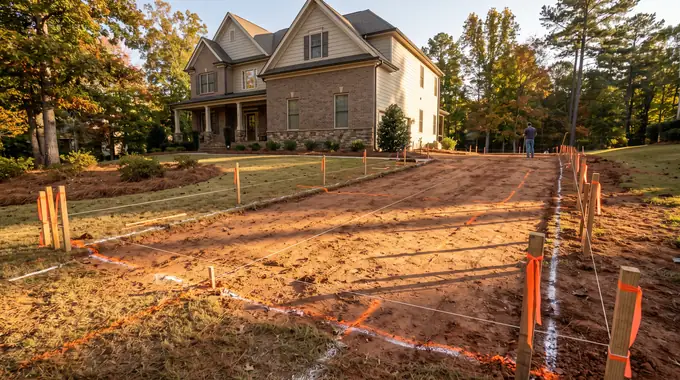
String lines and grade stakes laid out across a yard before a pour at a brick-and-siding two-story home in Alpharetta, GA, in late afternoon light.

Step 1: Site Evaluation

We start on the slab itself. We measure how far each panel has dropped, check cracks and joints for width and movement, and sound the surface for hollow spots where the base has washed out underneath. Water tells us most of it: where it sits, where it runs, whether a downspout dumps against the edge. Then we read thickness and reinforcement at a broken edge, since that decides whether a section is worth saving.

Settled garage approach slab the estimate would price to replace at a tan-brick colonial in Alpharetta, GA, in clear late-morning sun.

Step 2: Written Estimate and Permits

Everything goes in writing before work begins: the sections being lifted, ground, patched or replaced, the finish, and the reinforcement. Repair and resurfacing on existing sidewalks and driveways often needs no permit, and we say plainly when a job crosses into full replacement or new concrete installation that does. Permits get pulled and inspections scheduled where the work requires them. You keep a copy of the scope so nothing changes shape mid-job.

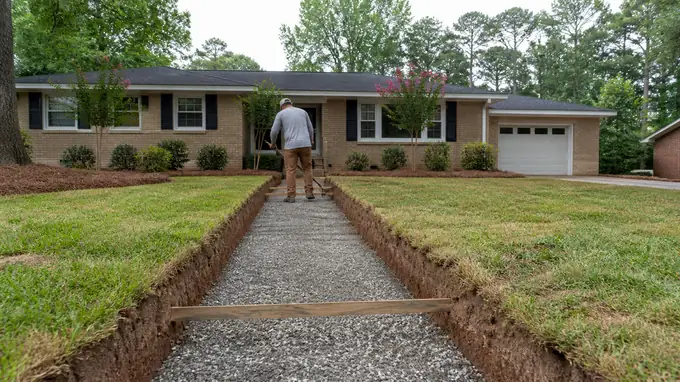
Front walkway removed and the trench squared out for a new pour at a buff-brick ranch home in Alpharetta, GA, under an overcast sky.

Step 3: Demolition and Base Prep

Demolition starts with a saw cut, so the seam between old and new lands on a clean straight line instead of a ragged break. The broken slab comes out and gets hauled off. Underneath, we dig out soft or washed material, then rebuild the subgrade with compacted graded aggregate base, running a plate compactor over it in lifts. Bad base is what cracked the last slab. Skipping it just repeats the failure.

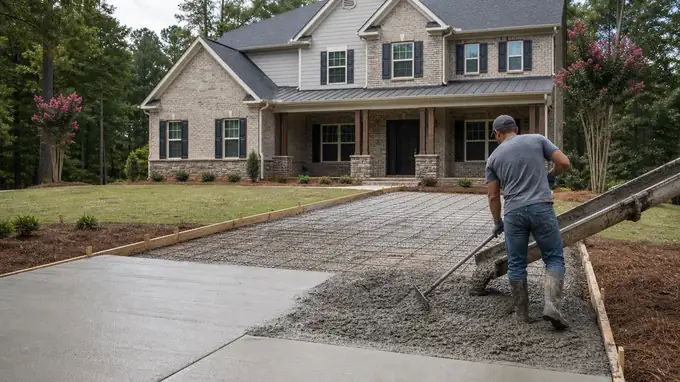
Concrete coming down the chute into formed driveway bays at a brick-and-siding two-story home in Alpharetta, GA, after a rain shower.

Step 4: Forming, Steel and the Pour

Forms go in on grade and string line, braced so nothing bellies out under the weight of wet mud. Steel depends on the pour: welded wire mesh on chairs for walkways, half inch rebar on a grid for a concrete driveway or anything carrying vehicles. Flatwork runs four inches, driveways five to six. We place the mix, screed it, bull float, and tool control joints at spacing that matches the slab.

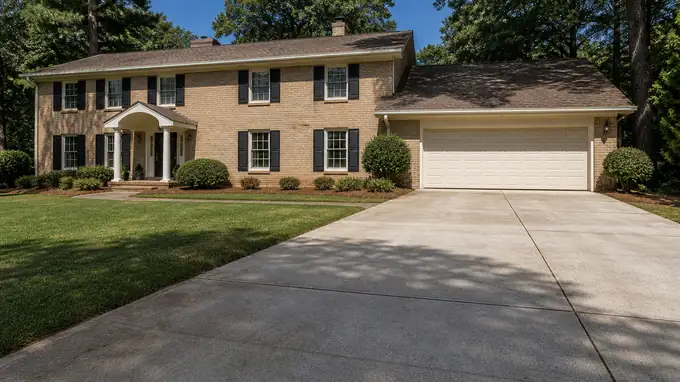
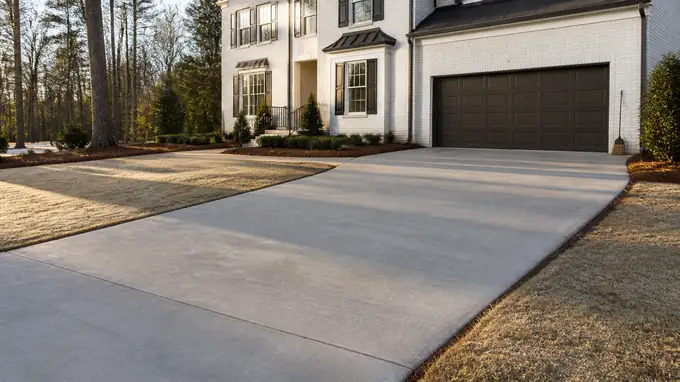
Cured driveway swept clean with the forms stripped away at a painted-white-brick two-story home in Alpharetta, GA, in early morning light.

Step 5: Finishing, Curing and Final Walkthrough

Finish is your call: broom texture for grip, stamped and colored to a pattern, or exposed aggregate washed back to the stone. Curing matters more than most people expect, so slabs get sealed or kept damp while they gain strength, and we tell you how long to stay off. Last, we walk the job with you, check joints, edges and drainage, and clean the surrounding surfaces before we pull out.

What Decides the Price of Repair, Leveling & Resurfacing

Two driveways of the same square footage can take very different amounts of work, and most of that difference is already sitting on your property where you can see it. Walk the job before you call anyone. These are the things that move the number.

What changes the priceWhich wayWhy
Old slab still in the groundCosts moreBreaking out and hauling concrete is its own day of labor before any new work starts.
Where a truck can parkCosts less when closeA chute reach beats wheelbarrowing or pumping around a house, a fence line, or a steep side yard.
Slab thickness the use calls forCosts more when thickerA patio walked on and a driveway parked on by a loaded truck are not the same pour.
Rebar mat instead of wire meshCosts moreRebar on chairs takes material and tying time, and some slabs genuinely need it.
Base under the failing concreteCosts more when washed outSoft or voided base has to be dug out and compacted, or the new work moves the same way the old work did.
Where water goes after rainCosts more when it poolsRegrading and drainage add work, and skipping it shortens the life of everything above it.
Stamped, colored, or exposed aggregate finishCosts more than broomMore material, more hands on the slab, and a tighter window to get it right.
Roots, irrigation lines, or utilities in the pathCosts moreThey have to be found, protected, or relocated by hand.

Compare bids line by line: slab thickness, rebar or mesh, how deep the base gets prepared, control joint spacing, whether tear-out and haul-off are in the number or added later. Two quotes that look far apart usually differ on one of those.

Repair, Leveling & Resurfacing: Questions We Are Asked Most

Will a resurfaced Alpharetta slab match the concrete next to it?

No, not exactly. A resurfacer goes down over concrete that has weathered for years, so the new layer reads cleaner and slightly different in tone. We can color it to sit close, and stamped or broom finishes hide the transition well. Where an exact match matters, the honest answer is to resurface the whole run rather than one panel of it.

What causes concrete to sink in Alpharetta, Georgia?

Concrete sinks when the ground under it moves. Fill that was never compacted properly settles over time, water finds a path along a downspout or a bad grade and washes soil out from beneath the slab, and tree roots decay and leave voids. The slab itself is usually fine. It is the base that failed, which is why lifting works.

How does concrete lifting work, and does it last in Georgia?

We drill small ports through the slab, pump material into the void underneath, and the slab rises back to grade. The holes get patched. It lasts as long as the ground stays put, so the drainage that caused the settling has to be corrected at the same time. Lift a slab and leave the downspout dumping beside it, and you will be back.

Is repair cheaper than replacement for a Alpharetta driveway?

Usually, yes. Lifting a settled section or resurfacing a worn one costs less than demolition, hauling, new base, rebar or wire mesh, and a fresh pour. The math turns when damage runs deep: a slab broken into many pieces, or one with a base that has washed out across most of its length. We tell you which one you have before anything starts.

How soon can we walk on repaired concrete in Georgia weather?

Depends on the repair. A lifted slab takes foot traffic within hours because the material cures under the concrete, not on top of it. A resurfaced driveway needs a day or so before walking and considerably longer before a vehicle. Heat speeds curing, rain and cold slow it, and we give you the actual number for your pour.

Is my Alpharetta concrete worth repairing, or should it be replaced?

Look at what is failing. Hairline cracks, surface scaling, a settled panel or two, uneven joints: all repairable, often for years more service. Widespread spiderweb cracking, crumbling edges, sections that rock underfoot, or a slab poured too thin with no reinforcement point to replacement. Much of the housing here dates to around 1996, and original flatwork from that era is at the age where it goes one way or the other.

Get a Free Estimate

Get a FREE Quote

Tap to call +1 470-260-7028