
+1 470-260-7028
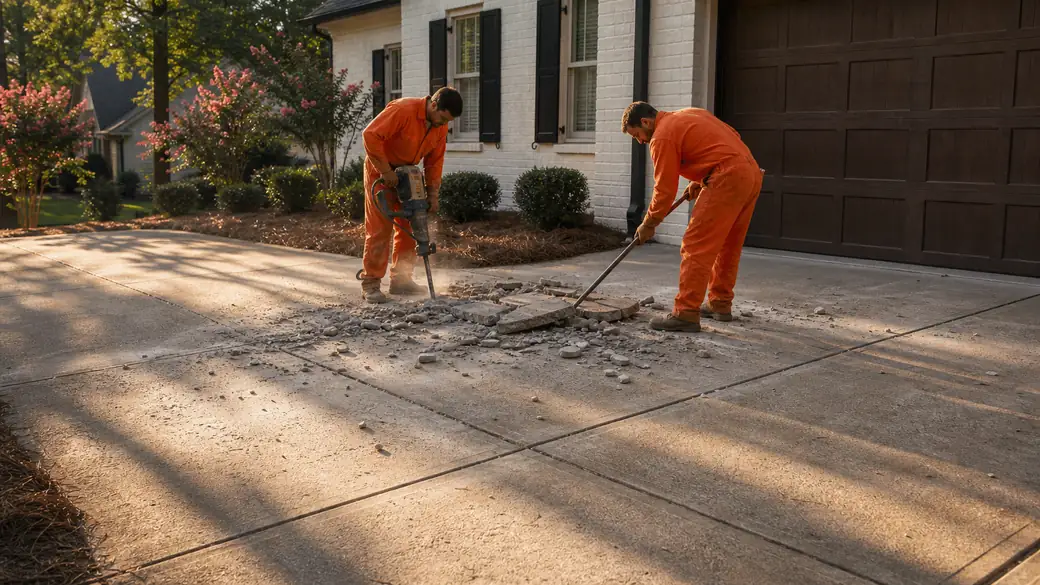
concrete demolition and removal completed by a local contractor at a painted-white-brick two-story home in Alpharetta, GA, in late afternoon light.

Concrete Demolition And Removal in Alpharetta, GA

Concrete demolition and removal is the part of a project nobody sees once it's finished, and it decides how well the new work holds. We break out old driveways, patios, walkways and slabs, haul the debris off the property, and leave a clean, graded base ready for whatever comes next. In Alpharetta, where the median home was built in 1996, plenty of that concrete is original to the house. Some of it has cracked, heaved or settled. Some of it is simply in the wrong place for how the family uses the yard now. Either way, it has to come out cleanly before anything new goes in.

The ground under a slab tells us more than the slab does. Fulton County is hilly, and it changes from one block to the next, so every site is graded and tested on its own before the first cut. Rion soil drains well across much of the county, though not everywhere, and with about 50 inches of rain a year, how water moves off a freshly exposed base matters. We saw-cut wherever an edge has to stay straight, protect the landscaping and the parts of the house we work beside, and handle the permit when the job needs one. Call for a free estimate.

Call +1 470-260-7028

Get a FREE Quote

Our Concrete Demolition And Removal Work in Alpharetta

concrete slab installation completed by a local contractor at a stacked-stone and stucco home in Alpharetta, GA, in clear late-morning sun.

Concrete Slab Installation Cost

What a slab costs comes down to what sits under it and what goes in it. Thickness, rebar versus wire mesh, and how much base stone the ground needs all move the number. On a sloped Alpharetta lot, grading and forming can outweigh the concrete itself. Tearing out and hauling off an old slab adds to it as well. Call for a free estimate. Every site is tested before work starts, and the price follows what that ground actually needs.


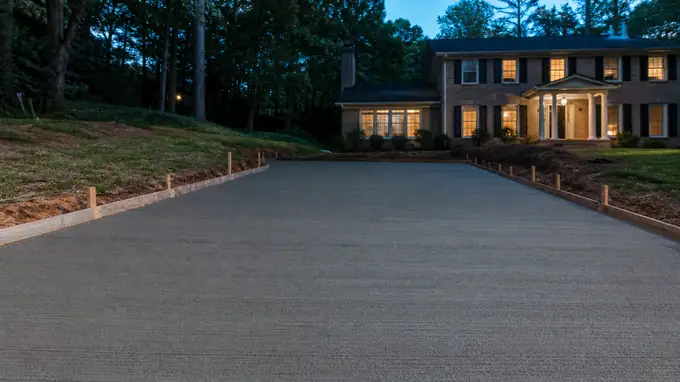
concrete driveway installation completed by a local contractor at a charcoal farmhouse-modern home in Alpharetta, GA, in late afternoon light.

Concrete Driveway Installation

A driveway poured with the house has taken a lot of weather, and the median home here was built in 1996. We saw-cut the old slab, break it out, haul it off, and rebuild the base with compacted stone. New work gets rebar, control joints cut before the slab can crack on its own, and a broom finish for grip on a sloped approach. Stamped and decorative finishes are there if you want them.

concrete flooring installation completed by a local contractor at a painted-white-brick two-story home in Alpharetta, GA, in early morning light.

Concrete Flooring Installation

Interior floors, garage floors and basement slabs all start below the surface. We lay a vapor barrier over compacted stone so ground moisture stays out of the finish, then set the reinforcement and pour. Hand troweling gives a tight, smooth surface for garages and workshops, while polished or sealed finishes suit living space. When an old floor has to come out first, we cut it in sections, remove it, and check what was underneath before anything new goes down.

concrete slab repair completed by a local contractor at a red-brick ranch home in Alpharetta, GA, at blue hour.

Concrete Slab Repair

Not every cracked slab needs replacing. Hairline shrinkage cracks can be routed and sealed. A slab that has sunk or heaved is a different problem, usually water working under it or a base that was never compacted properly, and patching the surface will not hold. With around 50 inches of rain a year, drainage is often the real fix. When a section is past saving, we cut out just that part, correct the base, dowel it into the sound concrete and pour it back.

How a Concrete Demolition And Removal Job Runs in Alpharetta

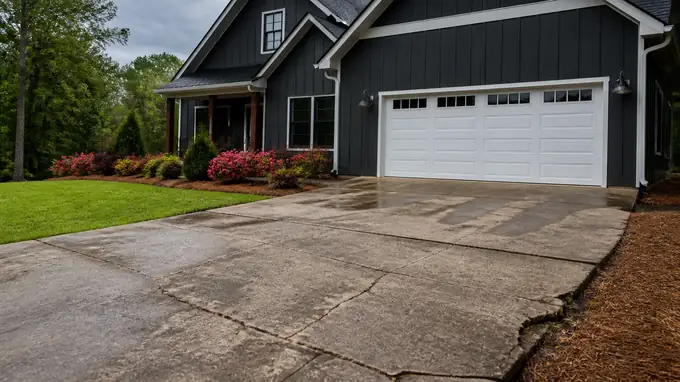
A worker examines an old driveway before replacement. at a charcoal farmhouse-modern home in Alpharetta, GA, after a rain shower.

Step 1: Site Assessment

We walk the property before anything gets broken. We measure the slab, chip an edge to check its thickness, and look for rebar, wire mesh, or no reinforcement at all, since that decides whether a skid steer with a breaker or a jackhammer does the work. With the median home here built in 1996, many driveways and patios have been down for decades. We mark utility lines, note downspouts, and handle the permit if the job needs one.

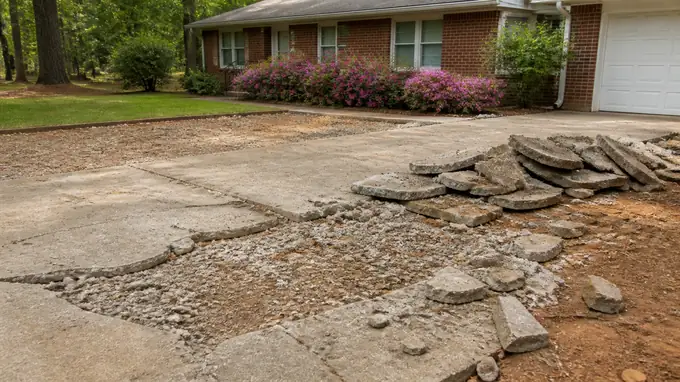
An old patio slab is broken up and hauled away. at a red-brick ranch home in Alpharetta, GA, under bright midday cloud.

Step 2: Site Preparation

Demolition comes first. We saw-cut wherever old concrete meets something staying, like a garage apron or a walkway, so the break stops clean. Then we break the slab, pull the rebar and mesh, and haul the rubble off for recycling. Fulton County is hilly, so we regrade for fall away from the house. Rion soil drains well across much of the county, but it varies, so we test and compact every subgrade before new stone goes down.

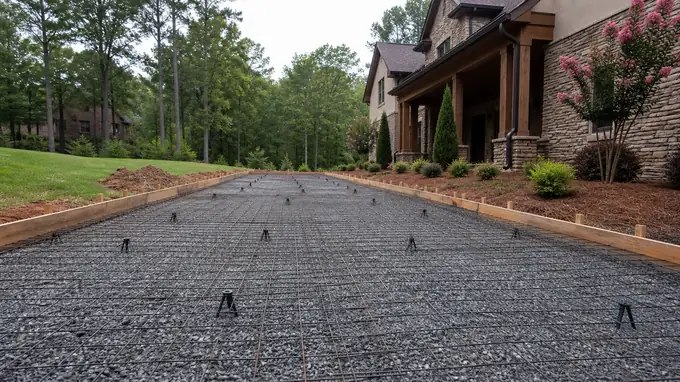
Wire mesh is unrolled across a driveway base before pouring. at a stacked-stone and stucco home in Alpharetta, GA, under an overcast sky.

Step 3: Forming & Reinforcement

Forms go up in straight lumber, staked and checked with a string line so the new surface sheds water where it should. Curves get bendable forms. We set rebar on chairs so it sits mid-slab instead of lying in the gravel, where it does nothing. A driveway carrying vehicles gets heavier reinforcement than a patio. Where new concrete meets old concrete that stays, we drill and pin dowels so the two move together instead of cracking apart.

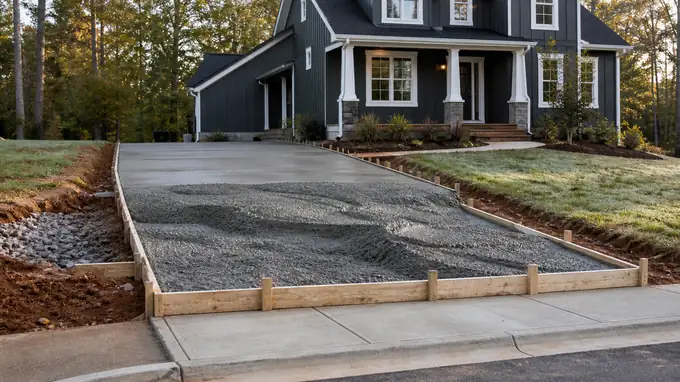
A ready-mix truck discharges concrete into a driveway form. at a charcoal farmhouse-modern home in Alpharetta, GA, in early morning light.

Step 4: Pouring

Pour day depends on the weather. About 50 inches of rain falls here in a typical year, so we watch the forecast and move the date rather than pour into a storm. The truck backs as close as the site allows. On steep or tight lots we pump or run buggies. We place the concrete in one continuous run, strike it off with a screed, and consolidate along the forms so no voids hide at the edges.

A broom drags across a driveway creating a slip-resistant texture. at a tan-brick colonial in Alpharetta, GA, at blue hour.

Step 5: Finishing

Finishing starts once the bleed water leaves the surface, not before. Working it wet weakens the top layer and leads to scaling later. We float, edge the perimeter, and cut control joints deep enough that cracks form in the joints instead of across the middle. Driveways usually get a broom finish for grip on a slope. Patios can be stamped, colored, or exposed aggregate, and decorative work sits on the same base and reinforcement as plain gray.

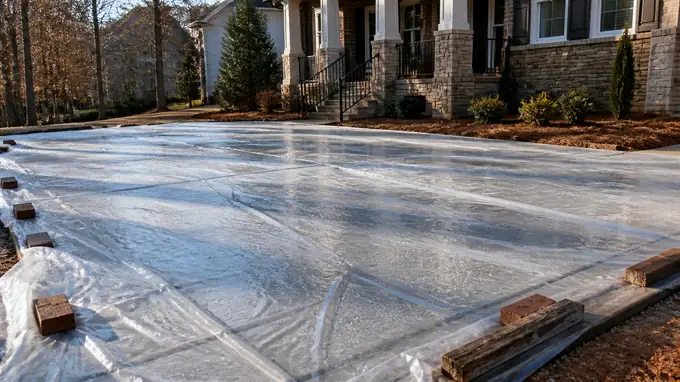
Plastic sheeting covers a curing driveway slab. at a brick-and-siding two-story home in Alpharetta, GA, under low winter sun.

Step 6: Curing

Concrete gains strength slowly, and most of what goes wrong later starts in the first days after the pour. We keep the slab damp or spray a curing compound so the surface does not dry faster than the core. Average daily highs here run around 71°F and lows around 53°F, but any warm, windy afternoon can pull water out of fresh concrete. Foot traffic comes first. Cars stay off until the slab has cured enough to carry them.

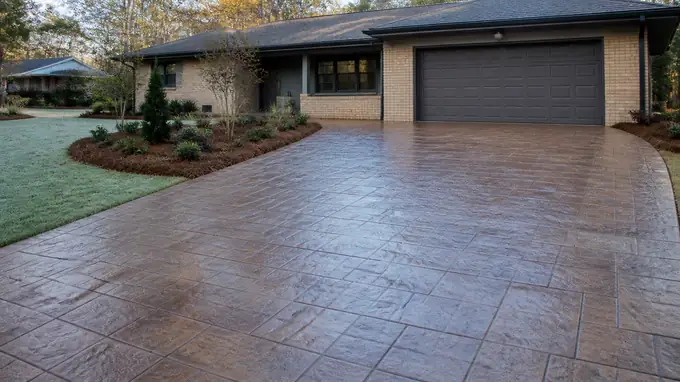
A finished stamped surface shows a glossy sealed sheen. at a buff-brick ranch home in Alpharetta, GA, in early morning light.

Step 7: Sealing

Sealing waits until the slab has fully cured, because sealer over damp concrete traps moisture and turns cloudy. Plain driveways get a penetrating sealer that soaks in and leaves no film. Stamped and colored surfaces get an acrylic sealer, which deepens the color and protects the pattern. We roll it thin and even, since puddled sealer gets slick underfoot. A sealed surface soaks up less water, resists oil stains, and cleans up with a hose.

Choosing the Right Concrete System

Once the old slab is out, the question is what goes back in its place, and the answer depends on what the surface has to carry. A driveway takes the weight of vehicles turning and parking every day, so it needs more thickness and steel reinforcement than a patio that only sees foot traffic and furniture. Walkways sit somewhere between. Then comes the finish. A plain broom finish is the simplest and gives good grip when wet, while stamped or decorative concrete takes more work up front and needs resealing over time. We walk the property with you and match the system to how it will be used.

Site conditions decide the rest. Alpharetta gets about 50 inches of rain a year, so slope and drainage matter as much as the mix. Water that sits against a slab or runs under its edge wears at it from below. Fulton County is hilly, and a sloped lot needs grading and a sub-base built for it before any concrete is placed. The dominant soil here, Rion, drains well, but it changes across the county, so we test every site on its own. Those results set the base materials, the reinforcement and the joint layout for the new installation.

Frequently Asked Questions About Concrete Demolition And Removal in Alpharetta

How much does concrete demolition and removal cost in Alpharetta, GA?

It depends on what is coming out, so we price each job after seeing it. A cracked walkway behind the house and a full driveway with a thickened edge are different days of work with different hauling loads. We walk the property, measure the area, check how thick and how reinforced the slab is, and look at how a truck gets in and out. The estimate is built from that, not from a rate sheet. Call for a free estimate.

What factors affect the cost of concrete demolition and removal in Alpharetta?

Thickness and reinforcement come first. A slab with rebar or wire mesh breaks slower and needs more cutting than plain concrete, and a driveway built to carry vehicles is usually heavier than a patio. Access matters next: tight side yards, fences and planting beds slow the machine down. Then slope. Fulton County is hilly, with 241 ft of local relief within a few miles, and a steep drive changes how we stage equipment and load trucks.

Do you handle the concrete demolition and removal permits, utility locating, and site safety in Alpharetta?

Yes. We handle the permit where the job needs one, and we call in a utility locate before any saw or breaker touches the ground, since gas, water and electric lines often run under driveways and patios. The work does not start until those lines are marked. On site we tape off the work area, keep people and pets clear of the equipment, and wet the concrete while cutting to hold the dust down.

What concrete demolition methods do you use for Alpharetta driveways, patios, and slabs?

Most residential work comes apart with a skid steer and a hydraulic breaker, with jackhammers for edges and tight spots. Where part of a surface stays, say a driveway apron or a walkway meeting the patio, we saw-cut a straight line first so the break stops exactly where it should. The median home here was built in 1996, so many slabs we remove have been down a long time, often with old patches and cracks we plan around.

How does the crew minimize downtime and maintain commercial site safety during active business operations in Alpharetta?

Phasing does most of the work. We split the area so part of the lot, entrance or loading zone stays usable while another section comes out. Barriers and signage keep customers and staff away from the crew. Cutting wet keeps dust out of doorways and air intakes. Noisy breaking can be scheduled around your hours where the site allows it, and we walk the plan with whoever manages the building so everyone knows which doors and parking stay open.

Are you fully licensed, insured, and bonded for commercial work in Southern Alpharetta?

Ask any contractor for current license, insurance and bonding documents before commercial work begins, and check them with the issuer rather than taking a website's word for it. That goes for us too. A commercial site carries more exposure than a backyard patio: public foot traffic, tenants, parked cars, and utilities feeding a whole building. Ask for the paperwork when you call about your project, read what it covers, and confirm it fits the work before you sign anything.

Get a Free Estimate

Get a FREE Quote

Tap to call +1 470-260-7028