
+1 470-260-7028
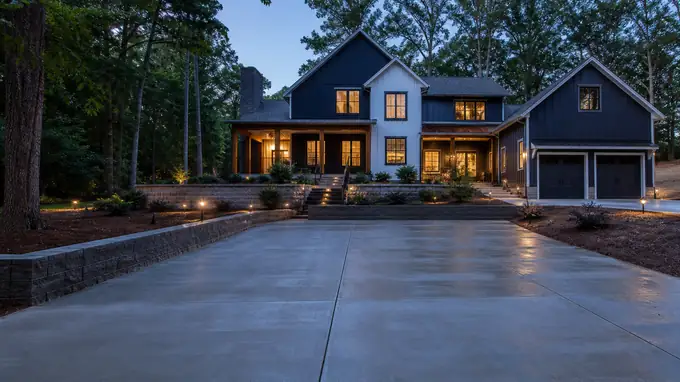
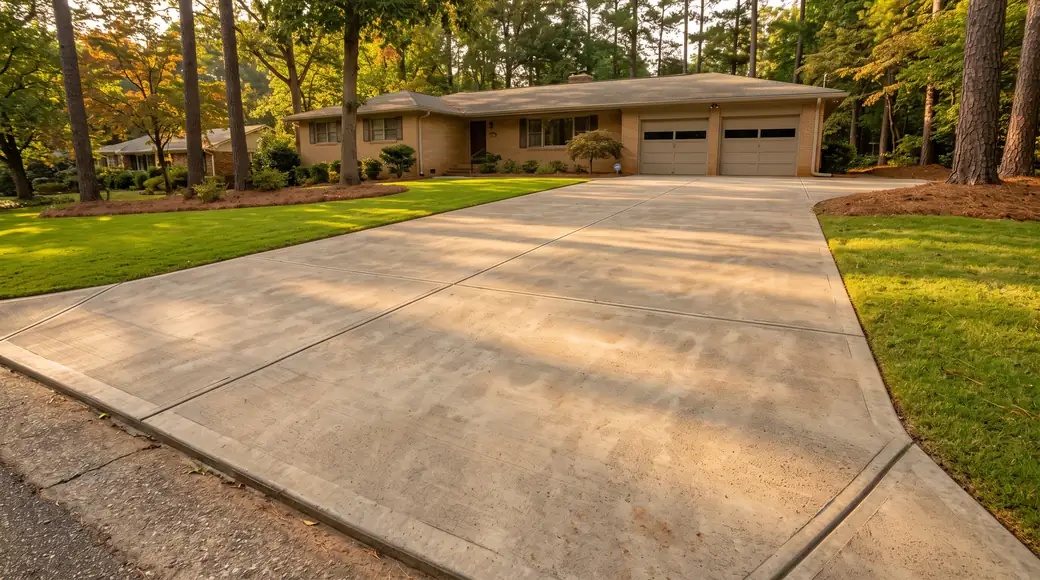
concrete driveway installation completed by a local contractor at a charcoal farmhouse-modern home in Alpharetta, GA, in late afternoon light.

Concrete Driveway Installation in Ball Ground, Georgia

We install concrete driveways in Ball Ground, from new pours on freshly cleared lots to tear-outs of old surfaces that have cracked, heaved or settled. A driveway is the slab that works hardest on any property. It carries every car, delivery truck and trailer that turns in, and it sits out in full sun and rain with nothing over it. Homeowners call us when they want that job done once and done properly. Most of what makes a driveway last happens below the finish, in the ground and in the base, so that is where we spend most of our time.

Driveways rarely fail at the surface. They fail because the ground under them was never ready: soft spots left in, fill that was never compacted, water with no way off the slab. Every site is tested individually before work starts, because what held up on the last lot tells us nothing certain about this one. Then comes a compacted base, reinforcement sized to the load, a slope that sheds water away from the house and garage, and control joints cut where the concrete would crack anyway. None of it shows once the slab cures. You notice it years later, when the driveway still sits flat and whole. Call us for a free estimate.

Call +1 470-260-7028

Get a FREE Quote

Our Concrete Work Around Ball Ground

concrete slab installation completed by a local contractor at a stacked-stone and stucco home in Alpharetta, GA, in clear late-morning sun.

Concrete Slab Installation Cost

What moves the number on a slab is mostly what happens before the truck arrives. Excavation depth, how much compacted stone base the ground needs, slab thickness, and whether it carries rebar or wire mesh all show up in the estimate. Access matters too: a slab we can reach with the chute pours faster than one we have to pump or wheelbarrow. We walk the property and price the site as it actually is.


Concrete Driveway Installation

A driveway fails from the bottom up, so we start there. We cut down to firm subgrade, lay and compact a stone base, and set rebar on chairs so it sits in the middle of the slab instead of on the dirt. Around Ball Ground we pour thicker at the apron where trucks turn in, cut control joints before the concrete can crack on its own, and leave a broom finish for grip in wet weather.

concrete flooring installation completed by a local contractor at a painted-white-brick two-story home in Alpharetta, GA, in early morning light.

Concrete Flooring Installation

Garage, basement and shop floors get a vapor barrier under the slab before anything else goes down, because moisture wicking up through concrete ruins coatings and whatever is stored on top. We slope the floor toward a drain where one is needed, trowel it hard and smooth, and saw-cut joints the same day. Planning to stain, seal or epoxy it later? Tell us up front. The finish we leave changes how well that coating bonds.

concrete slab repair completed by a local contractor at a red-brick ranch home in Alpharetta, GA, at blue hour.

Concrete Slab Repair

Cracks tell you what went wrong. A hairline crack across a slab is usually shrinkage, and it can be routed and sealed. A section that has dropped or tilted means the base underneath washed out or was never compacted properly, and patching the surface will not hold. With about 50 inches of rain a year, water under a slab is often the cause. We find where it gets in, then decide whether to repair or replace.

concrete sidewalk installation completed by a local contractor at a tan-brick colonial in Alpharetta, GA, under bright midday cloud.

Concrete Sidewalk Installation

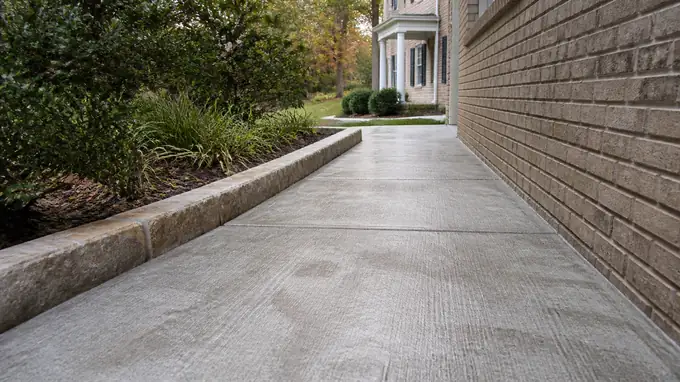
Sidewalks look simple, which is why so many get poured thin over loose fill and settle into broken, uneven panels. We compact the base, form straight or curved runs, and pitch the surface slightly so water sheets off instead of pooling at your door. Control joints go in at even spacing so cracks land in the joint rather than across the middle of a panel. Broom finish is standard; stamped and exposed aggregate are both options.

Our Warranty and Guarantee in Ball Ground

A driveway in Ball Ground earns its keep in the years after the trucks leave, and most of what decides that happens before any concrete arrives. Soil varies from lot to lot, so every site is tested individually before work starts. We set the base to suit what the test shows, place reinforcement where the slab will carry weight, and cut control joints so cracking follows a line we chose. With about 50 inches of rain a year, water has to leave the surface and the edges fast. Grading for that is part of the installation on every driveway we pour, not an extra.

Paper is worth less than the work it describes. A written promise cannot fix a slab poured on a soft base or finished too thin, and most driveway failures trace back to one of those, or to water left with nowhere to go. So before you sign with anyone, ask to see the details: slab thickness, the reinforcement and where it sits, joint spacing, how the base is prepared, and how long the concrete cures before a car rolls onto it. If those answers are vague, no document attached to them will make up the difference. Put the same questions to us. We would rather be judged on them.

How a Concrete Job Runs in Ball Ground

A contractor checks slope and drainage before work begins. at a tan-brick colonial in Alpharetta, GA, after a rain shower.

Step 1: Site Assessment

We walk the property before anything is quoted. We look at where the driveway meets the street, where water runs when it rains, which trees sit close enough to push roots under a slab, and whether a truck can reach the pour. Soil changes from lot to lot, so every site is tested individually before work starts. That test decides how much base we bring in and how deep we dig.

A plate compactor tamps down soil in a small excavated area. at a tan-brick colonial in Alpharetta, GA, at blue hour.

Step 2: Site Preparation

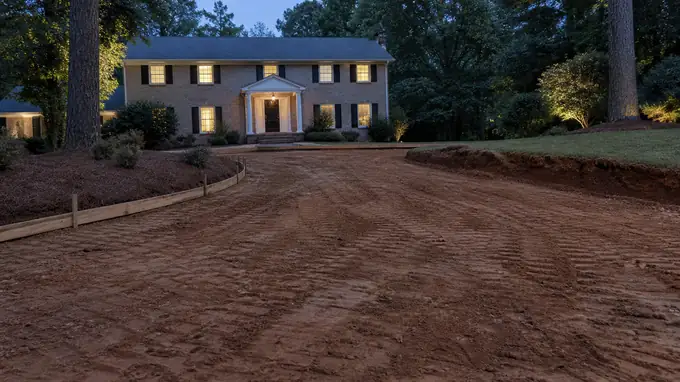
Most failed driveways fail from underneath. We strip the topsoil and organic material, cut to grade, and bring in crushed stone base, compacted in lifts with a plate compactor until it stops moving. Grade matters as much as depth. We pitch the finished surface so water sheds away from the garage and off the edges, because with about 50 inches of rain a year, standing water will find any low spot and work its way under the slab.

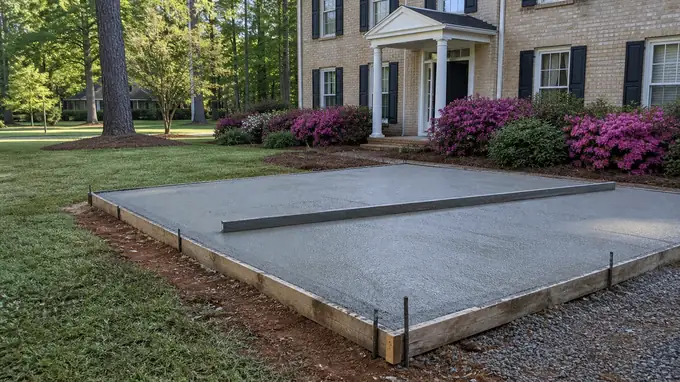
Wooden forms outline a patio slab before the pour. at a painted-white-brick two-story home in Alpharetta, GA, under an overcast sky.

Step 3: Forming & Reinforcement

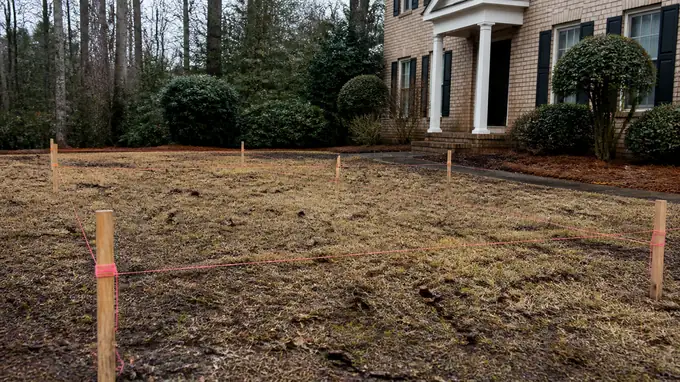
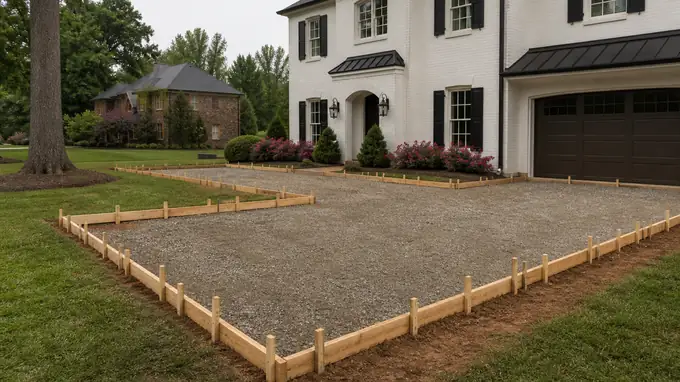
Forms go up in straight lumber, or flexible board for curves, staked tight and checked with a string line so the edges run true. Inside them we set steel rebar in a grid, tied at the crossings and lifted on plastic chairs so it sits in the middle of the slab. Reinforcement lying flat on the base does nothing. Where the driveway meets the garage floor or a sidewalk, isolation joint material goes in so each slab moves on its own.

A screed board levels fresh concrete on a small patio. at a tan-brick colonial in Alpharetta, GA, in early morning light.

Step 4: Pouring

Pour day is about timing. The ready-mix truck backs in, and we place concrete from the far end toward the street, moving it with rakes and come-alongs rather than adding water to make it flow. Extra water weakens the mix and shows up later as dusting and scaling. As it goes in, we screed the surface flat against the forms, then bull float it to push the stone down and close the top.

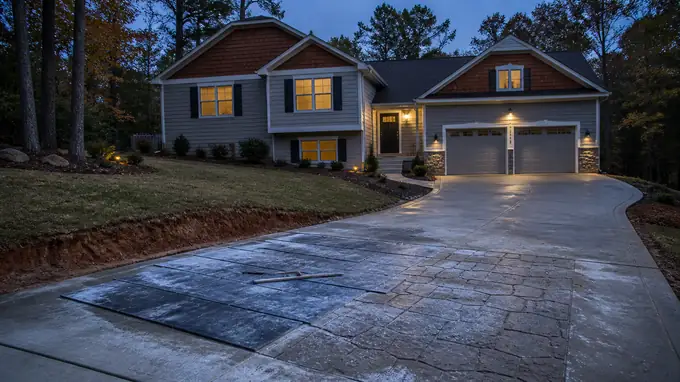
Stamping mats are pressed into a patio surface to imprint a pattern. at a grey split-level home in Alpharetta, GA, at blue hour.

Step 5: Finishing

Once the bleed water is gone off the surface, finishing starts. We run an edger along the forms, cut control joints that tell the slab where to crack, and pull a broom finish across the slope for traction in the rain. Decorative work happens here too: stamped patterns and color go in while the concrete is still workable, and that window is short. Finish too early and water gets trapped under a top layer that later flakes off.

A hand sprayer applies curing compound to a finished patio. at a charcoal farmhouse-modern home in Alpharetta, GA, at blue hour.

Step 6: Curing

Concrete keeps gaining strength for weeks after the finishers leave, and how it spends the first few days decides a lot. We keep moisture in with a spray-on curing compound or wet coverings so the surface doesn't dry too fast and craze. Traffic waits. Foot traffic comes first, cars after that, and heavy trucks later still. The exact timing depends on the mix and the weather that week, so we set it slab by slab.

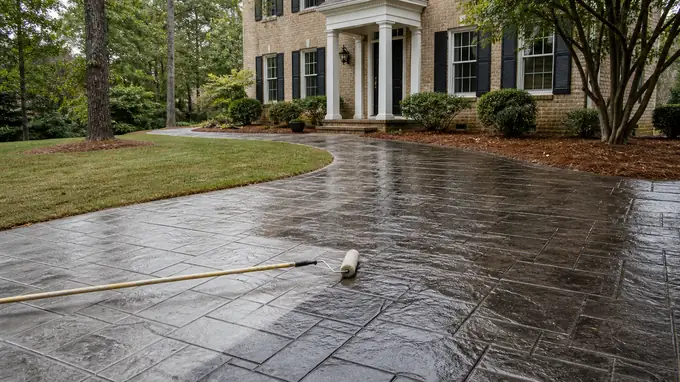
A roller applies sealer to a stamped patio surface. at a tan-brick colonial in Alpharetta, GA, after a rain shower.

Step 7: Sealing

Sealer goes on after the slab has cured, not before. On a plain broom-finished driveway we usually use a penetrating silane or siloxane sealer, which soaks in and repels water and oil without making the surface slick. Stamped and colored concrete gets an acrylic sealer that deepens the color and protects the pattern. Neither lasts forever. Resealing every few years keeps water, oil drips and tire marks from working into the surface.

The Concrete Options Available in Ball Ground

Most driveways we pour in Ball Ground come down to three finishes. Plain broom-finished concrete is the workhorse: a lightly textured surface that gives tires and shoes some grip on a wet morning. Stamped concrete has a pattern pressed into the slab while it is still workable, so it reads as slate, stone or brick without loose pieces to shift. Exposed aggregate washes back the top layer to show the stone inside the mix. A decorative border can pair two of these on one driveway.

Whatever the finish, the structure underneath is the same. We test every site individually before work starts, then grade and compact the base so water runs off the slab rather than under it. Reinforcement goes in according to what the driveway will carry. A pickup pulling a trailer asks more of the concrete than a sedan does, and the steel should reflect that. Control joints are cut at planned spacing, so when the concrete cracks, it cracks where we chose, in a straight line you barely notice.

This part of Georgia sees about 50 inches of rain a year, and that shapes the choices. Stamped and exposed surfaces need a sealer, and one that turns slick when wet is the wrong pick for a sloped driveway. Color is mixed into the concrete or cast onto the surface while it is fresh, never painted on later. Most of the failed driveways we see trace back to a thin base or joints cut too late. How you use the driveway decides the finish, and that is where a free estimate starts.

How Much Does Concrete Cost in Ball Ground?

A driveway price comes down to the ground under it and the work it takes to get that ground ready. Two driveways the same size can land far apart, so we price every job from the property itself. Most of what moves the number is something you can walk out and check today.

What changes the priceWhich wayWhy
Old concrete or asphalt still in placecosts moreIt has to be broken up, loaded and hauled away before any forms go down.
Tree roots or stumps along the pathcosts moreRoots get cut back and stumps ground out so they do not lift the slab years from now.
How a mixer truck reaches the pourcosts more when blockedA truck that backs straight up to the forms pours direct. Fences, narrow gates or a tight turn mean a pump or wheelbarrows.
Slab thicknesscosts more when thickerA driveway that carries a work truck, camper or boat needs more depth than one for two cars.
Reinforcementcosts moreRebar or wire mesh adds material and labor, and it holds the slab together when the ground shifts.
Where water goescosts more if it poolsLow spots or runoff toward the garage need grading or a drain first. With about 50 inches of rain a year, that water has to go somewhere.
Soft or filled ground under the padcosts moreWe test every site. Soft fill gets dug out and replaced with a compacted base.

Line competing bids up on the same points: slab thickness, the type and spacing of reinforcement, how deep the base goes and what it is made of, and whether removal and haul-off are included. A lower number that skips one of these is usually a thinner driveway, not a cheaper one.

Get a Free Estimate

Get a FREE Quote

Tap to call +1 470-260-7028