
+1 470-260-7028
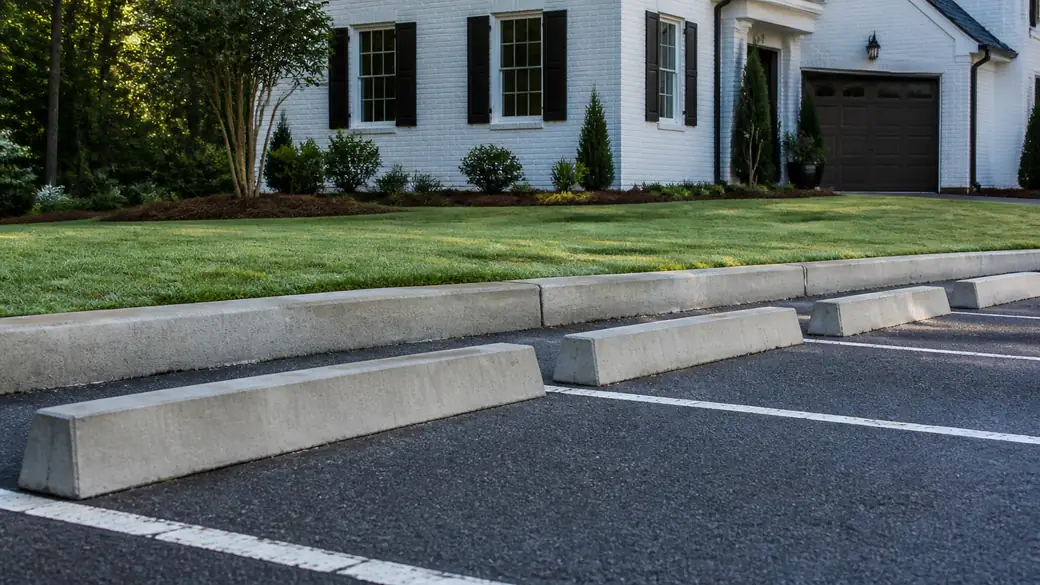
concrete parking lot construction completed by a local contractor at a painted-white-brick two-story home in Alpharetta, GA, in early morning light.

Concrete Parking Lot Construction in Alpharetta, GA

A parking lot carries more than a driveway ever will: delivery trucks, daily turning traffic, and cars parked in the same stalls for years. We build concrete parking lots for commercial property in Alpharetta, from a short row of stalls behind an office to a full lot serving a clinic, a school or a retail building. The work covers the grade, the base, the reinforcement and the slab itself, plus the curbs and drainage that let a lot hold up. It is heavy construction, and we treat it that way.

Water is what ruins most lots. Alpharetta sees about 50 inches of rain a year, and a surface that sheds it the wrong way leaves standing water in the stalls and washes out the edges. The ground is hilly too, with as much as 241 feet of relief within a few miles, and it changes from one block to the next. So every site is graded and tested on its own before we set a single form. Get the slope and the base right, and the slab has something solid to sit on.

Call +1 470-260-7028

Get a FREE Quote

Our Concrete Parking Lot Construction Work in Alpharetta

concrete slab installation completed by a local contractor at a stacked-stone and stucco home in Alpharetta, GA, in clear late-morning sun.

Concrete Slab Installation Cost

What a slab costs is set by what goes under it and into it. Thickness follows the load: a patio slab and a slab carrying delivery trucks are different pours. Rebar on chairs costs more than wire mesh and holds up better under traffic. Grading adds up on a sloped lot, and Fulton County has 241 feet of local relief within a few miles. We price each site after we have walked it and tested the ground.


concrete driveway installation completed by a local contractor at a charcoal farmhouse-modern home in Alpharetta, GA, in late afternoon light.

Concrete Driveway Installation

A driveway fails from the bottom up. Most cracks trace back to a soft subgrade, missing joints or water with nowhere to go. We dig out the base, compact crushed stone in lifts, set rebar on chairs so it sits mid-slab, and saw control joints before the concrete picks its own. With about 50 inches of rain a year, every driveway gets sloped to shed water away from the garage. Finishes run from broom to stamped.

concrete flooring installation completed by a local contractor at a painted-white-brick two-story home in Alpharetta, GA, in early morning light.

Concrete Flooring Installation

Garage floors, shop floors and commercial interiors share the same basic build: a compacted base, a vapor barrier under the slab, and reinforcement sized to what rolls across it. The finish is where floors differ. A steel-troweled surface is dense and easy to sweep, but it gets slick when wet, so we match the finish to the room. Floors that will be stained, sealed or polished need an even cure, or the color comes out blotchy.

concrete slab repair completed by a local contractor at a red-brick ranch home in Alpharetta, GA, at blue hour.

Concrete Slab Repair

Before we fix a crack, we find out why it opened. Hairline shrinkage cracks are cosmetic and can be routed and sealed. A slab that has dropped or tilted has lost support underneath, usually from washout or poor compaction, and patching the top will not hold. The median home here was built in 1996, so plenty of slabs have taken decades of load and runoff. We tell you plainly whether a section can be repaired or should be cut out and replaced.

What Makes Alpharetta Craftsman Concrete's Concrete Work Different

A parking lot fails at its edges and its low spots long before the middle wears out, so that is where we spend our attention. Fulton County is hilly, with 241 feet of local relief within a few miles, and about 50 inches of rain a year has to go somewhere. We grade every site on its own, test the soil before we set a form, and slope each slab so water leaves the surface instead of sitting on it.

Reinforcement is sized for what actually drives on the lot. Delivery trucks and a trash hauler put different loads on a slab than a row of sedans, and we place steel, set thickness and cut control joints to match. Joints go where the concrete wants to crack, not where it is convenient to saw. We also take the same care with curbs, aprons and transitions, because those are the pieces people notice when they are done badly. Call for a free estimate.

How a Concrete Parking Lot Construction Job Runs in Alpharetta

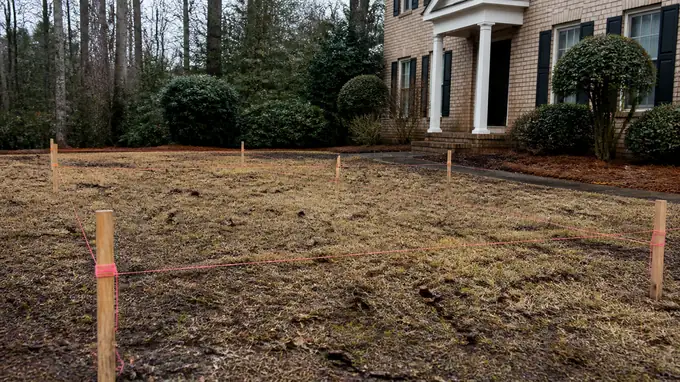
A contractor checks slope and drainage before work begins. at a tan-brick colonial in Alpharetta, GA, after a rain shower.

Step 1: Site Assessment

We walk the lot with the owner and look at what the pavement has to carry: delivery trucks, a dumpster pad, cars turning in the same spot all day. Fulton County is hilly, with 241 feet of local relief within a few miles, and it changes block to block. So we shoot grades and map where water goes before anything else. Soil gets tested on this site, not assumed. We handle the permit.

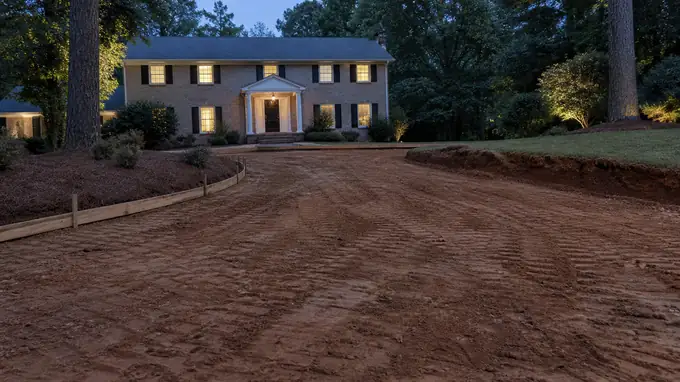
A plate compactor tamps down soil in a small excavated area. at a tan-brick colonial in Alpharetta, GA, at blue hour.

Step 2: Site Preparation

Most parking lot failures start here, not in the concrete. We strip topsoil and organics, cut and fill to the grades from the survey, and proof-roll the subgrade with a loaded truck to find soft spots. Those get dug out and replaced. Then comes a compacted layer of graded aggregate base. With about 50 inches of rain a year, slope to drains and inlets matters as much as anything else in the job.

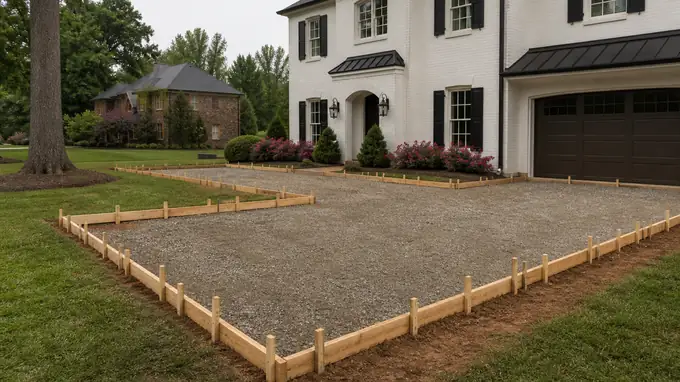
Wooden forms outline a patio slab before the pour. at a painted-white-brick two-story home in Alpharetta, GA, under an overcast sky.

Step 3: Forming & Reinforcement

Forms go in at finished grade, set to a string line and checked against the drainage plan so no bay holds a puddle. Drive lanes and dumpster pads get a thicker section than parking stalls, since that is where loaded trucks turn and brake. Rebar sits on chairs at mid-depth; rebar lying on the base does nothing. Dowels cross the construction joints so neighboring slabs stay level with each other under traffic.

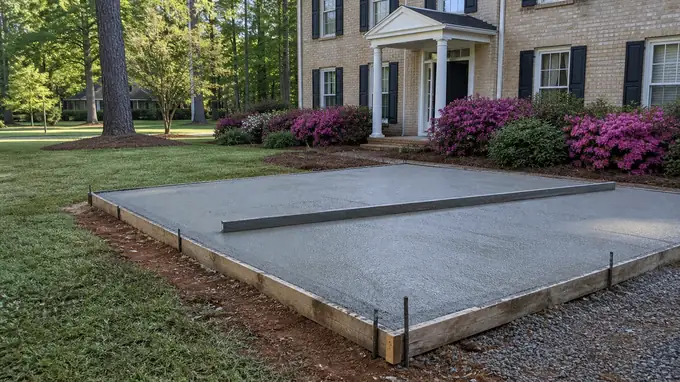
A screed board levels fresh concrete on a small patio. at a tan-brick colonial in Alpharetta, GA, in early morning light.

Step 4: Pouring

We schedule the pour around the weather and the ready-mix plant, and we check each truck's ticket against the mix we ordered. Concrete goes down in sections, placed close to where it ends up rather than dragged across the rebar. The crew consolidates with vibrators along forms and joints, then screeds to the string lines. Water added on site to make concrete easier to spread weakens the surface, so we don't do it.

Stamping mats are pressed into a patio surface to imprint a pattern. at a grey split-level home in Alpharetta, GA, at blue hour.

Step 5: Finishing

A parking lot wants traction, not shine. After bull floating, we wait for bleed water to leave the surface, because working it back in leaves a weak, dusty top. Then a broom finish goes across the direction of travel so tires and shoes grip in the rain. Control joints are sawcut early, before the slab picks where to crack on its own. Striping and stall layout come later, on cured concrete.

A hand sprayer applies curing compound to a finished patio. at a charcoal farmhouse-modern home in Alpharetta, GA, at blue hour.

Step 6: Curing

Concrete gains strength as long as it holds moisture, and the first days decide how the surface wears for years. We apply a curing compound or cover the slab right after finishing, then keep traffic off it. Cars come before trucks; heavy loads wait until the slab reaches the strength the design calls for. Hot, windy afternoons dry the top fastest, so those pours get covered sooner and checked more often.

A roller applies sealer to a stamped patio surface. at a tan-brick colonial in Alpharetta, GA, after a rain shower.

Step 7: Sealing

Sealing is the last step and the easiest to put off. A penetrating silane or siloxane sealer soaks in and keeps water, oil and vehicle fluids from getting into the concrete, without making the surface slick. Sawcut joints get a flexible sealant so water and grit stay out of the base below. Oil stains and tire marks still happen. On a sealed slab they come up with a pressure washer instead of setting in.

Choosing the Right Concrete System

A parking lot asks more of concrete than a residential driveway does. It carries delivery trucks, turning tires and dumpster pickups, so the system under the surface matters more than the finish on top. We size the slab to the heaviest vehicle that will use the lot, not the average one. Reinforcement follows from that: steel rebar where trucks load and turn, welded wire or fiber in the lighter parking rows. The base gets the same attention, because a strong slab on a weak subgrade still cracks. Stamped and decorative work belongs at entrances and walkways, not in the drive lanes.

Water decides most of what remains. Fulton County averages about 50 inches of rain a year, so we lay out slope, joints and drains together, and the lot sheds water where it should instead of pooling at the curb. The county is hilly, with 241 feet of local relief within a few miles, though it changes block to block. Rion soil is the dominant type and drains well, but that varies too. We grade and test every site on its own. The failure worth avoiding is a slab built for cars that ends up carrying trucks.

Concrete Parking Lot Construction Pricing in Alpharetta, GA

A parking lot is priced from the ground up, and most of what moves the number sits below the finished surface or along the edges of the property. We walk the site, look at what is there now, and price the work it actually calls for. Most of these factors you can check yourself before anyone comes out.

What changes the priceWhich wayWhy
Old asphalt or concrete still in placecosts moreIt has to be broken out, loaded and hauled off before grading can start.
Soft, cracked or sinking spots in the current lotcosts moreThose areas usually mean failed base underneath, which we dig out and replace with compacted stone.
Slope across the lotcosts moreFulton County is hilly, and a lot that falls hard needs more grading, more forming and tighter control of the finished grade.
Water that pools after a raincosts moreThe new slab needs added fall, drains or inlets so it sheds water instead of holding it.
Open access for a mixer truckcosts lessA truck that can back up to the pour saves pumping. Tight entrances, low limbs or overhead lines may call for a pump or buggies.
Delivery trucks, dumpsters or garbage trucks using the lotcosts moreLanes and pads under heavy wheels call for a thicker slab and heavier reinforcement than car parking.
Curbs, wheel stops, striping and accessible spacescosts moreEach is separate work on top of the flat slab.
Keeping the property open during workcosts morePouring in phases means more trips, more forming and more construction joints.

Lay competing bids side by side on the same points: slab thickness in each area, reinforcement type and spacing, depth of base stone, how drainage is handled, and whether demolition, haul-off, curbs, striping and the permit are included. A lower number with thinner concrete in the truck lanes or less base under it is a different job, not a better price.

Get a Free Estimate

Get a FREE Quote

Tap to call +1 470-260-7028