+1 470-260-7028
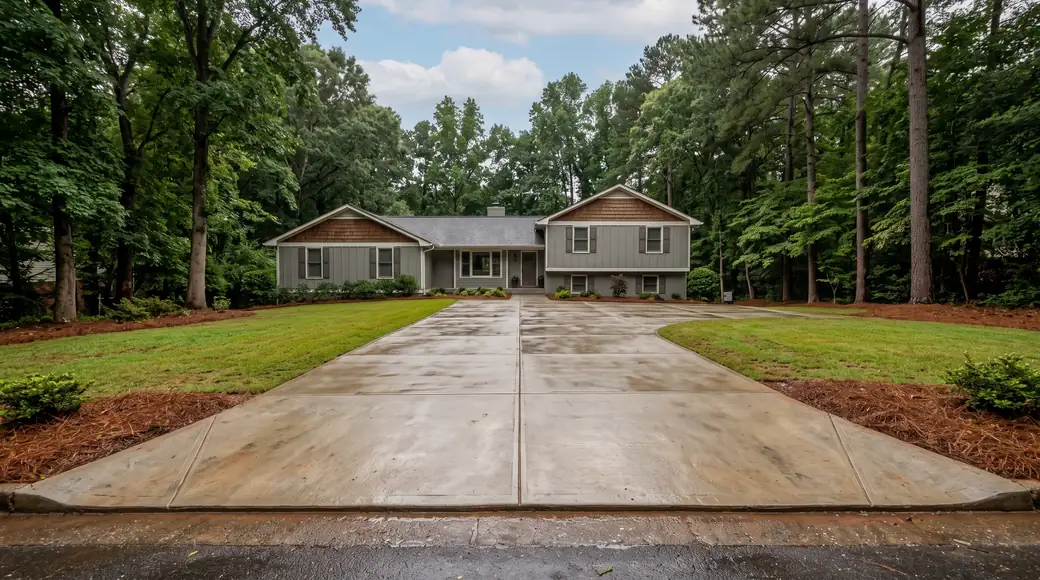
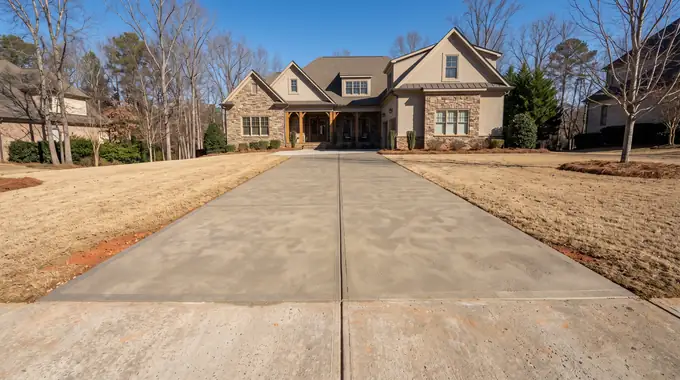
Wide view of finished concrete flatwork across the front of a home at a grey split-level home in Alpharetta, GA, after a rain shower.

Repair, Leveling & Resurfacing in Johns Creek, Georgia

Concrete fails in ways you can read off the surface. A slab that has dropped at a joint, a driveway with a crack opened well past hairline, a sidewalk panel sitting proud of the one beside it: each of those points at something different underneath. We are a concrete contractor, and most of what we do here is deciding which problems can be corrected in place and which ones need the slab out and replaced. That judgment comes before anything else, because the wrong call means the fix fails ahead of the concrete it was meant to save.

Leveling addresses the void, not the concrete. When a slab settles, the concrete itself is usually sound, and lifting it back to grade removes the trip hazard without disturbing a pour that was fine to begin with. Resurfacing is the opposite case: the slab holds its line, the top has spalled or scaled or worn thin, and it wants a bonded overlay rather than a lift. Repair sits between the two, patching a spot, cutting out a failed section, sealing a joint that has begun taking water.

Most of the failures we get called out to look at started as somebody's shortcut. An overlay laid over a surface that was never profiled, so it releases in sheets. Rebar or wire mesh dropped flat on grade and poured over instead of tied up into the slab where it actually does something. Patches feathered down to nothing at the edge, which is exactly where they break. Stamped concrete sealed with the wrong product and gone cloudy underfoot. None of it is exotic. All of it is avoidable.

Doing this correctly costs time more than it costs anything else. Prep is the slow part: grinding or shot blasting before an overlay, chasing a crack out until you reach sound material, drilling and setting ports so the fill under a settled slab goes where you want it and not somewhere else. None of that shows up in a photograph. It is the whole reason one patch is still tight years later and the one beside it has lifted at its edge. We would rather spend the day on prep than spend it coming back.

The housing stock here hands us a lot of original flatwork. Median build year in this market is 1996, which puts plenty of driveways, walks and patios at the far end of what a first pour gives you, on homes carrying a median value of $605,700. Owners at that stage are usually weighing more life out of what they have against starting over, and the honest answer depends on the slab in front of us, not on the year stamped in the corner. We came up out of Alpharetta and we read a slab the same way on every street we work. Call for a free estimate.

Call +1 470-260-7028

Get a FREE Quote

What We Do in Johns Creek

Replaced concrete driveway panel with clean saw-cut edges at a stacked-stone and stucco home in Alpharetta, GA, in clear late-morning sun.

Repair, Leveling & Resurfacing

Sunken slabs usually mean the base under them washed out or settled, so we lift them back to grade with polyurethane foam injected through small ports and patch the holes. Cracked or spalled surfaces get a different fix: we grind off the loose top layer, prime it, and bond an overlay a quarter inch thick. Not every slab is worth saving. If the concrete is crumbling through its full depth, we say so and price a replacement instead.

Broom-finished concrete driveway running up to a two-car garage at a buff-brick ranch home in Alpharetta, GA, in late afternoon light.

Driveway Installation & Replacement

We tear out the old driveway, regrade the base, and pour four to six inches of concrete over compacted stone with rebar on chairs or wire mesh, depending on what the slab has to carry. Control joints go in early so the concrete cracks where we cut it instead of wherever it wants. Broom finish is standard. Stamped or colored concrete and exposed aggregate are available on the same pour if you want the driveway to read differently from the street.

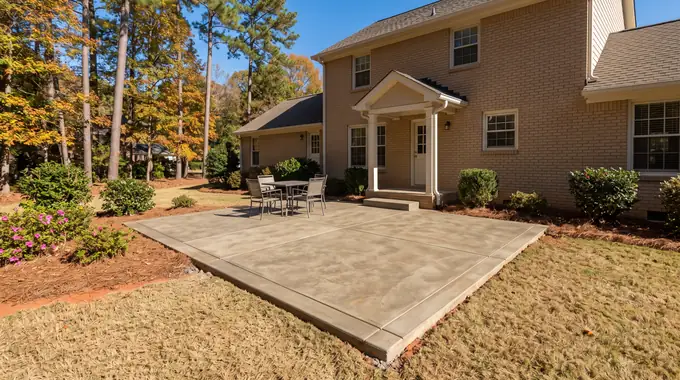
Rectangular concrete patio with a low step up to the rear door at a tan-brick colonial in Alpharetta, GA, in clear late-morning sun.

Patio Construction & Outdoor Living

Patios are flatwork with a slope, and the slope matters more than the finish. We pitch every slab away from the house so water leaves instead of pooling against the foundation. Four inches over compacted base, wire mesh through the field, joints cut on a grid that fits the shape. Stamped concrete in slate or wood plank patterns holds up well under furniture. Exposed aggregate stays cooler underfoot and hides wear better than a smooth trowel.

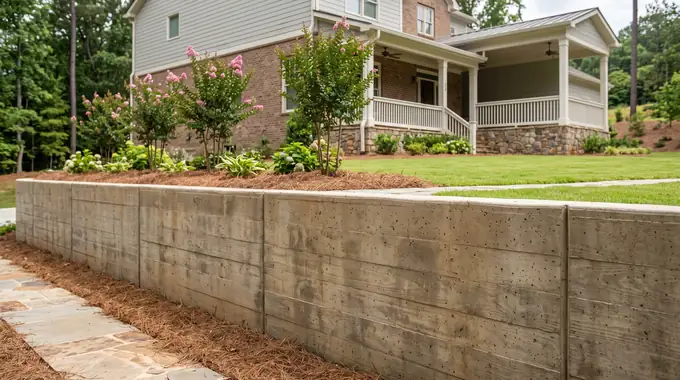
Board-formed concrete retaining wall holding a raised lawn at a brick-and-siding two-story home in Alpharetta, GA, under bright midday cloud.

Retaining Wall Construction

Walls fail when water builds up behind them, so we build the drainage first: washed stone against the back face, filter fabric, and perforated pipe that daylights somewhere useful. The footing goes below frost depth on undisturbed soil. Poured concrete walls get vertical rebar tied into the footing dowels. We batter the face slightly into the hill. Anything over four feet gets engineered drawings before we dig.

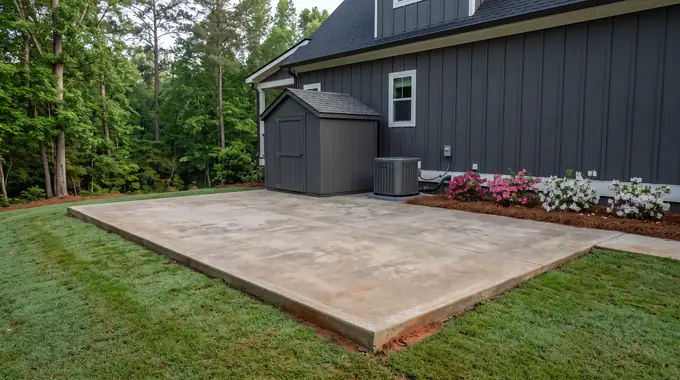
Square-edged concrete slab pad with a storage shed on it at a charcoal farmhouse-modern home in Alpharetta, GA, in early morning light.

Concrete Slabs & Pads

Shed floors, generator pads, hot tub bases, garage additions: same trade, different loads. We compact the subgrade, set vapor barrier where the slab will be enclosed, and size the reinforcement to the weight going on top. A hot tub pad needs more steel and more thickness than a place to park a mower. Thickened edges where a structure bears down. As a concrete contractor we also pour commercial concrete pads, dumpster enclosures, and concrete sidewalk work, including sidewalk installation that ties a new pad back to the existing walk.

How a Job Runs

A job starts with a walk. We meet you at the driveway, measure it, and look at where the water goes when it comes off the roof and the yard. We check the fall toward the garage, the condition of the existing slab, the depth of the old base where a broken edge shows it, and how the concrete meets the street. You tell us what has bothered you about it, and we take notes and photos before we say anything about the fix.

What we see decides the route. A slab that has settled in one panel but is otherwise sound can be lifted and leveled, and a surface that is worn or spalled can often be resurfaced over the same base. Tear-out and replacement is for concrete that has failed underneath, where the base is gone or the panels have broken up. Homes here run to a median build year of 1996, so plenty of the flatwork we look at is original to the house.

The estimate comes back in writing, and it lists what we are actually going to build: square footage, slab thickness, reinforcement, joint layout, and the finish. If one section needs more depth because a work truck parks on it, that is in there too. We would rather answer a question at the kitchen table than in the middle of a pour. Nothing gets added after the fact without you hearing about it first and agreeing to it, which is the whole point of writing it down.

Tear-out day is loud and it is quick. We break the old concrete, load it, and haul it off, and the lawn and the garage door get protection before anything swings. Old driveways hide things: a base two inches thinner than it should be, an irrigation line run shallow, roots that lifted a panel from below. We show you what turns up before we cover it again, and you can plan on parking at the curb once the slab is out.

Base work is where a concrete driveway is won or lost. We cut the subgrade to a consistent depth, compact it in lifts, and set forms to the fall we agreed on so water leaves the slab instead of standing at the garage. Rebar or wire mesh goes in on chairs, held up off the dirt, because steel lying in the mud does nothing for the slab. Then we pull a string across the forms and check them one more time.

Pour day starts early. Trucks back to the forms, we place the concrete, screed it flat, and bull float it while it is still wet. After that the work is mostly watching: the slab bleeds water, the sheen goes off, and finishing has to begin at the right moment rather than at a time someone wrote down in advance. Finish it too early and you seal water into the surface, which shows up as scaling years later.

Broom finish is standard on driveways and sidewalks because it gives grip and hides small imperfections. Stamped concrete, colored concrete, and exposed aggregate each have a tighter working window, so we bring more hands for them. Control joints get cut on a layout that follows the shape of the slab, early enough to do their job. Concrete cracks; the joints decide where. We cure the surface instead of letting it dry out fast, and we keep equipment off the green edges.

Alpharetta Craftsman Concrete handles concrete installation in Alpharetta, Johns Creek, Milton, Roswell, and Chamblee, all of it inside metro Atlanta, and the process above runs the same way in every one of them. Sidewalks, patios, commercial concrete, and driveways follow it too, scaled to the size of the pour. Call for a free estimate. The walk described above is where each of these jobs starts, and questions about color and joint layout go easier standing on the slab.
Johns Creek Questions

Can you match concrete you did not pour in Johns Creek?

Yes, within limits worth stating up front. Existing slab cures for years, picks up dirt and traffic, and drifts in color, so a fresh pour beside it starts out lighter almost every time. We match the mix, the finish texture and the joint layout, then let weather close the rest of the gap. On stamped or colored concrete we bring samples out and compare them in daylight.

How quickly can you get a crew to Johns Creek?

That depends on what is already on the board and on weather, which moves concrete schedules more than anything else does. Repair, leveling and resurfacing take less time on site than a full driveway installation, so they fit into gaps that bigger flatwork cannot. Call and ask what the current schedule looks like. Nobody should be putting a date on your job before they have seen the slab.

Who do I speak to about a Johns Creek job specifically?

The same people who pour it. We are a small outfit, so whoever walks your driveway and takes the measurements is the one running the crew on pour day. Permits go through whichever jurisdiction the address sits in, and for work inside Alpharetta that is the City of Alpharetta. We pull the paperwork ourselves instead of leaving it with the homeowner.

What is the ground like in Johns Creek, and does it change how you build?

We do not generalize about it. Ground varies street to street, sometimes corner to corner on a single lot, so we read the site instead: drainage, what the old slab has already done, how the subgrade feels under a probe. Base prep, slab thickness, rebar or wire mesh, and joint spacing all follow from that reading rather than from some rule about the town.

What is the drive time from Alpharetta to Johns Creek for a site visit?

Short. We work out of Alpharetta, and Johns Creek sits close enough that a site visit is an ordinary part of the day rather than a trip we plan around. That matters most on repair work, where standing on the slab is the only honest way to tell resurfacing from replacement. Same goes for Roswell and everywhere else we cover.

Get a Free Estimate

Get a FREE Quote

Tap to call +1 470-260-7028