+1 470-260-7028
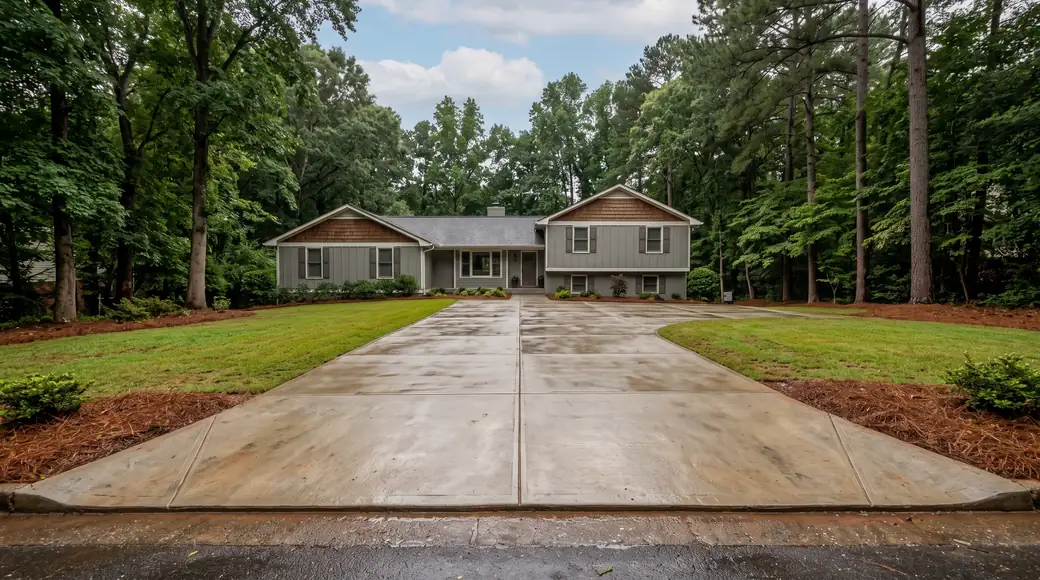
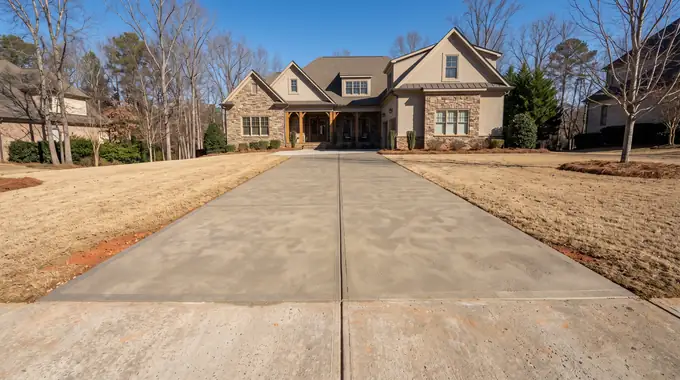
Wide view of finished concrete flatwork across the front of a home at a grey split-level home in Alpharetta, GA, after a rain shower.

Repair, Leveling & Resurfacing in Roswell, Georgia

Concrete that has cracked, sunk or worn rough does not always need to come out. Repair means cutting the failed section loose and tying new concrete into what stays. Leveling means lifting a settled slab back to grade so the panels meet flush again. Resurfacing means bonding a new wearing surface onto a slab that is still sound underneath. Which one your driveway or sidewalk needs depends on what the slab is doing below grade, not on how rough it looks on top. So that is where we start.

A repair starts at the joint. We saw a clean edge back to solid material, drill and epoxy dowels into the existing slab, then place the new pour so the two move together instead of pulling apart. Leveling works the other direction: fill the void under the panel until the slab rides on solid support again. Resurfacing needs a clean, profiled surface and a bonded overlay, which is also where stamped concrete comes in, since an overlay can carry a pattern and color that a plain gray slab never had.

Most of the failures we open up trace back to what went in underneath the first time. A slab poured thin, wire mesh that ended up lying on the ground instead of in the middle of the pour, rebar left out of a driveway that trucks park on, base material that was never compacted and has since washed out from under one corner of a sidewalk. Cracks are the symptom. The panel that rocks under your foot, or the lip you catch a toe on, is telling you the support under it moved.

Doing it right costs time in the parts nobody sees. Compacting the base in lifts, setting rebar or wire mesh up on chairs so it lands in the middle of the slab, cutting control joints at the right depth and spacing, then leaving the concrete alone while it cures. Skip any of that and the repair fails in the same place the original did. We say so when a slab is too far gone to resurface, because an overlay bonded to a moving slab cracks straight through. Replacement is the honest answer then.

Alpharetta Craftsman Concrete is a concrete contractor, and repair, leveling and resurfacing are a good share of what we do: driveways, sidewalks, patios and steps. The median house in this part of metro Atlanta went up in 1996, which puts a lot of original flatwork right around thirty years old, about when it starts to tell on itself. Plenty of that concrete is worth saving. Some of it is not, and no overlay changes that. We can walk yours and tell you which. Call for a free estimate.

Call +1 470-260-7028

Get a FREE Quote

What We Do in Roswell

Replaced concrete driveway panel with clean saw-cut edges at a stacked-stone and stucco home in Alpharetta, GA, in clear late-morning sun.

Repair, Leveling & Resurfacing

Settled slabs come back up with polyurethane foam pumped through small ports, which is faster and far less disruptive than tear-out when the concrete underneath is still sound. Trip hazards on a concrete sidewalk get ground flat. Spalling, scaling and a surface that never finished right take a bonded overlay over a cleaned, profiled substrate. When cracks run all the way through and a panel rocks underfoot, we say so and replace it.

Broom-finished concrete driveway running up to a two-car garage at a buff-brick ranch home in Alpharetta, GA, in late afternoon light.

Driveway Installation & Replacement

Replacement begins with breaking out the old driveway and hauling it off, then grading and compacting a stone base so the new slab sits on something that will not move. We pour four inches for cars and thicken the apron where delivery trucks swing in, with wire mesh or rebar held up on chairs instead of laid flat on the ground. Control joints get cut early. Finishes run from broom to exposed aggregate.

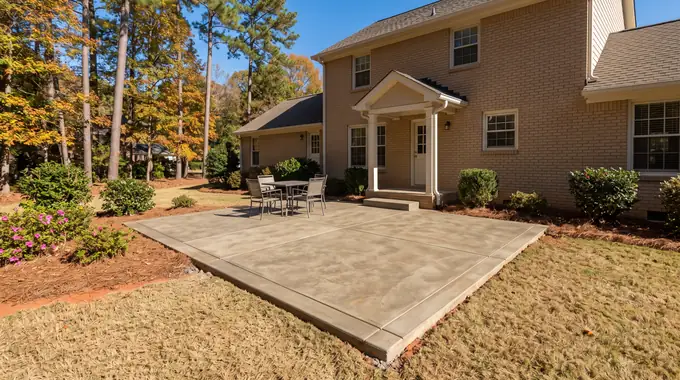
Rectangular concrete patio with a low step up to the rear door at a tan-brick colonial in Alpharetta, GA, in clear late-morning sun.

Patio Construction & Outdoor Living

Patios are where stamped concrete earns its keep: pattern mats pressed into fresh concrete, integral color with a release powder for depth, then a sealer once it has cured. Colored concrete and exposed aggregate do the same work more quietly. We slope every patio away from the house so water leaves, tie new pours into existing steps and landings, and lay out control joints on lines that follow the shape of the slab.

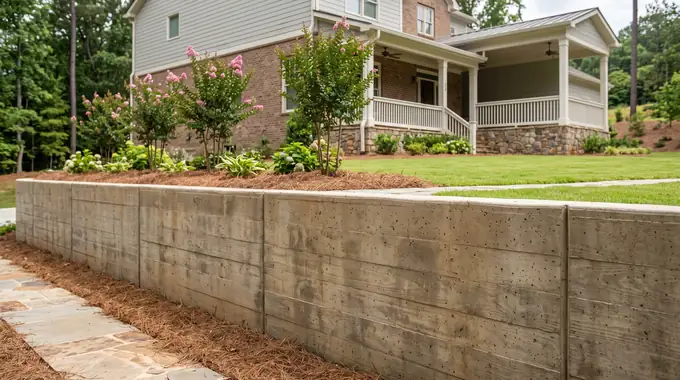
Board-formed concrete retaining wall holding a raised lawn at a brick-and-siding two-story home in Alpharetta, GA, under bright midday cloud.

Retaining Wall Construction

Poured walls start below grade on a footing sized for what the wall actually holds back, with vertical rebar tied up into the stem. Behind the wall we place washed stone and a perforated pipe run to daylight, because water pressure is what pushes walls over, not the weight of the soil alone. Weep holes go in where a pipe cannot run. Backfill goes in lifts, compacted, after the concrete has cured.

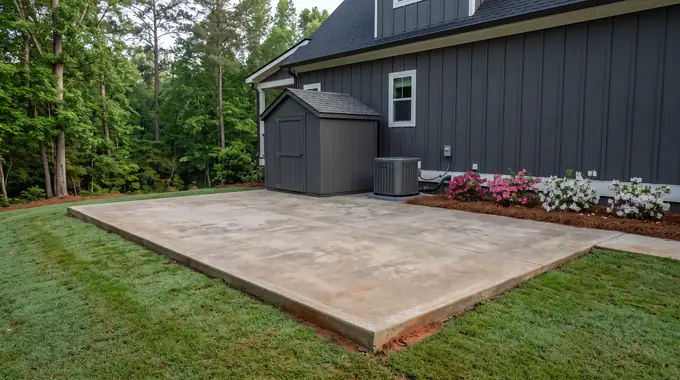
Square-edged concrete slab pad with a storage shed on it at a charcoal farmhouse-modern home in Alpharetta, GA, in early morning light.

Concrete Slabs & Pads

Slabs for garages, sheds, hot tubs, generators and air conditioning units get the same treatment as everything else we pour: compacted base, vapor barrier under conditioned space, a rebar mat, thickened edges wherever a wall or a point load lands. Commercial concrete work covers dumpster pads, loading areas and concrete sidewalk installation. As a concrete contractor we work Alpharetta, Milton, Roswell, Johns Creek, Chamblee and the surrounding metro Atlanta area on the same terms.

How a Job Runs

A job starts on the ground it will be poured on. We walk the site with you, measure the area, and look at where water goes when it rains hard. Old slabs tell us a lot: the pattern of the cracks, whether the edges have dropped, whether tree roots have worked their way underneath. We ask what you want out of the finish, whether that is a plain broom texture, stamped, or exposed aggregate. Then we take photos and notes and go work up numbers. Call for a free estimate.

The estimate comes back written out, line by line, so you can see what is in it and what is not. Thickness, base depth, reinforcement, square footage, joint layout, and how we plan to handle the tie-in at the garage apron or the street. If something about the site worries us, that is in there too, in plain language, before you decide anything. Questions are easier to answer at this stage than after the forms are set, so ask them.

Permits come next on work that calls for one. The application goes through the City of Alpharetta, and we file it and schedule the inspections instead of handing that back to you. We also call in utility locates and wait on the marks before anything breaks ground. Gas, water, cable and irrigation lines run shallower than most people expect, and with the median home here built in 1996, nearly every yard has had something trenched through it since.

Demolition is loud, dusty, and over faster than you would think. We saw cut clean edges where the new work meets what stays, break the old slab out, and haul it off rather than burying it in the yard. Plywood and planks protect the lawn where the wheelbarrows run. If the failure was a base problem, and on settled driveways it usually is, you can see it plainly once the concrete is off: soft spots, washed out fill, a void under the low corner.

Grading and base work take longer than the pour, and they decide how long the slab lasts. We cut the subgrade to depth, compact it in lifts, and bring in stone where the ground will not hold. Forms go in on string lines so the fall runs away from the house. Rebar on the heavier flatwork, wire mesh or bar on the lighter, all of it held up on chairs so the steel sits inside the concrete instead of resting on dirt.

Pour day starts early. We watch the forecast, because concrete installation in real heat sets faster than anyone wants, and rain on a fresh surface leaves a scar you cannot sand out. Trucks are staged so the placement stays continuous, and we screed, bull float, and edge as it goes. A concrete driveway gets finished, jointed, and then left alone. Stamped and colored work adds steps: release, mats, timing measured in minutes rather than hours.

Concrete cracks. The job is deciding where, which is what the control joints are for, cut at spacing that matches the thickness so the slab breaks along a line somebody chose. Curing matters just as much, so we keep the surface wet or covered while it gains strength, and we tell you when it can take foot traffic and when it can take a vehicle. Driving on it early is the most common way good work gets ruined in its first week.

The last day is cleanup and a walk through together. Forms come out, the site gets swept and washed down, spoil is hauled off, and we backfill and reseed the edges where the ground was disturbed. Sidewalks and aprons get checked joint by joint for trip lips. We go over sealing, when it makes sense and when it does not, and leave you knowing what the surface needs in year one. If something looks off after we go, call and tell us.
Roswell Questions

Does Roswell require its own permit for this work?

Yes. Permits are handled by the city the work sits in, so a Roswell job goes through Roswell and not a neighbor's counter. Whether yours needs one comes down to scope: a straight replacement in kind reads differently than new flatwork, a wider driveway apron, anything that changes drainage, or work in the right of way. We check first rather than find out with a saw already in the concrete.

Do you work on older properties in Roswell?

Yes. A good share of what we take out was poured decades ago, and old concrete is honest about how it failed: joints cut too shallow, edges crumbling where water stood, a section that dropped because the fill under it never got compacted. We match the new grade to the house as it stands today. Nothing about an older property makes it harder to pour well.

How quickly can you get a crew to Roswell?

Our trucks run out of Alpharetta, so the drive is never what sets the date. The board does: jobs already committed, weather that has to cooperate for a pour, and the prep a slab needs before concrete ever shows up. Call for a free estimate. We would rather name a date we can hold than a fast one.

How many jobs has Alpharetta Craftsman Concrete done around Roswell?

We do not publish a count, and a number would tell you nothing useful about your driveway. What is worth asking is how a crew handles the parts you stop being able to see once the concrete is down: subgrade prep, base depth, rebar or wire mesh placement, joint layout, thickness at the apron. Those answers hold up better than a tally does.

What is the ground like in Roswell, and does it change how you build?

It varies lot to lot, so we do not guess at it. We find out when the old slab comes out and the subgrade is open: what is under there, how it compacts, whether it holds water, whether somebody backfilled it years ago and moved on. That is what sets base depth, reinforcement and slab thickness. The dirt decides how we build, not the drawing.

Get a Free Estimate

Get a FREE Quote

Tap to call +1 470-260-7028