
+1 470-260-7028
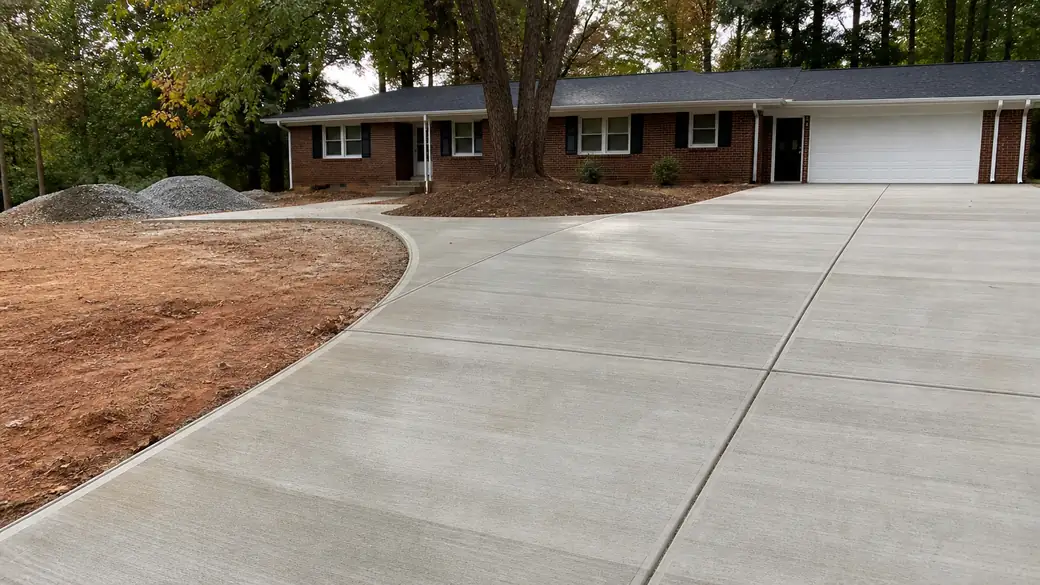
cement installation completed by a local contractor at a red-brick ranch home in Alpharetta, GA, under bright midday cloud.

Cement Installation in Alpharetta, GA

We pour driveways, patios, walkways and slabs for homes across Alpharetta, and we handle the whole installation ourselves: excavation, base, forms, reinforcement, placement and finish. The median home here was built in 1996, so much of the concrete we look at is original. It has had decades to settle, crack and lift at the joints. Some of it can be repaired. A lot of it needs to come out. We tell you which, plainly, and if it is a replacement, we build the new surface on a properly prepared base rather than over the old problem.

The ground decides a lot. Fulton County is hilly, and a driveway that reads as flat from the street often carries more fall than it looks. Rion soil, which drains well, covers much of the county, but it varies from block to block, so we grade and test every site on its own before a single form goes down. About 50 inches of rain a year means water has to go somewhere, and we decide where before we pour. For a plain broom finish or stamped decorative work, call for a free estimate.

Call +1 470-260-7028

Get a FREE Quote

Our Cement Installation Work in Alpharetta

concrete slab installation completed by a local contractor at a stacked-stone and stucco home in Alpharetta, GA, in clear late-morning sun.

Concrete Slab Installation Cost

What moves the number on a slab is mostly what happens before the pour. Fulton County is hilly, with 241 feet of local relief within a few miles, so a sloped lot can mean cut, fill and a compacted gravel base that a flat yard never needs. Thickness matters too: a patio slab and a garage slab carrying a truck take different amounts of concrete and steel. We walk the site, then write the estimate.


concrete driveway installation completed by a local contractor at a charcoal farmhouse-modern home in Alpharetta, GA, in late afternoon light.

Concrete Driveway Installation

A driveway fails from underneath first. We excavate, compact a crushed stone base, and set rebar on chairs so the steel sits in the middle of the slab instead of lying in the dirt. With about 50 inches of rain a year, drainage gets planned before the forms go in: pitch away from the garage, and control joints cut early so shrinkage cracks follow them. Finishes run from broom to exposed aggregate to stamped.

concrete flooring installation completed by a local contractor at a painted-white-brick two-story home in Alpharetta, GA, in early morning light.

Concrete Flooring Installation

Garage, basement and shop floors come down to flatness and moisture control. We lay a vapor barrier over the compacted base, reinforce with welded wire mesh or fiber, and power trowel the surface tight. A floor that will take epoxy needs a full cure before coating, or the coating lifts. Polished and stained finishes suit interior rooms. Where an old slab has been trenched for plumbing, we saw the edges clean and dowel new concrete into the old.

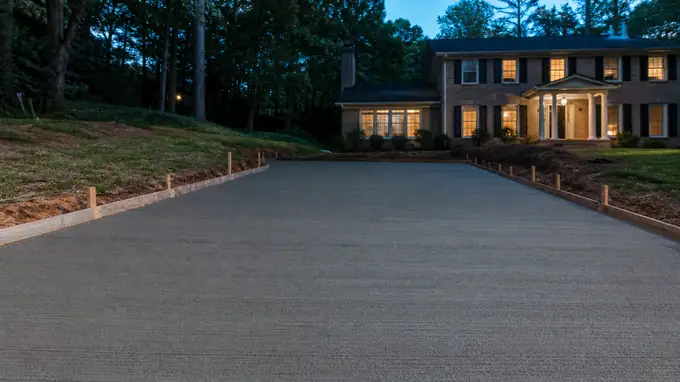
concrete slab repair completed by a local contractor at a red-brick ranch home in Alpharetta, GA, at blue hour.

Concrete Slab Repair

Not every cracked slab needs tearing out. Hairline shrinkage cracks can be routed and sealed. A slab that has sunk or tipped usually has a failed base, and a patch on top will not hold. Rion soil, the county's dominant type, drains well, but a downspout dumping on one corner can still wash the base away. We find the cause first, then choose between sealing, lifting, or cutting out the section and repouring it doweled into sound concrete.

What Makes Alpharetta Craftsman Concrete's Concrete Work Different

We don't pour to a standard spec and hope the ground agrees. Fulton County is hilly, with 241 feet of local relief within a few miles, and that changes from one block to the next. Rion soil, which drains well, is the dominant type here, but it varies across the county. So every site gets graded and tested on its own before we set a form. What we find there decides the base, the slope and the reinforcement for that slab.

Water is the other half of it. This area sees about 50 inches of rain a year, and on a sloped lot that water goes wherever the surface sends it. We pitch driveways, patios and walks to carry it away from the foundation, and we look at where it ends up. The median home here dates to 1996. When a slab is original to the house, it comes out down to sound ground; we don't hide a failing base under a stamped overlay. A finish lasts only as long as what sits beneath it.

How a Cement Installation Job Runs in Alpharetta

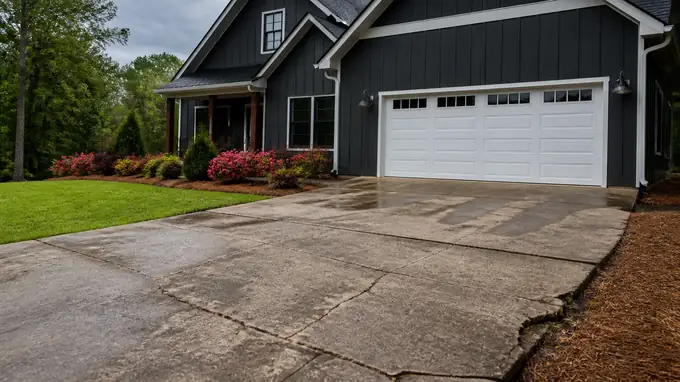
A worker examines an old driveway before replacement. at a charcoal farmhouse-modern home in Alpharetta, GA, after a rain shower.

Step 1: Site Assessment

Every job starts with us walking the property. We look at where water goes now, how the lot slopes, where the utility lines run, and what the old slab or lawn is hiding. Fulton County has 241 feet of local relief within a few miles, so the grade can change fast from one yard to the next. Rion soil drains well across much of the county, but it varies, so we test your site before planning anything.

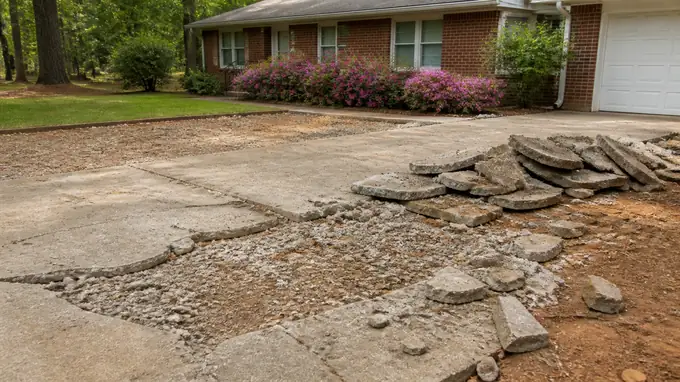
An old patio slab is broken up and hauled away. at a red-brick ranch home in Alpharetta, GA, under bright midday cloud.

Step 2: Site Preparation

Most failed slabs we tear out failed underneath. So we strip the topsoil and anything organic, then compact the subgrade in lifts until it stops moving under the plate. Crushed stone goes down next and gets compacted too. We set the grade so water sheds away from the house, which matters in a place that sees about 50 inches of rain a year. If the project needs a permit, we handle the permit.

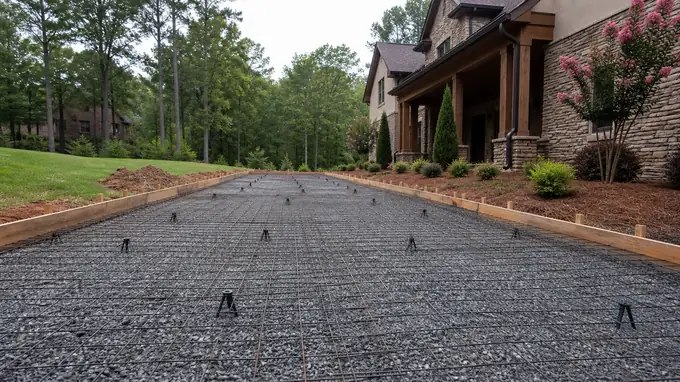
Wire mesh is unrolled across a driveway base before pouring. at a stacked-stone and stucco home in Alpharetta, GA, under an overcast sky.

Step 3: Forming & Reinforcement

Forms go in next: straight lumber or steel, staked tight, checked with a string line and a level for pitch. A form that bows during the pour leaves a wavy edge you will see for the life of the driveway. Inside the forms we lay rebar or welded wire, tied at the crossings and set on chairs so it sits in the middle of the slab. Wire left lying on the stone does nothing structural.

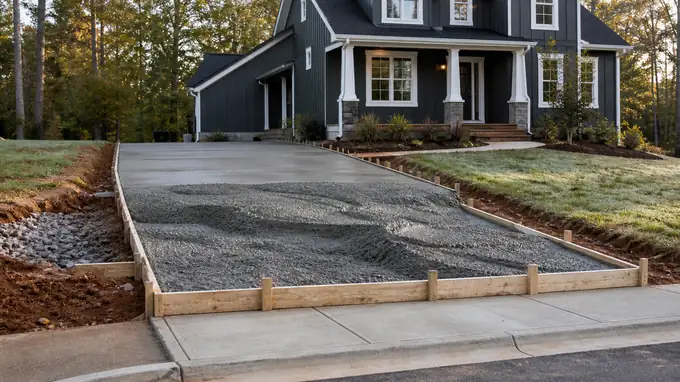
A ready-mix truck discharges concrete into a driveway form. at a charcoal farmhouse-modern home in Alpharetta, GA, in early morning light.

Step 4: Pouring

Ready-mix arrives from the plant with a mix chosen for the job, because driveways, patios and structural slabs don't get the same concrete. We pour continuously so no section sets up before the next one meets it. That is how cold joints happen. The crew places, rakes and screeds in one motion, working concrete into the corners and tight against the forms. We never add water at the truck to make it flow easier. It weakens the surface.

A broom drags across a driveway creating a slip-resistant texture. at a tan-brick colonial in Alpharetta, GA, at blue hour.

Step 5: Finishing

Timing matters more here than anywhere else. We bull float right after screeding, then wait for the bleed water to leave before touching it again. Troweling too early traps water, and the surface flakes later. Control joints get tooled or saw-cut so the slab cracks where we choose. Driveways get a broom finish for grip. Stamped and decorative surfaces get color, release agent and patterns set while the concrete is still soft enough to take them.

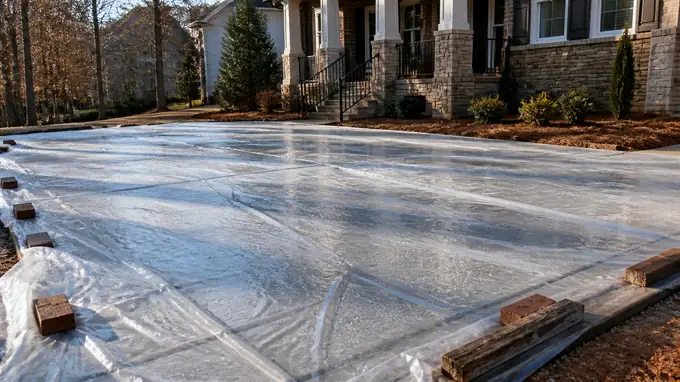
Plastic sheeting covers a curing driveway slab. at a brick-and-siding two-story home in Alpharetta, GA, under low winter sun.

Step 6: Curing

Concrete gains strength by holding water, not by drying out. Through the first week we keep a new slab damp with curing compound, wet coverings or both, depending on the weather that day. Hot sun and wind pull moisture out of the top quickly, and the result is a weak, dusty surface. We tell you when you can walk on it and when a car can go on it. Rushing either one shows up later.

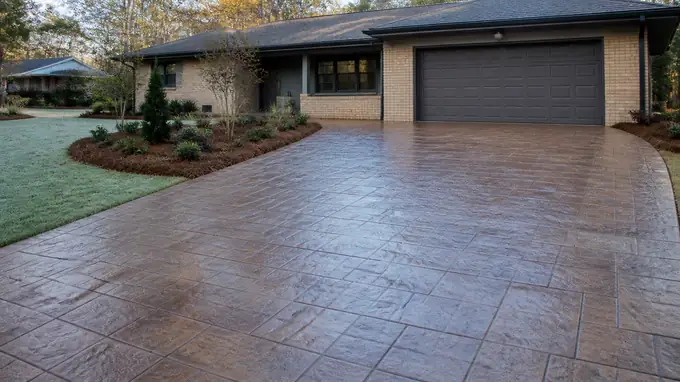
A finished stamped surface shows a glossy sealed sheen. at a buff-brick ranch home in Alpharetta, GA, in early morning light.

Step 7: Sealing

Sealer goes on once the slab has cured, not before. A penetrating sealer soaks in and helps a driveway shed water and resist staining. On stamped and decorative work we use a film-forming sealer that deepens the color and protects the pattern. We apply it thin, in even coats, because puddled sealer turns cloudy and slick. Resealing every few years keeps the surface looking the way it did the week we finished.

Choosing the Right Concrete System

Most jobs come down to three choices: a plain broom-finished slab, stamped concrete, or a decorative surface with color and texture worked in. A broom finish is the workhorse. It gives tires and shoes something to grip, and it is the easiest surface to patch years from now. Stamped concrete has a pattern (slate, flagstone, brick) pressed into the slab while it is still workable, and it suits patios and walkways that people see up close. Decorative finishes sit between the two. We talk through each one standing on your property, not from a brochure.

The site settles the rest. Fulton County gets about 50 inches of rain a year and plenty of hills, so slope and runoff shape the plan as much as looks do. A driveway on a grade needs a surface with grip and a pitch that sends water off the slab, away from the garage. Reinforcement follows the load: rebar where trucks will park, wire mesh or fiber where the traffic is lighter. Soil varies across the county, so we test every site before we settle on thickness. The median home here dates from 1996, and an old slab often shows us what the ground did last time.

Cement Installation Pricing in Alpharetta, GA

The price of a concrete job is set mostly by the ground it sits on and the path to reach it. Two driveways with the same footprint can land far apart once we see what has to come out, how the truck gets in and where the water goes. We price a job after we have seen the property.

What changes the priceWhich wayWhy
An old slab or asphalt to break outcosts moreDemolition, hauling and disposal all happen before any new concrete goes down.
Tree roots, stumps or irrigation lines in the footprintcosts moreThey have to be cleared or rerouted so the base sits on solid, even ground.
No straight path for the truck to the formscosts moreIf the chute cannot reach, we pump or wheel the concrete in, which adds equipment and labor.
A slope across the pourcosts moreFulton County is hilly, and a grade means more excavation, taller forms and sometimes steps.
Thickness and reinforcement the slab needscosts moreA driveway carrying heavy vehicles needs more depth and rebar than a patio that sees foot traffic.
Water that runs toward the house or poolscosts moreWith about 60" of rain a year, we pitch the surface away from the foundation and sometimes add a drain.
Stamped or decorative finishcosts morePattern, color and sealing take extra materials and more hands on the pour.
Broom finish on an open, level lotcosts lessClear access and a flat base keep the labor close to the pour itself.

When you compare bids, look past the total. Check that each one states the slab thickness, the reinforcement, the base material and its depth, whether removal and haul-off are included, and who handles the permit. A lower number that leaves one of those out is often pricing a different job.

Get a Free Estimate

Get a FREE Quote

Tap to call +1 470-260-7028