+1 470-260-7028
concrete slab installation completed by a local contractor at a stacked-stone and stucco home in Alpharetta, GA, in clear late-morning sun.

Concrete Slab Installation in Woodstock, Georgia

A concrete slab is the flat, load-bearing surface that everything else sits on: a garage floor, a shed pad, a patio, the base for a workshop or an addition. We pour residential slabs across Woodstock, and from the curb the work looks simple. It isn't. A slab is only as good as the ground under it and the reinforcement inside it, and nearly all of that is buried before anyone sees the finish. Get those two things right and the surface stays flat and quiet. Get them wrong and no amount of troweling on top will save it.

Each project starts on foot. We walk the property, look at where water goes when it rains, and test the soil at that exact site, because conditions change from one lot to the next and a guess is not a plan. Then we dig out, compact the base in layers, and set forms to grade. Steel goes in on supports so it sits in the middle of the slab instead of lying in the dirt. Pour day is the short part. The finishing, jointing and curing that follow decide how the surface wears for years.

Most slab failures trace back to water or to rushed prep. The area gets about 50 inches of rain a year, and water that pools against an edge or runs underneath will soften the base and find every weak spot in it. Cracks follow. So do sunken corners and garage floors that tilt toward the house. Control joints cut too shallow, or spaced too far apart, let the concrete crack where it wants to rather than where it should. None of this shows on pour day. It shows up later, when fixing it means tearing it out.

Getting a slab right is mostly a matter of not skipping steps. It means a proper base instead of whatever fill is handy, materials and reinforcement sized to what the slab will actually carry, and forms checked for slope before a truck is ever ordered. It means a finish crew that stays until the surface is ready, not until the truck is empty, and patience while the concrete cures. The steps are the same whether the slab is plain broom finish or the base for a stamped, decorative patio. If you have a slab in mind, call us for a free estimate.

Call +1 470-260-7028

Get a FREE Quote

Our Concrete Work Around Woodstock

Concrete Slab Installation Cost

What moves the number on a slab is mostly what sits under and inside it. A 4-inch slab for a shed pad takes less material than a 6-inch slab carrying a vehicle, and rebar on a grid costs more than wire mesh. Excavation, hauling in compacted gravel base, forming on a slope and how close a truck can get all count. We price each project after walking the property and testing the site.

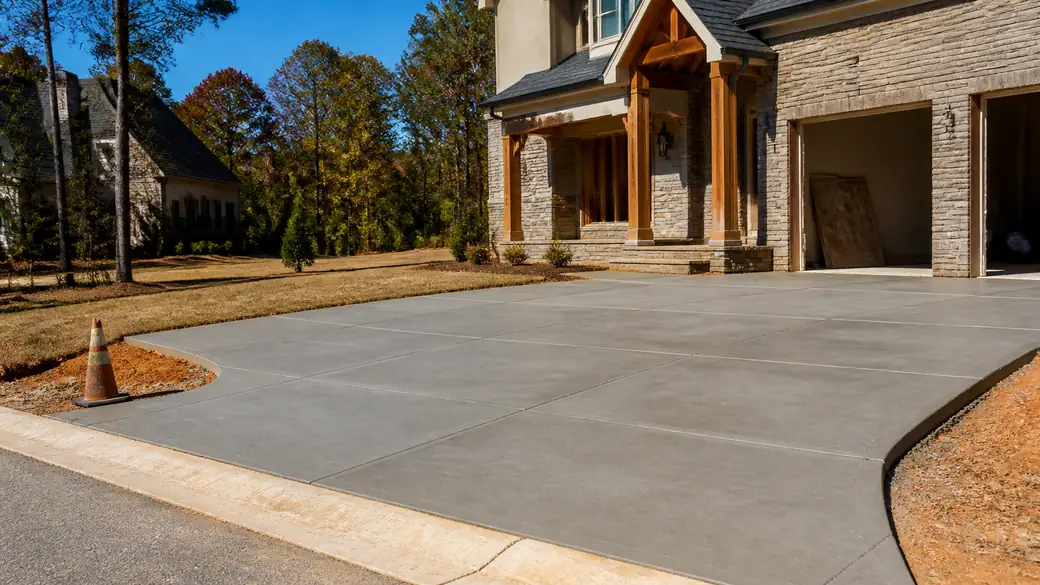
concrete driveway installation completed by a local contractor at a charcoal farmhouse-modern home in Alpharetta, GA, in late afternoon light.

Concrete Driveway Installation

Most residential driveways we pour are 4 to 5 inches thick over a compacted gravel base, with rebar or fiber reinforcement and control joints cut so cracks land where we want them. Water is what we plan around. With about 50 inches of rain a year, we slope the surface away from the garage and toward the street, and keep downspouts from dumping onto the edge. Finishes run from plain broom to stamped and decorative.

concrete flooring installation completed by a local contractor at a painted-white-brick two-story home in Alpharetta, GA, in early morning light.

Concrete Flooring Installation

Interior floors start below the concrete: compacted base, a vapor barrier so ground moisture does not wick up into flooring laid on top, and reinforcement sized to the load. For a garage, basement or workshop we trowel the surface smooth and hard. Where the slab is the finished floor, it can be ground and polished, stained, or sealed. Joints get planned around walls and doorways so shrinkage cracks follow them instead of wandering across the room.

concrete slab repair completed by a local contractor at a red-brick ranch home in Alpharetta, GA, at blue hour.

Concrete Slab Repair

Before patching anything, we find out why the slab failed. Hairline shrinkage cracks are cosmetic and can be sealed. A slab that has sunk or heaved usually points to a washed-out base, poor drainage or roots, and a patch will not hold until that is fixed. Depending on what we find, the answer is crack filling, lifting a settled section, resurfacing a scaled top, or cutting out and repouring the bad panel. We tell you which it is.

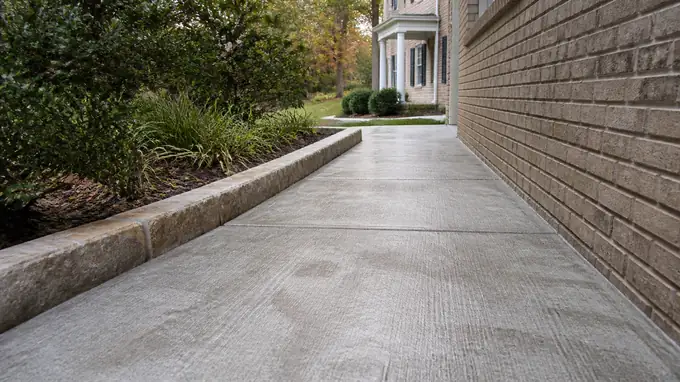
concrete sidewalk installation completed by a local contractor at a tan-brick colonial in Alpharetta, GA, under bright midday cloud.

Concrete Sidewalk Installation

A walk has to be flat enough to push a mower across and pitched just enough to shed water. We pour sidewalks about 4 inches thick on a compacted base, tool a joint every few feet, and give the surface a light broom finish so it grips when wet. Along a driveway or patio we add an isolation joint so the slabs can move separately. Stamped or exposed aggregate borders are an option.

Our Warranty and Guarantee in Woodstock

A slab's life is mostly settled before the truck leaves, so that is where our standard lives. The base it sits on, how thick it is, where the reinforcement ends up, how the surface is finished and cured: none of that can be fixed with a signature afterward. On every Woodstock project we treat those steps as the real commitment. They are the parts a homeowner cannot see once the concrete sets, and they are the parts that decide whether a driveway or patio still sits flat and sheds water years from now.

Work starts with the ground. Every site is tested individually before we form anything, because soil changes from one lot to the next and a slab is only as steady as what carries it. We compact the base in lifts, set forms to a grade that moves water away from the house, and place reinforcement on chairs so it ends up inside the slab rather than lying at the bottom. Control joints go in at spacing matched to the slab's thickness. Then we cure it properly, keeping the surface from drying faster than the concrete underneath can gain strength.

Nearly every slab failure traces back to a skipped step. Cracks that wander across a driveway usually mean joints were cut too late or spaced too far apart. A slab that sinks at one corner often sat on fill nobody compacted. Stamped and decorative surfaces flake when they were sealed too soon, or when water was sprinkled on top to make troweling easier. Standing water is a grading mistake. None of this shows on pour day. It shows after months of use and weather, when the crew that poured it is long gone.

Getting it right costs time more than anything else. Proper base preparation takes longer on some lots. Cutting joints at the right moment means someone stays on site when leaving would be easier. Good materials and correct reinforcement are a small share of a slab next to the expense of tearing one out and pouring it again. Call for a free estimate, and ask any contractor you talk to, us included, to spell out the thickness, the reinforcement and the base work in writing. That is the only fair way to compare one number against another.

How Much Does Concrete Cost in Woodstock?

Most of what moves a concrete price is sitting on your property right now, and you can check it yourself. Walk the spot with this list before anyone quotes you. You will have a good sense of where your project lands.

What changes the priceWhich wayWhy
An old slab, patio or pavers in the footprintcosts moreIt has to be broken up, loaded and hauled off before we can set a single form.
A mixer truck can back right up to the formscosts lessConcrete goes straight down the chute, with no pump and no wheelbarrows.
The pour sits behind the house or past a fencecosts moreWe need a line pump or a long run of wheelbarrow trips, plus boards to protect the lawn.
The slab will carry a truck, RV or shop equipmentcosts moreThat load calls for a thicker slab and rebar set on chairs instead of light wire mesh.
The ground slopes across the pourcosts moreWe cut and fill to grade, and a steep drop can need a thickened edge or a short form wall.
Water collects where the slab will gocosts moreWith about 50 inches of rain a year, we add gravel base, pitch the surface away from the house, and sometimes move a downspout.
Roots, stumps or irrigation lines in the waycosts moreRoots come out so they cannot lift the slab later, and buried lines get located and rerouted.
The ground is already level, firm and clearcosts lessLess excavation and base work leaves the crew's time for forms, reinforcement and finish.

When two bids come in far apart, put them side by side. Look for the slab thickness, the reinforcement and its spacing, the depth of gravel base, whether demolition and haul-off are included, and how each crew plans to handle drainage. A lower number that leaves one of those out is quoting a different job.

Frequently Asked Questions About Concrete in Woodstock

Are you licensed and insured?

Ask for it in writing, from us and from anyone else bidding your project. A spoken answer on a driveway is not proof of anything. Current license and insurance documents should be in your hands before anyone breaks ground or orders a truck of concrete. If a contractor hesitates to show them, you have learned something useful before it cost you money. Paperwork takes a minute to check. Repairs take much longer.

Will Alpharetta Craftsman Concrete take care of our city permits and inspections?

Yes. We find out what the city requires for your specific project and build the permit and inspection steps into the schedule before any concrete is ordered. Where an inspection is required, it happens at a set point, such as after the forms and reinforcement are in and before the pour. Nothing gets covered up until it has been looked at. You know where each step stands while the work is underway.

What is the standard width for commercial sidewalks in Woodstock?

The width is not ours to pick. Woodstock's development standards, accessibility requirements and the approved site plan set it, and they can differ depending on where the walk runs and what it connects to. We build commercial sidewalks to the stamped drawings the city signed off on, with the slope, joints and reinforcement those drawings call for. If your plans are not finished yet, bring what you have and we can read through them together.

Do you only serve Woodstock, or do you work in surrounding areas too?

We work well beyond Woodstock. It is one of several towns across metro Atlanta where we pour driveways, patios and slabs, and every one of them gets the same crew, the same materials and the same standard of work. A homeowner in Canton books us exactly the way someone in Woodstock does. The full list of places we cover is on this page, and none of them waits behind another.

Do I need permits for foundation work in Woodstock?

Yes, in nearly every case. A foundation is structural work, and structural work is exactly what a building department wants to review and inspect. The details depend on the project, so we confirm them with the city before anything is dug. Skipping a permit to save a few weeks tends to surface later. Often it shows up when the property is sold and a buyer's inspector starts asking questions.

What's the best foundation contractor in Woodstock?

The best one for your job is the one who looks at your ground first. Soil changes from one lot to the next, so we test every site individually before work starts. After that, look for someone who explains the reinforcement, the slab thickness and the drainage plan in plain terms, then puts all of it in writing. Good foundation work is mostly preparation. The pour itself is the short part.

Get a Free Estimate

Get a FREE Quote

Tap to call +1 470-260-7028