
+1 470-260-7028
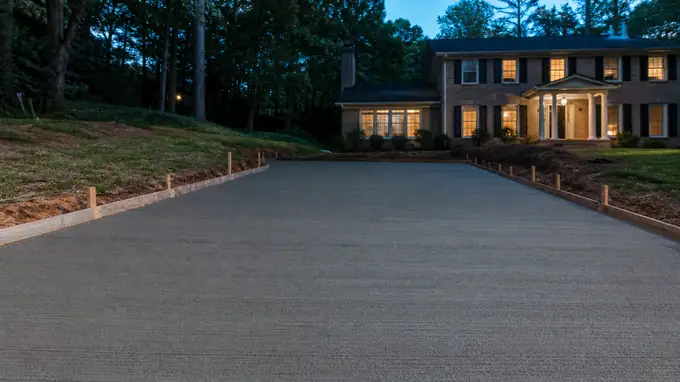
concrete installation completed by a local contractor at a buff-brick ranch home in Alpharetta, GA, under low winter sun.

Concrete Installation in Alpharetta, GA

We pour concrete driveways, patios, walkways and slabs for homes across Alpharetta. The median house here was built in 1996, so a lot of what we look at is the original flatwork: driveways that have dropped at the garage lip, patios pulling away from the foundation, walks cracked across the middle. Some of it can stay. Some of it needs to come out and go back in properly, with a sound base and the right reinforcement under it. We also do decorative work, stamped and colored surfaces for patios and pool decks, when the owner wants the finish to suit the house. Commercial property gets the same materials and the same care.

Ground is the part people underestimate. Fulton County is hilly, with 241 feet of local relief within a few miles, and about 50 inches of rain a year has to go somewhere. On a sloped lot, that water finds the edge of a slab and starts working its way underneath. Rion soil, the county's dominant type, drains well, but it changes from one yard to the next. So we test every site on its own before we set a single form. Grading and drainage get settled first, because no amount of steel fixes a slab sitting on ground that moves. Get that right and the concrete on top lasts.

Call +1 470-260-7028

Get a FREE Quote

Our Concrete Installation Work in Alpharetta

concrete slab installation completed by a local contractor at a stacked-stone and stucco home in Alpharetta, GA, in clear late-morning sun.

Concrete Slab Installation Cost

Size, thickness, site grading and truck access set the price of a slab. On a sloped lot (much of Fulton County is hilly), the digging, filling and compaction under the slab can take as much work as the pour itself. Rebar costs more than wire mesh in material and labor, and it earns that under heavy loads. Broom finish is the plainest surface. Stamped and decorative work adds time. Call for a free estimate.


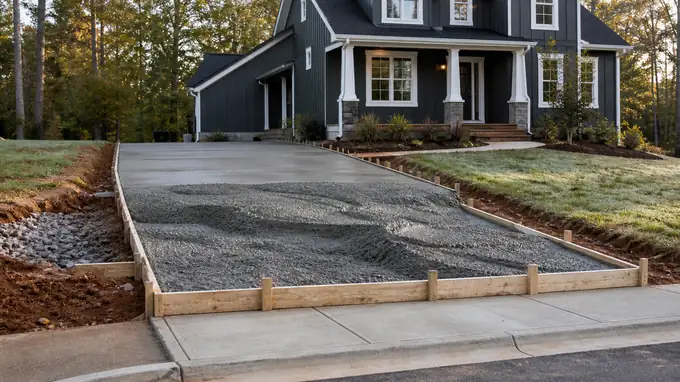
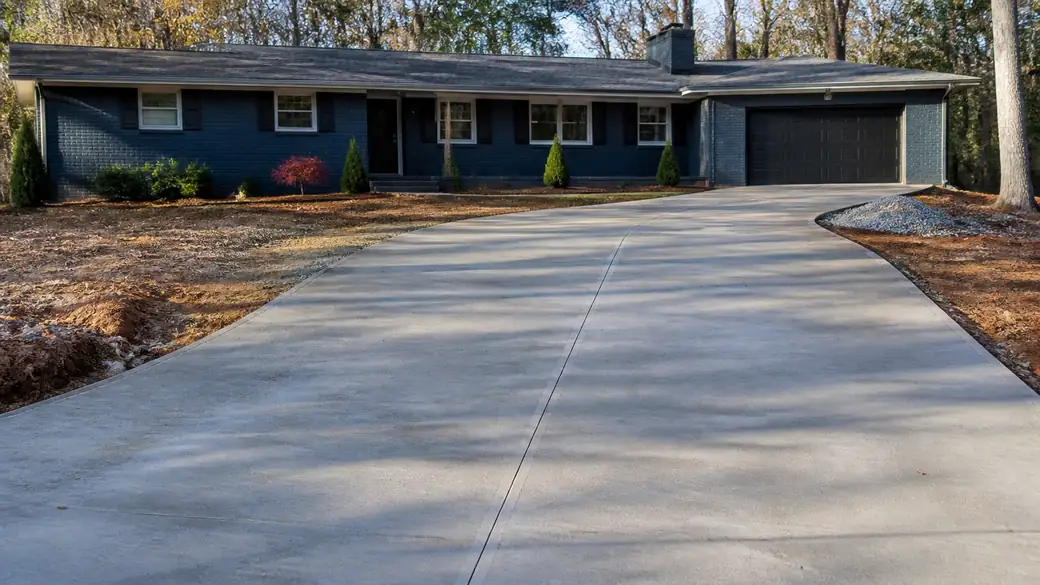
concrete driveway installation completed by a local contractor at a charcoal farmhouse-modern home in Alpharetta, GA, in late afternoon light.

Concrete Driveway Installation

A driveway carries cars, delivery trucks and the occasional loaded trailer, so we pour it thicker than a patio. The rebar sits on chairs so the steel ends up in the middle of the slab, not pressed into the dirt. Under it goes compacted gravel, graded to pitch water away from the garage. With about 50 inches of rain a year, that pitch earns its keep. Control joints get cut early, before the concrete picks its own crack lines.

concrete flooring installation completed by a local contractor at a painted-white-brick two-story home in Alpharetta, GA, in early morning light.

Concrete Flooring Installation

Garage floors, basements and small commercial spaces each get a slab built for what will sit on it. Indoors, we lay a vapor barrier under the pour so ground moisture doesn't work up into finished flooring later. The surface is steel-troweled smooth, then left bare, sealed, or ground and polished. Timing matters here. Close the surface too early and it can blister or peel. We let it cure properly and keep traffic off until it's ready.

concrete slab repair completed by a local contractor at a red-brick ranch home in Alpharetta, GA, at blue hour.

Concrete Slab Repair

Half the homes here were built in 1996 or earlier, and their slabs have had years to settle and crack. Before touching the concrete, we find the cause: a downspout emptying at the edge, a washed-out base, tree roots, or a slab poured without enough joints. Hairline cracks get routed and sealed. Sunken or broken sections get cut out, re-based and poured back. Patch a crack without fixing its cause and it comes right back.

What Makes Alpharetta Craftsman Concrete's Concrete Work Different

The difference starts before the concrete truck shows up. Fulton County is hilly, with 241 feet of local relief within a few miles, and the ground changes from block to block. So we grade and test every site on its own, even when the lot next door looks the same. Rion soil is the dominant type here, and it drains well, but it is not the only soil in the county. A slab is only as good as what sits under it. We find out what that is before we set a form.

Water is the other thing we plan around. The area sees about 50 inches of rain a year, and on a sloped lot that water wants to run somewhere. We pitch a driveway or patio so it sheds toward ground that can take it, not toward your foundation or the garage door. Reinforcement goes where the slab carries load and where the grade changes, not spread thin out of habit. Stamped and decorative surfaces get the same base work as a plain slab. The pattern on top only lasts as long as the ground underneath holds still.

How a Concrete Installation Job Runs in Alpharetta

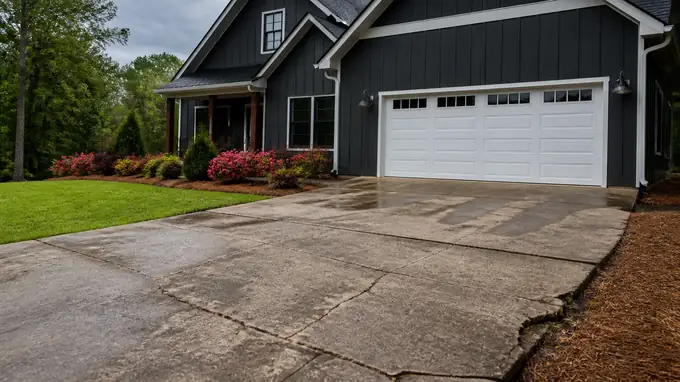
A worker examines an old driveway before replacement. at a charcoal farmhouse-modern home in Alpharetta, GA, after a rain shower.

Step 1: Site Assessment

We walk the property first. We look at where water runs in a hard rain, how the ground falls toward the house, what any old slab is doing, and where roots and utility lines sit. Fulton County is hilly, with about 241 feet of local relief within a few miles, and it changes from block to block. So every site gets graded and tested on its own before we plan the job. If the work needs a permit, we handle the permit.

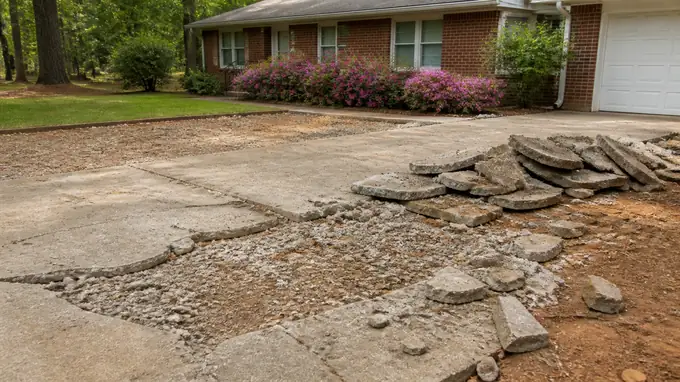
An old patio slab is broken up and hauled away. at a red-brick ranch home in Alpharetta, GA, under bright midday cloud.

Step 2: Site Preparation

A slab is only as good as what sits under it. We excavate down to firm ground, strip out topsoil and organic material, and lay a crushed stone base compacted in lifts with a plate compactor. Rion soil is the county's dominant type and drains well, but it varies across Fulton County, so we test yours instead of assuming. Soft spots get dug out and rebuilt now, because they turn into sunken corners and cracked panels later.

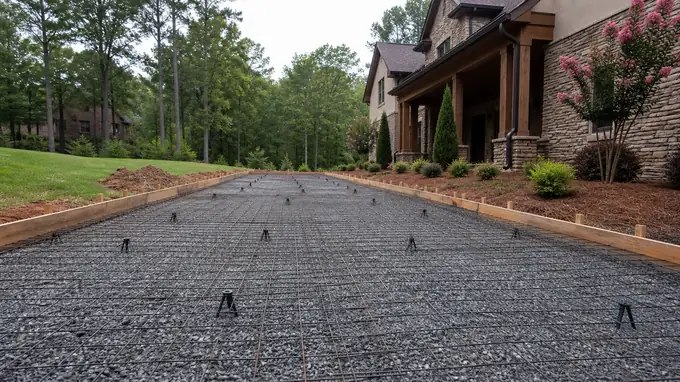
Wire mesh is unrolled across a driveway base before pouring. at a stacked-stone and stucco home in Alpharetta, GA, under an overcast sky.

Step 3: Forming & Reinforcement

Forms go in straight and staked tight, set with enough pitch that water sheds off the surface and away from the house. For driveways we run rebar on a grid or welded wire mesh, held up on chairs so the steel sits mid-slab. Wire left lying on the stone does nothing; it is a common shortcut, and it shows up years later as cracks that open and heave. Expansion joints go wherever new concrete meets the house, garage or walk.

A ready-mix truck discharges concrete into a driveway form. at a charcoal farmhouse-modern home in Alpharetta, GA, in early morning light.

Step 4: Pouring

The truck gets as close as the site allows. On a steep lot we pump or wheel the concrete in rather than drive over forms. We place it in one continuous pour, work it into the corners, and screed it flat off the forms. Patios and walks usually run four inches thick; driveways that carry trucks run five or six. Adding water at the chute makes concrete easier to spread and weaker once it sets, so we don't.

A broom drags across a driveway creating a slip-resistant texture. at a tan-brick colonial in Alpharetta, GA, at blue hour.

Step 5: Finishing

Once the bleed water is off the surface, we float it, round the edges, and cut control joints about a quarter of the slab's depth, spaced so cracks land in the joints. Driveways and walks get a broom finish for grip when wet. Stamped and decorative work has a narrow window: stamp too early and the pattern slumps, too late and it tears. Troweling bleed water back into the surface is what makes concrete flake.

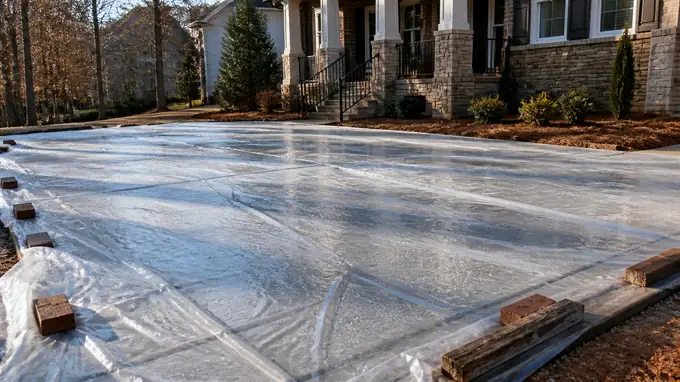
Plastic sheeting covers a curing driveway slab. at a brick-and-siding two-story home in Alpharetta, GA, under low winter sun.

Step 6: Curing

Concrete gains strength by holding water, not by drying out. Right after finishing, we keep the slab damp or apply a curing compound so the surface doesn't dry faster than the core (that is how you get crazing and a dusty top). Foot traffic can come early. Cars wait about a week, and the slab keeps hardening for weeks after. With average highs around 71°F, the first day on a warm afternoon gets our closest attention.

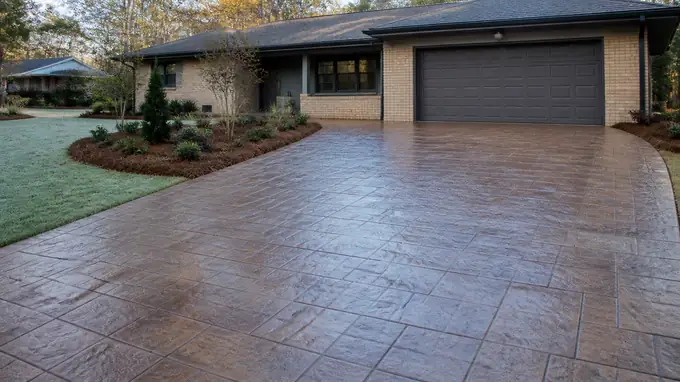
A finished stamped surface shows a glossy sealed sheen. at a buff-brick ranch home in Alpharetta, GA, in early morning light.

Step 7: Sealing

Sealer goes on after the slab has cured, never on green concrete. We use a penetrating sealer on broom finished driveways and an acrylic on stamped and colored surfaces, where it deepens the color and keeps oil and leaf stains from soaking in. The area sees about 50 inches of rain a year, so keeping water out of the surface matters. A slab that is resealed every few years holds its finish far longer than one that never is.

Concrete Installation Pricing in Alpharetta, GA

We don't put a number on a job until we've seen the site. Two driveways of the same size can come out far apart once we know what's under them and how a truck gets to them. Every factor below is something you can walk out and check on your own property before anyone looks at it.

What changes the priceWhich wayWhy
Old concrete or asphalt still in placecosts moreIt has to be broken up, loaded and hauled off before we can set a single form.
How a mixer truck reaches the pourcosts more when blockedIf a truck can't back up to the forms (a fence, a tight side yard, soft lawn), we pump or wheel the concrete in, which adds equipment and labor.
Slope across the work areacosts moreFulton County is hilly, and a sloped yard needs cutting, filling and compacting before the slab sits level or pitches the way it should.
Where water goes nowcosts more if it poolsStanding water near the house or across the pour area calls for regrading or a drain before forms go down.
Thickness and reinforcementcosts more for heavier loadsA walkway needs less than a driveway carrying a truck or a trailer. Heavier use means a deeper slab and more steel in it.
Roots and buried linescosts moreRoots in the path get cut back, and irrigation or utility lines near the surface have to be located and worked around.
A plain broom finishcosts lessStamped and decorative surfaces take extra materials, more crew time and sealing. A broom finish goes down fastest.

When two bids come in, lay them side by side and check that they describe the same job: slab thickness, the reinforcement named, how the base is prepared and compacted, whether removal and haul-off are included, and who handles the permit. A lower bid that leaves one of those out is usually a smaller job, not a better price.

Frequently Asked Questions About Concrete Installation in Alpharetta

Does Alpharetta Craftsman Concrete handle commercial concrete projects?

Yes. Alongside driveways and patios, we pour slabs, sidewalks, curbs, loading pads and parking areas for commercial property. The approach is the same one we bring to a house, scaled to the loads. We size the thickness, reinforcement and joint spacing to what will actually cross the surface, whether that is steady foot traffic or a loaded delivery truck. Commercial sites usually have other trades working too, so we plan our pours around theirs.

Do I need a permit for concrete work in Alpharetta, GA?

Yes, for a lot of concrete work. Whether a particular job needs one depends on its size, what it connects to, and where it sits on the lot, so we check before anything is formed. We handle the permit as part of the job: the drawings, the application and the inspections along the way. You should not have to learn a code book to get a new driveway poured in Alpharetta.

How much does concrete floor installation cost per square foot?

It depends on more than the square footage, which is why we do not quote a flat rate. Slab thickness, reinforcement, the finish (broom, stamped or decorative), how much grading the site needs, and how close a truck can get all move the number. A garage or basement floor in an existing house also means demolition and hauling that a new slab does not. Estimates are free, and they are based on your floor, not an average.

How does the climate in the Alpharetta area affect concrete garage floors, and how can they be protected?

Water matters more here than cold. The area gets about 50 inches of rain a year and around 2 inches of snow, so for a garage floor the thing to manage is water running in off tires and the driveway and sitting on the surface. We pitch the slab slightly toward the door so it drains. Control joints go where we want any cracking to happen. A penetrating sealer keeps moisture out, and resealing every few years keeps it working.

What are the signs that a Alpharetta concrete surface should be repaired versus replaced?

Hairline cracks, surface scaling and small chipped edges are usually repair work: we clean, fill and reseal them. Replacement starts to make sense when a slab has sunk or tilted, when cracks keep widening, when one side sits higher than the other, or when water pools against the house instead of running off. Those point to trouble underneath, in the base or the ground, and patching the top will not fix it. With the median home in Alpharetta built in 1996, plenty of original driveways are old enough to ask.

Can concrete work be done during rainy or cold weather in Alpharetta?

Yes, with care about timing. We do not pour into active rain, since water on fresh concrete weakens the finished surface. With about 50 inches falling here each year, we watch the forecast and move a pour when a wet day lines up with it. Once the concrete has set, light rain does little harm. On cold days we adjust the mix and cover fresh slabs with curing blankets so they gain strength at a steady pace.

Get a Free Estimate

Get a FREE Quote

Tap to call +1 470-260-7028